
 Worksheets
Atom & PT - TEST is February 14
Total questions: 71
Worksheet time: 2hrs 18mins
Same group
Same period
energy levels
valence electrons
protons
neutrons
Periods
Groups
Families
Periods
Groups
Families

Number of energy levels (shells)
Number of valence electrons
Number of protons
Number of neutrons
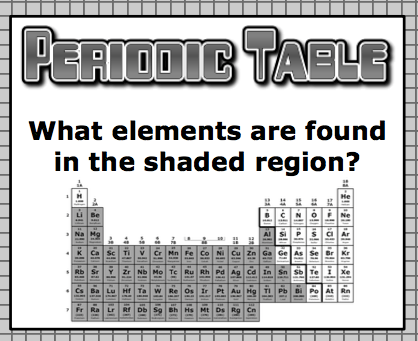
Metals
Nonmetals
Metalloids
Lanthanides
Actinides
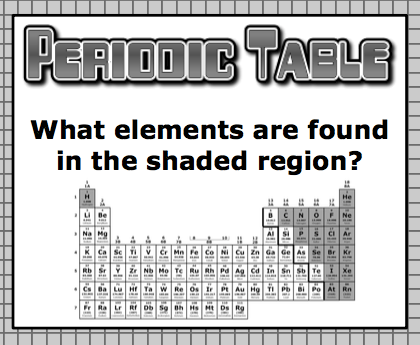
Metals
Nonmetals
Metalloids
Actnides
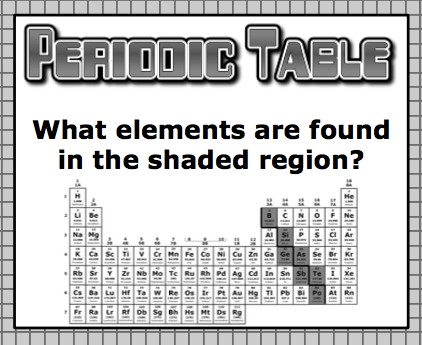
Metals
Nonmetals
Metalloids
Metals
Nonmetals
Metalloids
Metals
Nonmetals
Metalloids
Metals
Nonmetals
Metalloids
Noble gases
Metals
Nonmetals
Metalloids
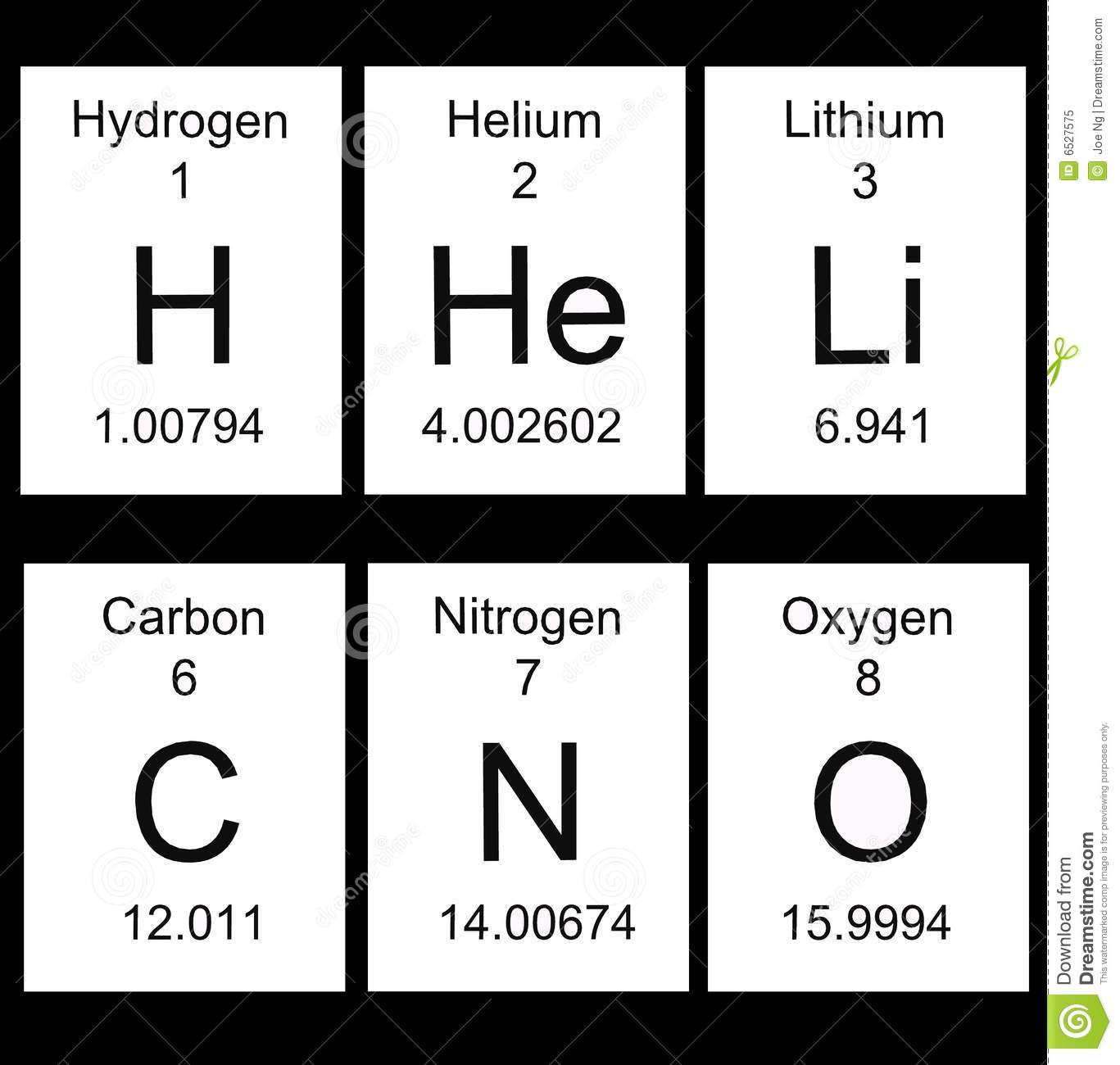
What is the chemical symbol for Lithium?
li
3
Li
LI

Most of the elements on the periodic table are classified as _____.
Metals
Nonmetals
Metalloids
Noble gases

Why do some elements have 3 letter chemical symbols?
There are no elements with 3 letter symbols
They are named after scientists
They are named after places
They have a temporary name until scientists agree on a new name.

A horizontal row of elements in the periodic table.
column
group
period

A vertical column in the periodic table. Elements share similar properties.
row
group
period
family
Elements in a _____have similar chemical properties.
period
group
row
family
The simplest substance is..?
Carbon
An element
Water
A compound
A proton is....
A negatively charged subatomic particle
A positively charged subatomic particle
A neutrally charged subatomic particle
The only subatomic particle located in the nucleus
A neutron has a charge of
+2
No charge
-1
+1

Nonmetals are located in what section of this periodic table?
Blue
Yellow
Pink
None of these are correct
all matter is made of what
energy
atoms
electrons
compounds
The positive particles of an atom are
electrons
positrons
neutrons
protons
the central region of an atom where its neutrons and protons are is its
nucleus
electron cloud
core
center
Particles in an atom that are neutral (have no charge) are
negatrons
electrons
neutrons
protons
In the modern periodic table elements are arranged by:
atomic mass
atomic number
valence electrons
number of isotopes
What particle uniquely identifies an element?
Number of Valence Electrons
Number of Protons
Number of Electrons
Atomic Mass

What element is this?
Helium
Hydrogen
Argon
Silver

How many electrons does Si contain? (click to see image)
14
28
2
None of these

What element is represented in this Bohr Model?
Carbon
Hydrogen
Aluminum
Lithium
How many valence electrons does chlorine (Cl) have?
2
5
6
7
How many valence electrons does carbon (C) have?
3
4
5
6

This is a correct dot diagram for oxygen (O)
true
false
Which of these grouping of elements could have the characteristic of brittle?
Metal
Nonmetal
Which of the following is a good conductor of heat?
Metal
Nonmetal
Metalloid
Which of these is a property of metals?
It's malleable
It can't conduct electricity
They are used in food
It's very brittle
All of the following would classify an element as a metal except?
Dull
Luster
Malleable
Hard
Non-metals are good conductors of heat and electricity.
TRUE
FALSE
Which of the following properties refers to the ability of metals to be drawn into wires?
malleability
compressibility
ductility
luster
Which of the following property of metal can reflect light
malleability
compressibility
ductility
luster
If a substance breaks easily, it is said to be ________________.
Magnetic
Brittle
Conductive
Ductile
Metals appear to the _______ of the dark ziz-zag line on the periodic table.
right
middle
left
Nonmetals occur to the ________of the dark zig-zag on the periodic table.
right
middle
left

Elements in this area can best be described as -
Malleable
Brittle
Dull
Insulators

Look at the periodic table that is provided. Where would metalloids be located?
to the left of the table
to the right of the table
the "stairs"

When an object changes shape when struck by a hammer.
luster
malleable
brittleness
ductile
Metals are solid at room temperature
False
True

What is my dog's name?
Muffins
Wilma
Neil
Buddy
What is the name of the first electron shell?
k
K
a
A
What is the name of the 4th electron shell?
D
d
N
n
How many electrons can the first shell hold?
1
2
8
18
32
How many electrons can the SECOND shell hold?
2
8
18
32
How many electrons can the THIRD shell hold?
2
8
18
32
There can never be more than ___ valence electrons
2
8
18
32
They are unlimited
The atomic number of an element is the number of
Protons
Neutrons
Electrons
Protons + Neutrons
The atomic mass is the number of
Protons
Neutrons
Electrons
Protons + Neutrons
The center of the atom is called the
orbital
nucleus
neutron
shell
Family #1 is called the
Alkali metals
Alkaline earth metals
Transition metals
Noble gasses
Halogens
Family #18 is called the
Alkali metals
Alkaline earth metals
Transition metals
Noble gasses
Halogens
Family #14 is called the
Alkali metals
Alkaline earth metals
Transition metals
Noble gasses
Carbon family
All living things contain
Hydrogen
Helium
Chlorine
Carbon
Which element is in period 4, group 6?
Chromium (Cr)
Calcium (Ca)
Nobium (Nb)
None of the above
Which element is in period 6, family 4?
Chromium (Cr)
Calcium (Ca)
Nobium (Nb)
None of the above
Which element is in period 3, family 17?
Chromium (Cr)
Chlorine (Cl)
Nobium (Nb)
None of the above
A BOHR diagram includes:
Protons and Neutrons in the nucleus
The element's symbol
All the electrons
Only the valence electrons
A LEWIS diagram includes:
Protons and Neutrons in the nucleus
The element's symbol
All the electrons
Only the valence electrons
The elements in group 2 have ___ valence electrons
1
2
12
There is no way to know
The elements in group 14 have ___ valence electrons
4
14
There is no way to know

