
 Worksheets
Physical & Chemical Properties Test Review
Total questions: 70
Worksheet time: 2hrs 36mins
Name
Class
Date
1.
Is this scenario a Physical or Chemical Change?
Cutting Your Hair
Cutting Your Hair
a)
Physical Change
b)
Chemical Change
2.
Is this scenario a Physical or Chemical Change?
Baking Brownies
Baking Brownies
a)
Physical Change
b)
Chemical Change
3.
Is this scenario a Physical or Chemical Change?
Crushing a Sugar Cube
Crushing a Sugar Cube
a)
Physical Change
b)
Chemical Change
4.
Is this scenario a Physical or Chemical Change?
Rust Forming on Steel Wool
Rust Forming on Steel Wool
a)
Physical Change
b)
Chemical Change
5.
Is this scenario a Physical or Chemical Change?
Mixing Milk and Vinegar
Mixing Milk and Vinegar
a)
Physical Change
b)
Chemical Change
6.
Is this scenario a Physical or Chemical Change?
Cleaning A Penny With Vinegar & Salt
Cleaning A Penny With Vinegar & Salt
a)
Physical Change
b)
Chemical Change
7.
Is this scenario a Physical or Chemical Change?
Burning Leaves/Sticks
Burning Leaves/Sticks
a)
Physical Change
b)
Chemical Change
8.
Is this scenario a Physical or Chemical Change?
Rusting Bicycle
Rusting Bicycle
a)
Physical Change
b)
Chemical Change
9.
Is this scenario a Physical or Chemical Change?
Ice Melting
Ice Melting
a)
Physical Change
b)
Chemical Change
10.
Is this scenario a Physical or Chemical Change?
Ice Melting
Ice Melting
a)
Physical Change
b)
Chemical Change
11.
Assuming we drop this object in water with a density below. Will it sink or float?
Density = 0.22 g/cm3
Density = 0.22 g/cm3
a)
Sink in Water
b)
Float in Water
12.
Assuming we drop this object in water with a density below. Will it sink or float?
Density = 1.85 g/cm3
Density = 1.85 g/cm3
a)
Sink in Water
b)
Float in Water
13.
Assuming we drop this object in water with a density below. Will it sink or float?
Density = 0.84 g/cm3
Density = 0.84 g/cm3
a)
Sink in Water
b)
Float in Water
14.
Assuming we drop this object in water with a density below. Will it sink or float?
Density = 5.0 g/cm3
Density = 5.0 g/cm3
a)
Sink in Water
b)
Float in Water
15.
What term best describes this definition: To REPLACE the volume of an object with the volume of another object.
a)
Density
b)
Displacement
c)
Mass
d)
Volume
16.
What term best describes this definition: The amount of MATTER in an object.
a)
Density
b)
Displacement
c)
Mass
d)
Volume
17.
What term best describes this definition: The amount of SPACE an object or liquid takes up.
a)
Density
b)
Displacement
c)
Mass
d)
Volume
18.
What term best describes this definition: The measure of how much MASS is contained in a given VOLUME.
a)
Density
b)
Displacement
c)
Mass
d)
Volume
19.
A characteristic that you can see without changing the substance into something new is a ________________.
a)
Chemical Property
b)
Physical Property
20.
A characteristic that describes how a substance is able to change into something new is a _______________________.
a)
Chemical Property
b)
Physical Property
21.
What happens in ALL chemical changes?
a)
Change in state of matter
b)
A new substance is formed
c)
Bubbles are produced
d)
An explosion
22.
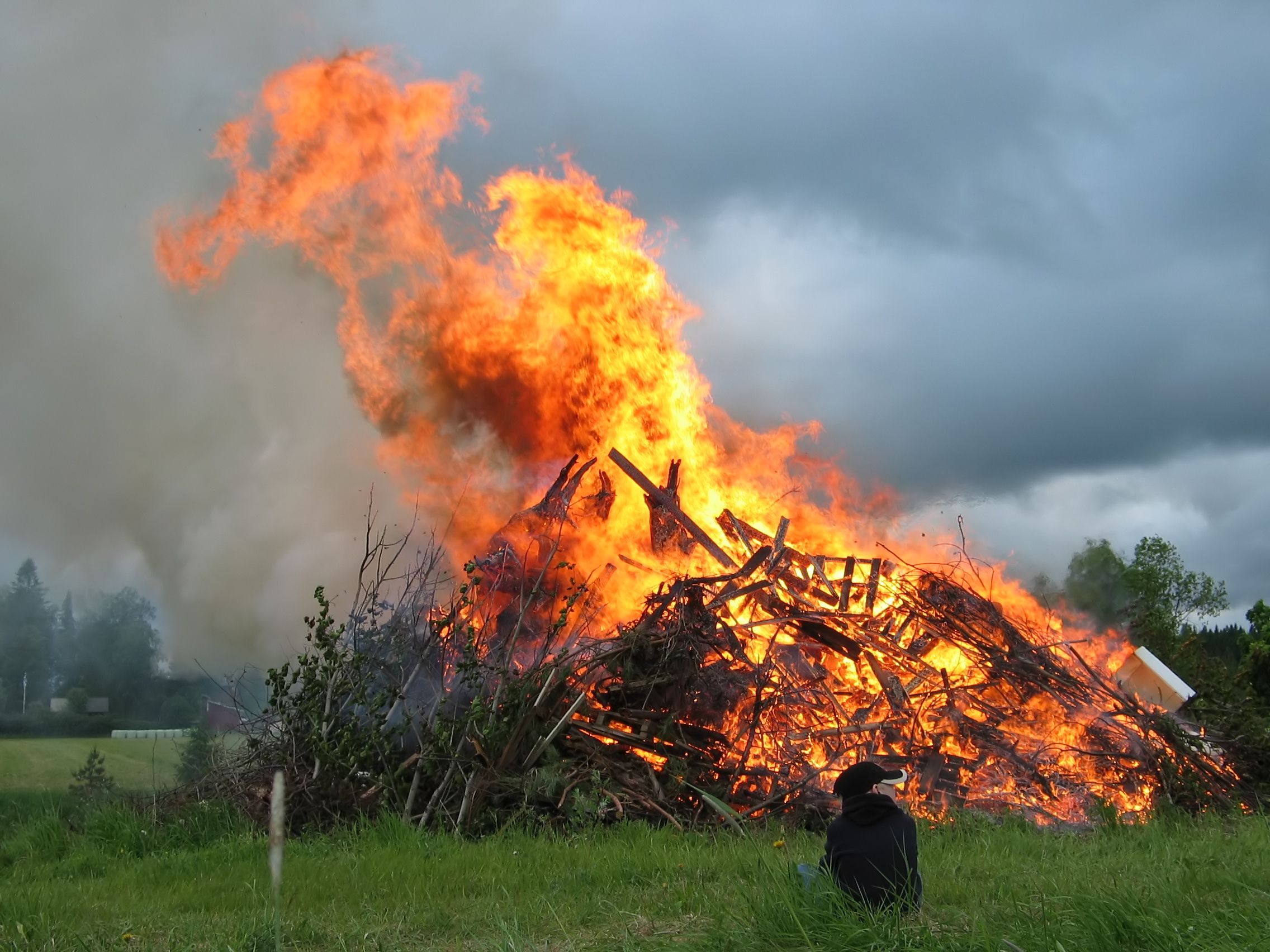
Is wood burning a physical or chemical change?
a)
Physical
b)
Chemical
23.
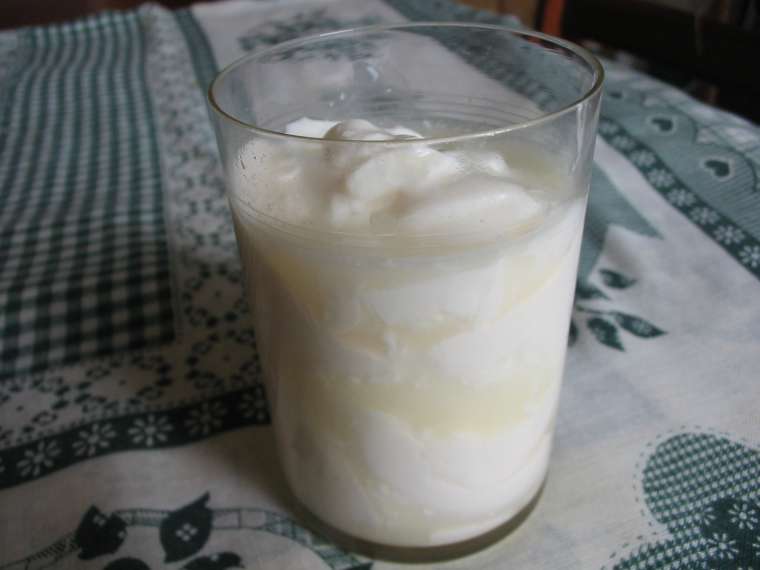
Is milk going sour a physical or chemical change?
a)
Physical
b)
Chemical
24.

Is gatorade powder dissolving in water physical or chemical change?
a)
Physical
b)
Chemical
25.

Is mold growing on cheese a physical or chemical change?
a)
Physical
b)
Chemical
26.

Is sharpening a pencil a physical or chemical change?
a)
Physical
b)
Chemical
27.

Is copper tarnishing a physical or chemical change?
a)
Physical
b)
Chemical
28.
Which lab tool might you use to measure the volume of a liquid?
a)
electric scale
b)
bunsen burner
c)
test tube
d)
graduated cylinder
29.

What is the volume of Object X?
a)
10.0 cm3
b)
15.0 cm3
c)
20.0 cm3
d)
25.0 cm3
30.
What is the formula for density?
a)
density = mass x volume
b)
density = mass / volume
c)
density = mass + volume
d)
density = mass - volume
31.
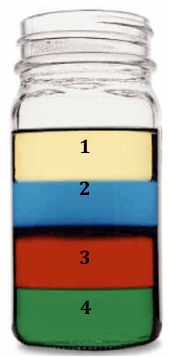
Put the liquids in order from most dense to least dense?
a)
4, 3, 2, 1
b)
1, 2, 3, 4
c)
3, 4, 2, 1,
d)
4, 3, 1, 2
32.
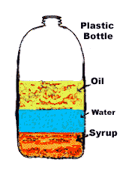
Which liquid is the least dense?
a)
oil
b)
water
c)
syrup
d)
plastic bottle
33.

Calculate the density of the cube.
a)
2 g/cm3
b)
4 g/cm3
c)
6 g/cm3
d)
8 g/cm3
34.

Which liquid has the highest density?
a)
corn syrup
b)
lamp oil
c)
rubbing alcohol
d)
honey
35.

What is the volume of the fish?
a)
18.0 cm3
b)
6.0 cm3
c)
38.0 cm3
36.

Here are 5 cubic centimeters (cm3). All together they have a mass of 20 g what is the density?
a)
20 g/cm3
b)
80 grams
c)
4 g/cm3
d)
80 g/cm3
37.

What do we know about the density of lamp oil, rubbing alcohol, and vegetable oil?
a)
The density is greater than 1.0 g/mL
b)
The density is less than 1.0 g/mL
c)
The density is equal to 1.0 g/mL
d)
The density can not be determined
38.

Why do the liquids form different layers?
a)
They have different densities.
b)
They have different masses.
c)
They have different volumes.
d)
They are different temperatures.
39.
What units can be used to express density?
a)
g/mL
b)
grams
c)
millimeters
d)
milliliters
40.
What Units are used to measure Volume?
a)
g
b)
cm3
c)
g/cm3
d)
cm3/g
41.
What is the name of the large gray animal with a long flexible nose and two long tusks?
a)
Elephant
b)
Density
c)
Mass
d)
Volume
42.
What is Mr. Oste's dog's name?
a)
Bernard
b)
Charlie
c)
Etso
d)
Dude
43.
The density of water is
a)
100 g/ml
b)
1000g/ml
c)
1g/ml
d)
1Kg/m3
44.
How do you find the volume of a cube?
a)
add all sides
b)
l x w x h
c)
l - w - h
d)
divide volume
45.
Which answer would float in water?
a)
.2Kg
b)
7g/ml
c)
3g/ml
d)
.03g/ml
46.
Why shouldn't you line up at the door before class ends?
a)
It's a bit "elementary-schoolish."
b)
Safety reasons
c)
There is a lot of safety equipment near the door.
d)
All choices are correct
47.
Want more time on an assignment? What do you fill out?
a)
Additional Time Request Form
b)
Student Helper Form
c)
Peer Evaluation Form
48.
Stay Solid Konkrete _______
a)
Teachers
b)
Students
c)
Kids
49.
Who recently won History Teacher of the Year for Northampton County?
a)
Mrs. Burke
b)
Mr. Frailey
c)
Mr. Seng
d)
Mrs. Bleiler
50.

The atomic number of this pictured element is
a)
28
b)
58.6934
c)
Ni
d)
Nickel
51.

What does the 1 stand for?
a)
Hydrogen
b)
atomic number
c)
atomic mass
d)
atomic explosion
52.
Select the term that best completes the following statement:
H2O (water) contains one _____________.
H2O (water) contains one _____________.
a)
oxygen atom
oxygen atom
b)
element
element
c)
compound
d)
mixture
53.
Basic particle from which all elements are made is called ________.
a)
Matter
b)
Atom
c)
Element
d)
Compound
54.
Where should you record your homework every single day?
a)
In your agenda.
b)
On a sheet of paper.
c)
On an index card.
d)
Nowhere, you can make a mental note of it.
55.
What should you do with your Chromebook each night?
a)
Keep it in your Chromebook case.
b)
Let the battery die.
c)
Play games on it.
d)
Charge it back up to 100% battery
56.
What color bin in the Classroom Papers Area do you hand in papers?
a)
White
b)
Blue
c)
Green
d)
Red
57.
If you are absent from school, how do you get caught up in science class?
a)
Just guess what we did.
b)
It doesn't matter, just assume you're exempt from our work.
c)
Check Schoology and our Kiln 3 homework spreadsheet.
d)
Ask Santa Claus.
58.
What has Mr. Oste used as an attention-grabber?
a)
Clapping our hands.
b)
Raising his hand.
c)
Screaming at the top of his lungs.
d)
Mooing like a cow!
59.
Why should you NOT line up at Mr. Oste's classroom door?
a)
People can see you through the glass.
b)
There is safety equipment nearby.
c)
It's fun to run out the door.
60.
When should you read our announcements, fill in your agenda, cash in Schoology badges, take care of bathroom/drinks, check your email, check Sapphire, and complete your warm-up?
a)
During our game plan time.
b)
During our warm-up time.
c)
Whenever you feel like it.
d)
During N-Block.
61.

Which group does the element Mn (Manganese) belong to?
a)
6
b)
7
c)
5
d)
8
62.
What charge does the neutron have?
a)
positive
b)
negative
c)
neutral
63.
What charge does the electron have?
a)
positive
b)
negative
c)
neutral
d)
visa
64.
What charge does the proton have?
a)
positive
b)
negative
c)
neutral
d)
nobody knows
65.
What is Oxygen?
a)
Ox
b)
Oy
c)
Hg
d)
O
66.
My symbol is Au? What is my name?
a)
AaaayyyUUUU
b)
Silver
c)
Gold
67.
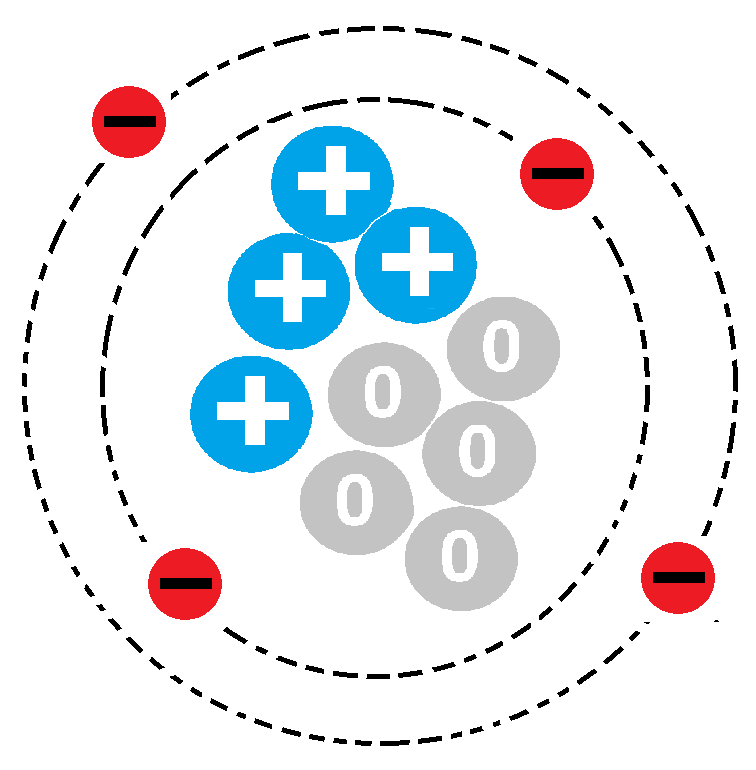
What is the atomic number of this atom?
a)
4
b)
5
c)
9
d)
none of the above
68.

What is the atomic number of this atom?
a)
2
b)
4
c)
6
d)
none of the above
69.
Valence electrons are:
a)
Electrons farthest away from the nucleus
b)
Electrons closest to the nucleus
c)
Electrons that just come and go - they don't stay with the atom
70.
If you want to resubmit an assignment, what should you do?
a)
Just email Mr. Oste
b)
Fill in the "I want to resubmit my assignment form"
c)
Don't communicate wiht Mr. Oste anything.
d)
Tell your lab table partner.
100 %

