wayground logo

Free Printable Worksheets

NEW

Font size

S
M
L
XL
Worksheets

Composition, Types, and Phases of Matter (Unit Review)

Total questions: 66

Worksheet time: 30mins

Name
Class
Date
1.

Which phase of matter is the most abundant in the universe?

a)

Solid

b)

Liquid

c)

Gas

d)

Plasma

2.
The theory that states that all particles in matter are constantly moving; helps to describe the phases of matter
a)
behavior of gases
b)
kinetic theory 
c)
matter matters
d)
temperature 
3.
Solids are described as having a 
a)
definite shape and indefinite volume
b)
indefinite shape and indefinite volume
c)
definite shape and definite volume
d)
indefinite shape and definite volume
4.
Liquids are described as having a 
a)
definite shape and indefinite volume
b)
indefinite shape and indefinite volume
c)
definite shape and definite volume
d)
indefinite shape and definite volume
5.
Gases are described as having a 
a)
definite shape and indefinite volume
b)
indefinite shape and indefinite volume
c)
definite shape and definite volume
d)
indefinite shape and definite volume
6.
Gas particles have the ________ kinetic energy because they move the fastest.
a)
least
b)
most
7.
When a liquid changes its phase and turns into a solid it is known as
a)
condensation.
b)
melting.
c)
vaporization.
d)
freezing or solidification.
8.
When a gas changes its phase and turns into a liquid it is known as
a)
condensation.
b)
sublimation.
c)
vaporization.
d)
freezing or solidification.
9.
When a gas changes its phase and turns into a solid it is known as
a)
deposition.
b)
sublimation.
c)
condensation.
d)
freezing or solidification.
10.
When a solid changes its phase and turns into a gas it is known as
a)
deposition.
b)
melting.
c)
condensation.
d)
sublimation.
11.
All phase changes are
a)
chemical changes
b)
chemical reactions
c)
physical changes
d)
irreversable
12.
What kind of energy is added to or removed from matter to cause a phase change?
a)
Radiation
b)
Heat
c)
Solar
d)
Wind
13.
Which state of matter take up ALL the space inside a container? 
a)
solid
b)
liquid
c)
gas
d)
all of the above
14.
Which state of matter has a definite shape?
a)
solid
b)
liquid 
c)
gas
d)
plasma
15.
What is happening in the statement below?
The ice cube melted.
a)
Matter is changing from a liquid to a solid.
b)
Matter is changing from a liquid to a gas.
c)
Matter is changing from a solid to a liquid.
d)
Matter is changing from a gas to a liquid.
16.
When heat is added to a solid, it ______________.
a)
freezes
b)
evaporates
c)
melts
d)
condenses
17.
Liquids and gases are similar because __________________________.
a)
they both take the shape of their container
b)
they both have their own shape
c)
liquids pour and gases don't
d)
liquids take the shape of the container but gases have their own shape
18.
The drops of water that appear on the outside of a glass of cold juice on a warm day are an example of?
a)
Sublimation: A solid turning into a gas.
b)
Condensation: A gas changing to a liquid.
c)
Evaporation: A liquid changing to a gas.
d)
Deposition: A gas changing to a solid.
19.
Electrically charged state of matter similar to a gas.
a)
temperature
b)
liquid
c)
plasma
d)
gas
20.
Which item is not made of matter?
a)
air
b)
water
c)
a pencil
d)
a shadow
21.

Freezing point and melting point are the same temperature.

a)

True

b)

False

c)

It depends on the substance

d)

Only on Wednesdays

22.
Electrically charged state of matter similar to a gas.
a)
temperature
b)
liquid
c)
plasma
d)
gas
23.
A pure substance that cannot be broken down into other substances by chemical or physical means. 
a)
compound          
b)
atom
c)
mixture 
d)
element
24.
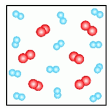
This diagram represents a _____.
a)
pure substance that is a compound
b)
mixture of elements
c)
pure substance that is an element
d)
mixture of compounds
25.
This diagram represents a _____.
a)
pure substance that is a compound
b)
mixture of elements
c)
pure substance that is an element
d)
mixture of compounds
26.

Can a mixture be separated?

a)

No

b)

Yes

c)

Only sometimes

d)

Not enough information given

27.
The basic unit of matter is
a)
a mixture
b)
a substance
c)
an atom
d)
a compound
28.
A substance that contains only one type of atom is a(n)
a)
compound
b)
element
c)
heterogeneous mixture
d)
homogeneous mixture
29.

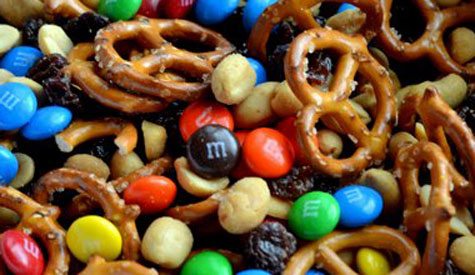
This picture represents which of the following?

a)

Element

b)

Compound

c)

Mixture

d)

Molecule

30.
NaHCO3 is an example of —
a)
an abbreviation
b)
a compound
c)
a mixture
d)
an element
31.

At higher temperatures

a)

particles in an object have less energy

b)

particles in an object move faster

c)

a gas contracts

d)

plasma becomes a gas

32.
Particles (molecules) in a ______________________ have more energy than the other states of matter.
a)
gas
b)
solid
c)
liquid
33.
Particles of a liquid
a)
are tightly packed together and stay in a fixed position.
b)
have no viscosity.
c)
decrease in volume with increasing temperature.
d)
are free to move around one another but still touch.
34.
The speed of the molecules determines the _____.
a)
volume
b)
density
c)
pressure
d)
temperature
35.

A pure substance made of only one kind of atom and cannot be broken down into simpler substances

a)

Atom

b)

Compound

c)

Element

d)

Molecule

36.

How many elements are in a molecule of caffeine?

a)

4

b)

24

c)

8

d)

16

37.

How many atoms are in a molecule of caffeine?

a)

4

b)

24

c)

8

d)

16

38.

How many atoms are in a molecule of water?

a)

1

b)

2

c)

3

d)

4

39.

How many elements are in a molecule of water?

a)

1

b)

2

c)

3

d)

4

40.

What do all atoms of an element have in common?

a)

The same number of protons

b)

The same number of neutrons

c)

The same number of electrons

d)

All of the above

41.

Which of the following is an element?

a)

gold

b)

salt

c)

water

d)

steel

42.

What happens when water is frozen?

a)

Only a physical change

b)

Only a chemical change

c)

Both a physical and chemical change

d)

Neither physical nor chemical change

43.
A copper penny turning greenish after a few years is an example of ...
a)
Chemical Change
b)
Physical Change
44.
A change in which NEW substances are formed.
a)
Chemical change
b)
Physical change
c)
Casual change
d)
Formal change
45.
Which of the following is NOT an example of chemical change?
a)
sour milk
b)
burning wood
c)
breaking a pencil
d)
rust
46.
Which of the following is NOT an example of a physical change?
a)
crumpled paper
b)
pencil sharpening
c)
shrunken clothing
d)
sour milk
47.
Which of the following IS a physical change?
a)
Getting a haircut
b)
Rusty metal
c)
sour milk
d)
A compound
48.
Is melting butter for popcorn a chemical or physical change?
a)
chemical
b)
physical
49.
Ripping up paper ...
a)
Chemical Change
b)
Physical Change
50.
Bubbles form when two or more substances are combined ...
a)
Chemical Change
b)
Physical Change
51.
Change in size ...
a)
Chemical Change
b)
Physical Change
52.
An explosion occurs ...
a)
Chemical Change
b)
Physical Change
53.
Causes a change in odor ...
a)
Chemical Reaction 
b)
Physical Reaction
54.
Evidence of Chemical Change.
a)
New Substance 
b)
Size change
c)
State change
d)
Mixture 
55.
Physical properties are
a)
properties that can be observed without changing the identity of the substance
b)
properties that describe how a substance changes into a completely different substance
56.
On a camping trip, Mrs. Benavides roasts a marshmallow in the campfire. She notices that the roasted marshmallow smells and tastes differently than the uncooked marshmallows. What change has taken place, and how does Mrs. Benavides know?
a)
a chemical change because the marshmallow changed in taste, color and smell
b)
no change because the marshmallow is not a new substance
c)
only a physical change because the marshmallow changed in size
d)
a chemical change because the marshmallow only changed in pH level
57.
Is glass breaking a chemical or phyiscal change?
a)
chemical
b)
physical
58.
Is hammering wood together to build a house a chemical or physical change?
a)
chemical
b)
physical
59.
Is spoiling food a physical or chemical change?
a)
phyiscal
b)
chemical
60.
Is moldy cheese a chemical or physical change?
a)
chemical
b)
physical
61.
Green bananas turning yellow on their own as they ripen.
a)
Chemical Change
b)
Physical Change
62.
Which of the following is NOT an example of a physical change?
a)
crumpled paper
b)
pencil sharpening
c)
shrunken clothing
d)
sour milk
63.
Which of the following is NOT an example of chemical change?
a)
sour milk
b)
burning wood
c)
breaking a pencil
d)
rust
64.
Which type of property is the ability to conduct electricity?
a)
physical property
b)
chemical property
65.
Which of the following properties is a physical property?
a)
magnetism
b)
reactivity with oxygen
c)
flammability
d)
non-reactive
66.
What characteristic defines all chemical changes?
a)
There is a change of state.
b)
Electricity is produced.
c)
A new material is formed.
d)
Bubbles are produced.