wayground logo

Free Printable Worksheets

NEW

Font size

S
M
L
XL
Worksheets

Chemical Reactions

Total questions: 67

Worksheet time: 1hrs 10mins

Name
Class
Date
1.
When a scientist mixed two chemicals, an exothermic reaction takes place. Which of the following would be proof that the reaction was exothermic?
a)
a change of color
b)
a change of state
c)
a temperature decrease
d)
a temperature increase
2.
What types of reactions absorb and release heat?
a)
acidic and basic
b)
endothermic and exothermic
c)
endothermic and heat transfusion
d)
covalent and ionic
3.
A scientist combines chemicals and produces an exothermic reaction. What byproduct of this reaction would show that it is exothermic?
a)
heat
b)
coolness
c)
a precipitate
d)
gas bubbles
4.
In the reaction methane + oxygen turns into carbon dioxide + water, the methane and oxygen are called _______________.
a)
reactants
b)
products
c)
neutrals
d)
energizers
5.
What type of change occurs when a new substance is formed that has different properties from the original substances?
a)
chemical change
b)
nuclear change
c)
physical change
d)
mutation
6.

Which is an example of an endergonic reaction?

a)
burning wood
b)
airplane using fuel
c)
plant leaves using photosynthesis
d)
digesting food
7.
If you combine two substances in a beaker at room temperature and the beaker feels cold to the touch, it means that the substances:
a)
have not reacted with each other
b)
have undergone an endothermic reaction
c)
have undergone a physical change
d)
have undergone an exothermic reaction
8.
In any chemical reaction, the mass of the products is always:
a)
slightly less than the mass of the reactants
b)
much less than the mass of the reactants
c)
the same as the mass of the reactants
d)
greater than the mass of the reactants
9.
How do chemical reactions turn substances into new substances?
a)
with burning acid
b)
the molecules mix together and create new substances
c)
the atoms break apart and combine back together in new ways
d)
the ionic compounds mix in water to form solutions
10.
the starting materials in a chemical reaction
a)
Products
b)
Reactants
c)
Starters
d)
Enders
11.
a substance that is formed as the result of a chemical reaction
a)
Product 
b)
Reactant
c)
Starters
d)
Enders
12.
tells us the number of atoms of each element in a compound
a)
Coeffecient
b)
Exponent
c)
Chemical Formula
d)
Calculator
13.
the symbolic representation of a chemical reaction
a)
Long Hand
b)
Short Hand
c)
Electron Configuration
d)
Chemical Equation
14.
type of chemical reaction where an element reacts with a compound and takes the place of another element in that compound
a)
Double Displacement
b)
Single Displacement
c)
Synthesis
d)
Decomposition
15.
type of chemical reaction where two compounds react, and the positive ions (cation) and the negative ions (anion) of the two reactants switch places, forming two new compounds or products
a)
Double Displacement
b)
Single Displacement
c)
Synthesis
d)
Decomposition
16.
type of reaction in which two or more elements combine to form a more complex compound
a)
Double Displacement
b)
Single Displacement
c)
Synthesis
d)
Decomposition
17.
type of reaction in which a compound is broken down into its simple elements
a)
Double Displacement
b)
Single Displacement
c)
Synthesis
d)
Decomposition
18.
True or False
In a chemical reaction, no new atoms are created, and no atoms are destroyed. 
a)
true
b)
false
19.
The left side of the equation below is called
a)
Products
b)
Reactants
20.
The right side of the equation below is called the
a)
products
b)
reactants
21.
Which statement is not a description of a chemical reaction?
a)
A solid is dropped into a beaker of liquid and a gas is released.
b)
Two liquids are mixed in a beaker and a solid forms at the bottom of the beaker.
c)
A solid is dropped into a beaker of liquid and an explosion occurs.
d)
A liquid is heated in the sun and half of it evaporates.
22.
A number in front of a chemical formula in an equation that indicates how many molecules or atoms of each reactant and product are involved in a reaction.
a)
Coefficient
b)
reactant
c)
subscript
d)
product 
23.
A chemical reaction that absorbs heat
a)
Single replacement
b)
Exothermic
c)
Endothermic
d)
Decomposition
24.
Which of the following answers will balance the equation below?
__K + __Br2 --> __KBr
a)
2, 1, 1
b)
2, 3, 2
c)
2, 1, 2
d)
1, 2, 3
25.
Which of the following options correctly balances the equation below?
__HNO+ __O2 --> __HNO3
a)
4, 1, 4
b)
1, 2, 1
c)
1, 2, 1
d)
2, 1, 2
26.

How many Carbons are present on the reactant side?

a)

1

b)

2

c)

3

d)

4

27.

How many Hydrogens are on the product side of this chemical equation?

a)

1

b)

2

c)

3

d)

4

28.
Number of C's in 2Na₂CO₃
a)
1
b)
2
c)
3
d)
5
29.
Which of the following shows the correct way to balance the chemical equation?
Fe + O2 -> Fe2O3
a)
4Fe + 3O2 -> 2Fe2O3
b)
2 Fe + 3O2 -> Fe2O6
c)
4 Fe + O6 -> 2Fe2O3
d)
None of the options are correctly balanced.
30.
Balance this equation,            
Al2O3 --> Al + O2 
a)
Cannot be balanced
b)
2Al2O3 --> 2Al+3O2 
c)
2Al2O3--> 4Al+3O2 
d)
3Al2O3--> 2Al+O2 
31.
If reaction starts with 20g of reactants it should produce... 
a)
a total of 40g of product
b)
a total of 10g of product
c)
a total of 80 g of product
d)
a total of 20g of product
32.
What is the arrow in a chemical equation...
H2 + O --> H2O
a)
Reactants
b)
Products 
c)
Yields 
d)
Chemical Equation 
33.
In the equation,          2Mg + O2 ---> 2MgO, which are the reactants?
a)
Mg and O
b)
MgO
c)
Mg and MgO
d)
O and MgO
34.
Which of the following is evidence of a chemical reaction?
a)
fizzing
b)
water changing to ice
c)
saltwater
d)
paper being cut in half
35.
Which of the following is NOT evidence that that a chemical reaction has occurred?
a)
produces light/heat
b)
production of a gas
c)
formation of a precipitate
d)
melting
36.
Which of the following describes a precipitate?
a)
a liquid forms when a block of metal is heated
b)
a solid forms when one liquid is poured into another
c)
a gas forms when a solid is placed in a liquid
d)
bubbles form when an acid is poured on a rock
37.

Two substances combine into 1 substance.

a)

Synthesis

b)

Decomposition

c)

Single Replacement

d)

Double Replacement

38.

One substance breaks down into two or more substances.

a)

Synthesis

b)

Decomposition

c)

Single Replacement

d)

Double Replacement

39.

One element trades places with another element in a compound.

a)

Synthesis

b)

Decomposition

c)

Single Replacement

d)

Double Replacement

40.

When the positive ion of one compound replaces the positive ion of another compound to form two new compounds.

a)

Synthesis

b)

Decomposition

c)

Single Replacement

d)

Double Replacement

41.

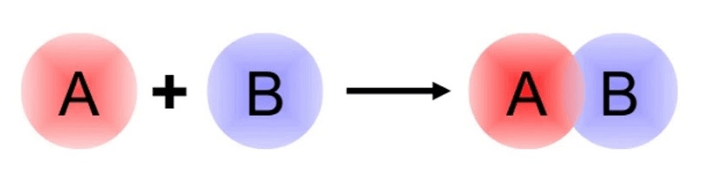
A + B --> AB

a)

Synthesis

b)

Decomposition

c)

Single Replacement

d)

Double Replacement

42.

AB --> A + B

a)

Synthesis

b)

Decomposition

c)

Single Replacement

d)

Double Replacement

43.

A + BC --> B + AC

a)

Synthesis

b)

Decomposition

c)

Single Replacement

d)

Double Replacement

44.

AB + CD --> CB + AD

a)

Synthesis

b)

Decomposition

c)

Single Replacement

d)

Double Replacement

45.

C + H2 --> CH4

a)

Synthesis

b)

Decomposition

c)

Single Replacement

d)

Double Replacement

46.

Ni(ClO3)2 --> NiCl2 + O2

a)

Synthesis

b)

Decomposition

c)

Single Replacement

d)

Double Replacement

47.

HCl + NaOH --> NaCl + H2O

a)

Synthesis

b)

Decomposition

c)

Single Replacement

d)

Double Replacement

48.

What are reactants?

a)

The chemicals that start the reaction.

b)

The chemicals that the reaction produced.

c)

The chemicals that are on the right side of the arrow.

49.

What are products?

a)

The chemicals that start the reaction.

b)

The chemicals that the reaction produced.

c)

The chemicals that are on the left side of the arrow.

50.
Two Reactants and One Product
a)
Decomposition
b)
Synthesis
c)
Combustion
d)
Single Replacement
51.
One reactant into several products.
a)
Decomposition
b)
Synthesis
c)
Combustion
d)
Single Replacement
52.
One element replaces another in a compound.
a)
Synthesis
b)
Combustion
c)
Single Replacement
d)
Double Replacement
53.
Always starts with a Hydrocarbon that reacts with oxygen and produces carbon dioxide and water. 
a)
Decomposition
b)
Synthesis
c)
Combustion
d)
Single Replacement
54.

The metal ions in two compounds switch.

a)

Synthesis

b)

Combustion

c)

Single Replacement

d)

Double Replacement

55.

What is the type of reaction shown above?

a)

Synthesis

b)

Decomposition

c)

Single Replacement

d)

Double Replacement

56.

Identify the reaction type:

C2H6 + O2 --> CO2 + H2O

a)

Double replacement

b)

Synthesis

c)

Acid base

d)

Combustion

57.

Identify the reaction type for the following equation:

K + F2 --> KF

a)

Double replacement

b)

Single Replacement

c)

Synthesis

d)

Decomposition

58.

Identify the type of reaction:

ZnCl2 + Mg --> Zn + MgCl2

a)

Precipitate

b)

Single Replacement

c)

Double Replacement

d)

Decomposition

59.

Identify the reaction type:

NaCl + KOH --> KCl + NaOH

a)

Double replacement

b)

Combustion

c)

Synthesis

d)

Decomposition

60.

Identify the reaction type:

H2O2 --> H2O + O2

a)

Decomposition

b)

Synthesis

c)

Combustion

d)

Acid Base

61.

What type of reaction is the following:
3CuS +2Al > Al2S3+3Cu3CuS\ +2Al\ ->\ Al_2S_3+3Cu

a)

Combination

b)

Decomposition

c)

Single Replacement

d)

Double Replacement

e)

Combustion

62.

What type of reaction is the following:
Na2S +2HCl > H2S+2NaClNa_2S\ +2HCl\ ->\ H_2S+2NaCl

a)

Combination

b)

Decomposition

c)

Single Replacement

d)

Double Replacement

e)

Combustion

63.
Breaking down a substance into simpler substances
a)
Displacement
b)
Synthesis
c)
Decomposition
d)
Oxidation
64.
Combining substances to form a new substance
a)
Displacement
b)
Synthesis
c)
Decomposition
d)
Oxidation
65.
During an endothermic reaction, what happens to energy in relation to the surroundings?
a)
released to
b)
absorbed from
c)
 mixed with
66.
During an exothermic reaction, what happens to energy in relation to the surroundings?
a)
released to
b)
absorbed from
c)
 mixed with
67.
In a cold pack, which type of reaction draws heat from the surroundings?
a)
exothermic
b)
endothermic
c)
exergonic