wayground logo

Free Printable Worksheets

NEW

Font size

S
M
L
XL
Worksheets

Elements, Compounds, Mixtures, and The Periodic Table Review

Total questions: 70

Worksheet time: 1hrs 10mins

Name
Class
Date
1.
A pure substance containing only one kind of atom.
a)
element
b)
mixture
c)
compound
2.
It is a pure substance containing two or more different kinds of atoms.
a)
element
b)
mixture
c)
compound
3.
Can only be separated by chemical means.
a)
element
b)
mixture
c)
compound
4.
These are found on the Periodic Table.
a)
elements
b)
mixtures
c)
compounds
5.

What are diamonds (C) and Uranium (U)

a)
elements
b)
mixtures
c)
compounds
6.

Both water (H2O) and carbon dioxide (CO2) are what?

a)
elements
b)
mixtures
c)
compounds
7.
This picture represents which of the following?
a)
Element
b)
Compound
c)
Mixture
8.
This picture represents which of the following?
a)
element
b)
compound
c)
mixture
9.
This picture represents which of the following?
a)
element
b)
compound
c)
mixture
10.
This picture represents which of the following?
a)
element
b)
compound
c)
mixture
11.
What does the green represent in the atmosphere?
a)
nitrogen
b)
oxygen
c)
water vapor
12.
What does the blue represent in the atmosphere?
a)
nitrogen
b)
oxygen
c)
water vapor
13.
What is water?
a)
element
b)
compound
c)
mixture
14.
What is sugar?
a)
element
b)
compound
c)
mixture
15.
What is gold?
a)
element
b)
compound
c)
mixture
16.
What is krypton?
a)
element
b)
compound
c)
mixture
17.
What is salad?
a)
element
b)
compound
c)
mixture
18.
Anything that has mass and takes up space is called ________. 
a)
Matter
b)
Volume
c)
Element
d)
Compound
19.
Basic particle from which all elements are made is called ________. 
a)
Matter
b)
Atom
c)
Element
d)
Compound
20.
A(n) ___________________ is made up of 1 type of atom. Found on the periodic table. Cannot be broken down into any other substance. 
a)
Matter
b)
Atom
c)
Mixture
d)
Element
21.
A(n) ___________________ is 2 or more atoms chemically bonded (same or different).
a)
Compound
b)
Atom
c)
Mixture
d)
Molecule
22.
A(n) ___________________ shows the elements in a compound and the number of the atoms for each element.
a)
Chemical Symbol
b)
Compound
c)
Chemical Formula
d)
Chemical Date
23.
A(n) ___________________ shows one or two letter abbreviation of an element. 1st letter is capital, 2nd letter is lowercase.
a)
Chemical Symbol
b)
Compound
c)
Chemical Formula
d)
Chemical Date
24.
Select the term that best completes the following statement:
H2O (water) contains one _____________.
a)

oxygen atom
b)

element
c)
compound
d)
mixture
25.
Hydrogen is a pure substance represented by the chemical symbol H. Which of the following best describes hydrogen?
a)

Hydrogen is a compound made of two or more kinds of atoms.
b)
Hydrogen is an element made of two or more kinds of atoms.
c)
Hydrogen is an element made of only one kind of atom.
26.
The chemical combination of two or more different atoms in fixed amounts is called a(n)
a)
orbit
b)
element
c)
mixture
d)
compound
27.
Which is a substance made up of only one kind of atom?
a)
element
b)
compound
c)
mixture
28.
Which of the following definitions characterizes an element? 
a)

contains only one type of atom
b)

contains a basic combination of two or more substances
c)
can only be broken down by chemical means
29.

The vertical (up and down) columns in the Periodic Table are called

a)

groups

b)

towers

c)

periods

d)

atomic numbers

30.
The Modern Periodic Table of Elements is arranged by
a)
atomic mass
b)
atomic number
c)
valence electrons
d)
number of isotopes
31.
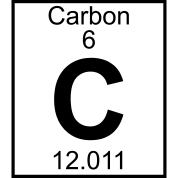
What does the 6 represent?
a)
atomic mass
b)
atomic number
c)
element name
d)
chemical symbol 
32.
What does 12.011 represent?
a)
atomic mass
b)
atomic number
c)
element name
d)
chemical symbol 
33.
What does the C represent?
a)
atomic mass
b)
atomic number
c)
element name
d)
chemical symbol 
34.
These are found on the Periodic Table.
a)
Compounds
b)
Elements
c)
Mixtures
35.

What is the biggest group on the table?

a)

metals

b)

nonmetals

c)

metaloids

d)

halogens

36.

Where are the metalloids found?

a)

far left, vertical

b)

stair step/diagonal

c)

far right horizontal

d)

at the bottom

37.

What is the small group of elements called that include C,N,O?

a)

metals

b)

nonmetals

c)

metaloids

d)

noble gases

38.

Symbols must have at least

a)

1 cap. letter

b)

2 cap. letters

c)

2 lower case letters

d)

any letter you want

39.
The atomic number tells you what?
a)
number of electrons
b)
number of protons
c)
number of neutrons
d)
both electrons and protons in an atom.
40.
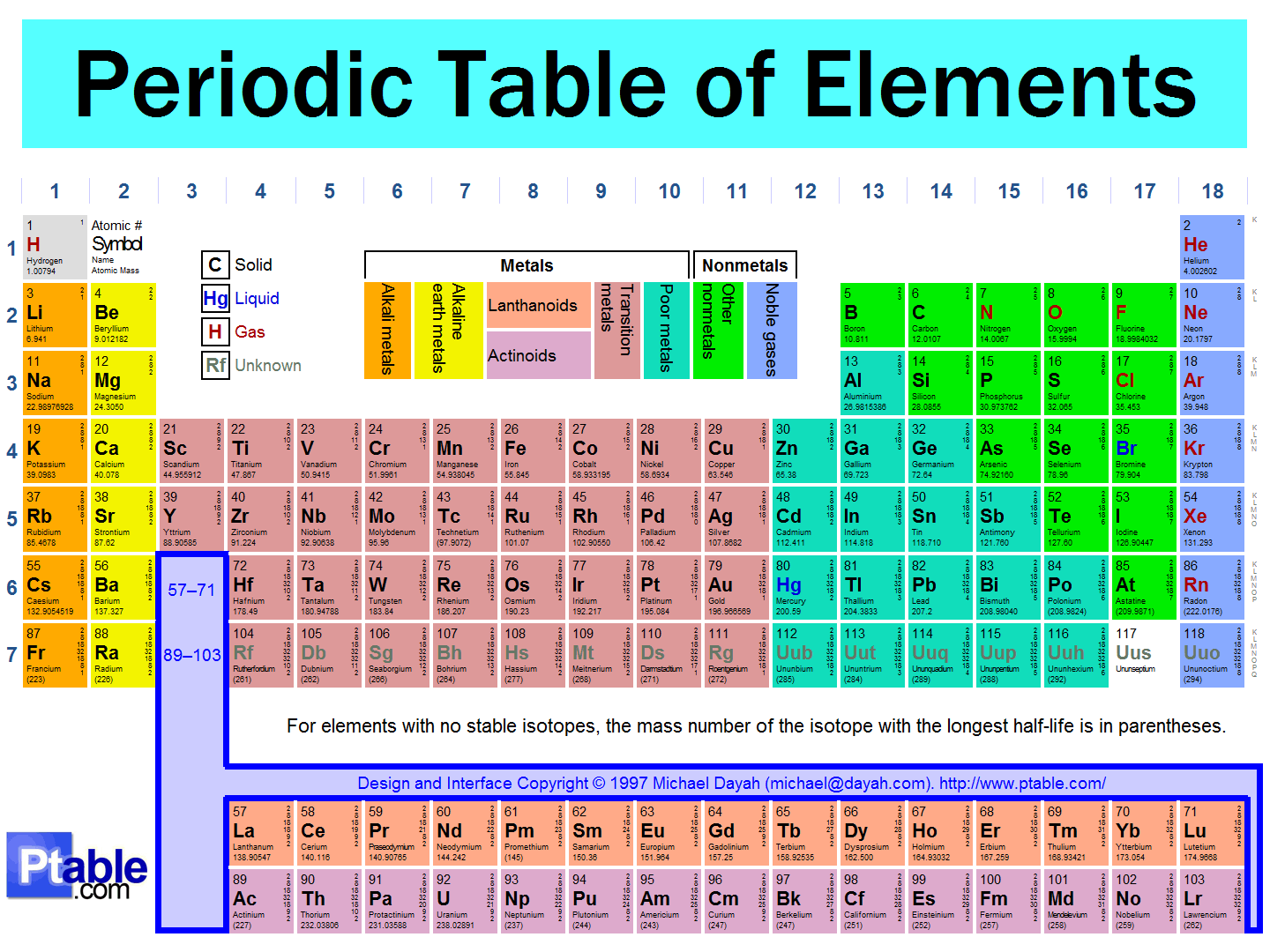
Use the periodic table to answer the question.
Which element listed below is a nonmetal?
a)
 sodium (Na)
b)
 magnesium (Mg)
c)
iron (Fe)
d)
 chlorine (Cl)
41.
a)
Metals
b)
Nonmetals
c)
Metalloids
42.
Iron is a good conductor, malleable and magnetic. What type of element is Iron? 
a)
Metal
b)
Nonmetal
c)
Metalloid
d)
Pretty
43.
Silicon is a semiconductor and has properties of both metals and nonmetals. What type of element is Silicon? 
a)
Metal
b)
Nonmetal
c)
Metalloid
d)
Pretty
44.
Which elements are found on the left to middle of The Periodic Table? 
a)
Metals
b)
Nonmetals
c)
Metalloids
d)
Candles
45.
Which elements are found on the right side of The Periodic Table?
a)
Metals
b)
Nonmetals
c)
Metalloids
d)
Water
46.
All of these properties describe metals except...
a)
malleable
b)
conductors
c)
brittle 
d)
shiny
47.
How would this element be classified?
a)
Metal
b)
Nonmetal
c)
Metalloid
d)
Metamorphic
48.
Which of these is a property of metals?
a)
Malleable
b)
Good Insulator
c)
Dull
d)
Very brittle
49.
Which of the following is typically a good conductor of heat?
a)
Metal
b)
Nonmetal
c)
Metalloid
50.
Some characteristics of a metal are that it is malleable and ductile.
a)
TRUE
b)
FALSE
51.
Silicon is a semiconductor and has properties of both metals and nonmetals. What type of element is Silicon? 
a)
Metal
b)
Nonmetal
c)
Metalloid
d)
Pretty
52.
Which elements are found on the right side of The Periodic Table?
a)
Metals
b)
Nonmetals
c)
Metalloids
d)
Water
53.
All of the following would classify an element as a metal except?
a)
Dull
b)
Luster
c)
Malleable
d)
Hard
54.
Which of the following represents an element?
a)
H2O
b)
H2
c)
NaCl
d)
CaCO3
55.
Which of the following COULD be a symbol on the periodic table of elements? (think about the rules of chemical symbols...)
a)
JZ
b)
jz
c)
Jz
d)
JZa
56.
How many elements are represented in the compound?
Na2CO3
a)
1
b)
2
c)
3
d)
4
57.
Which of the following is a physical characteristic of a metalloid?
a)
texture
b)
malleable
c)
brittle
d)
semi-conductor
58.
What does luster mean?
a)
Breaks into pieces
b)
can be hammered into thin sheets
c)
No shine
d)
reflects light shiny 
59.
What does brittle mean?
a)
Breaks into pieces
b)
can be hammered into thin sheets
c)
No shine
d)
reflects light shiny 
60.

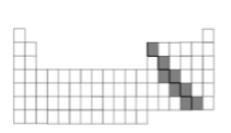
Elements in the shaded area can best be described as -

a)

Malleable

b)

Brittle

c)

Dull

d)

Insulators

61.

Elements in the shaded area can best be described as -

a)

Semi-conductors

b)

Insulators

c)

Ductile

d)

Siny

62.

Elements in the shaded area can best be described as -

a)

Shiny and brittle

b)

Insulators

c)

Good conductors

63.

I can be drawn into wires

a)

Malleable

b)

Ductile

c)

Luster

d)

Conductor

64.

Heat and electricity flow through me

a)

Malleable

b)

Ductile

c)

Luster

d)

Conductor

65.

I can be hammered into flat sheets

a)

Malleable

b)

Ductile

c)

Luster

d)

Conductor

66.
A student is examining the physical properties of a sample. The sample is malleable, but does not conduct electricity nor have luster. This sample would be a...
a)
metal 
b)
nonmetal 
c)
metalloid
67.
If a student observes a silvery solid that is malleable, good conductor, and ductile it is a...
a)
nonmetal 
b)
metal 
c)
metalloid
68.
Which of the following describes a nonmetal?
a)
Reflects light
b)
breaks into pieces
c)
conducts heat and electricity 
d)
Ductile
69.
a)

Metal

b)

Nonmetal

c)

Metalloid

70.
a)

Metal

b)

Nonmetal

c)

Metalloid