wayground logo

Free Printable Worksheets

Font size

S
M
L
XL
Worksheets

Year 9 Chemistry Super Revision Quiz

Total questions: 66

Worksheet time: 1hrs 26mins

Name
Class
Date
1.
Activation energy is required to start a chemical reaction. What is activation energy?
a)
The energy needed for a reaction to occur
b)
The minimum amount of energy needed for a reaction to potentially occur
c)
The energy added by a catalyst
d)
The energy possessed by the products
2.
Increase in temperature of the reactants can do one of the following
a)
Slow collision frequency
b)
Allow less effective collision between the particles
c)
Cause particles to lose speed
d)
Increase collision between the particles thus increasing the rate.
3.
Grinding a seltzer tablet into powder increases the rate of reaction due to increased
a)
concentration
b)
surface area
c)
temperature
d)
reactants
4.
Which factors increase the rate of a reaction.
a)
increasing temperature
b)
increasing concentration
c)
increasing surface area
d)
all of these
5.
A ______________ is a substance that increases the rate of a reaction without being used up during the reaction. 
a)
catalyst
b)
product
c)
reactant
d)
solute
6.
Increasing the concentration of the reactants will slow down the reaction.
a)
false 
b)
true
7.
Why does a higher temperature increase the rate of a reaction?
a)
it increases both the frequency and energy of particle collisions
b)
it only increases the frequency of particle collisions
c)
it only increases the energy of particle collisions
d)
it reduces the activation energy of the reaction
8.
Why does a higher concentration increase the rate of reaction?
a)
it increases the amount of reactants
b)
it lowers the activation energy
c)
it increases the energy of particle collisions
d)
it increases the frequency of particle collisions because there are more collision sites
9.
Products will form faster if____________
a)
the particle size of the reactants are larger.
b)
temperature is decreased.
c)
concentration of the reactants are increased.
d)
the reaction is not stirred.
10.
Explosions can happen when there is a large amount of powdered substance because of a large
a)
temperature
b)
surface area
c)
concentration
d)
pressure
11.
Fluorine has an atomic number of 9. What can you conclude about an atom of fluorine from this fact?
a)
it has 9 protons
b)
it weighs 9 grams
c)
it has 9 electron shells
d)
it has a boiling point of 9 degree celsius
12.
In what part of an atom can protons be found?
a)
inside the electron
b)
inside the neutron
c)
inside the atomic nucleus
d)
inside the electron shells
13.
An atom of fluorine has an atomic mass of 19 u. Keeping in mind that its atomic number is 9, what can you infer about this atom?
a)
it has 9 neutrons
b)
it has 10 electrons
c)
it has 10 neutrons
d)
it has 10 protons
14.
If a sulfur atom has 16 protons, 16 electrons, and 16 neutrons, its atomic mass is:
a)
16
b)
32
c)
48
d)
64
15.
What can you conclude about carbon-14 from its name?
a)
It has 14 electrons
b)
it has 14 neutrons
c)
it has 14 protons
d)
it has an atomic mass of 14 u
16.
How many neutrons does the isotope of lithium have?
a)
8
b)
3
c)
4
d)
5
17.
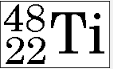
How many protons does this isotope of titanium have?
a)
48
b)
22
c)
26
d)
70
18.
How many neutrons does the isotope below have?     89 36Kr
a)
53
b)
36
c)
89
d)
125
19.
How many neutrons does an atom of the isotope Neon-22 have?
a)
12
b)
10
c)
22
d)
20
20.

Isotopes of an element have a different number of...

a)

Protons

b)

Neutrons

c)

Electrons

d)

Mass

21.

Describe the structure of an alpha particle.

a)

a fast-moving electron

b)

2 protons and 2 neutrons

c)

a slow-moving neutron

d)

a hydrogen nucleus

22.

In alpha decay, the mass number...

a)

increases by 2

b)

decreases by 2

c)

increases by 4

d)

decreases by 4

23.

In alpha decay, the atomic number...

a)

increases by 2

b)

decreases by 2

c)

increases by 4

d)

decreases by 4

24.

The mass number of Neptunium (Np) is (a)   .

25.

The atomic number of Neptunium (Np) is (a)   .

26.

How is the alpha particle written in a nuclear equation?

a)

42He

b)

24He

c)

0-1e

d)

00γ

27.
A helium nucleus with two protons and two neutrons is called a(n) ____.  
a)
alpha particle
b)
electroscope
c)
beta particle
d)
gamma ray
28.
Solve this equation for alpha decay.
85209At = ___ + 24He
a)
83205Bi
b)
86209Rn
c)
81207Tl
d)
85208At
29.

As you move down a group, atomic radius increases because

a)

you add more and more neutrons.

b)

you add more and more protons.

c)

you add more and more shells (energy levels).

d)

you add more atomic mass.

30.

As you move across the periodic table from left to right -->, the atomic radius decreases. Why?

a)

The number of protons & electrons increases, so the electrostatic attraction to electrons increases.

b)

The number of energy levels increases.

c)

The number of electrons increases.

d)

The atomic mass increases.

31.

Francium (Fr) has the lowest ionization energy in Group 1 because

a)

it has the smallest number of valence electrons.

b)

it has the greatest atomic mass.

c)

it has the greatest number of protons, so it attracts its electrons the strongest.

d)

its 1 valence electron is very far from the nucleus, so little energy is needed to remove it.

32.

Which atom in Period 4 has the largest atomic radius?

a)

K

b)

Kr

c)

Fe

d)

Fe

33.

Ions are formed when atoms gain or lose ___.

a)

electrons

b)

protons

c)

neutrons

d)

atomic mass

34.
Ions are: 
a)
atoms with a positive or negative charge
b)
atoms with no charge
c)
atoms with ONLY a positive charge
d)
atoms with ONLY a negative charge
35.

When an atom loses an electron, it becomes a(n) _____________ ion.

a)

positive

b)

negative

c)

neutral

d)

polyatomic

36.
What is the charge of an atom that has lost one electron?
a)
-1
b)
-2
c)
+1
d)
+2
37.

What is the charge of an atom that has gained two electrons?

a)

-1

b)

-2

c)

+1

d)

+2

38.

Which group on the periodic table is known as the alkaline earth metals?

a)

group 1A

b)

group 2A

c)

group 8A

d)

group 7A

39.

Atoms of elements in group 1 have ____________.

a)

one electron in their outermost energy level

b)

two electrons in their outermost energy level

c)

seven electrons in their outermost energy level

d)

eight electrons in their outermost energy level

40.

Which of the following elements is most likely to form a negatively-charged ion?

a)

I

b)

Br

c)

Cl

d)

F

41.

Which of the following is an ion?

a)

O2-

b)

C

c)

HCl

d)

Lithium-3

42.

Where would you expect to find the smallest atoms?

a)

upper left

b)

upper right

c)

lower left

d)

lower right lower right

43.

Sodium (Na) and Cesium (Cs) are in the same group on the periodic table. Based on their locations, which statement about sodium and Cesium is true?

a)

Sodium is less electronegative than cesium.

b)

Sodium has fewer energy levels than cesium.

c)

Sodium has a larger ionic radius than cesium.

d)

Sodium has lower ionization energy than cesium.

44.
All elements found on the left side of the Periodic Table of the Elements have what properties in common?
a)
They conduct heat and electricity 
b)
They are all gases 
c)
They are brittle and dull
d)
They are radioactive
45.
Which of these elements has an electron structure most similar to that of element X?
a)
1
b)
2
c)
3
d)
4
46.
Based on their locations in the periodic table, which element has chemical properties most similar to those of calcium, Ca?
a)
beryllium, Be
b)
potassium, K
c)
titanium, Ti
d)
yttrium, Y
47.
The number of valence electrons in an element affects the reactivity of that element. Which element listed has the fewest valence electrons?
a)
beryllium (Be)
b)
sodium (Na) 
c)
oxygen (O) 
d)
neon (Ne)
48.
Which atom has the largest atomic radius?
a)
potassium
b)
rubidium 
c)
francium
d)
cesium
49.

Vertical columns of elements are known as ________________- Elements in a column have the same number of ______________ .

a)

groups, valence electrons

b)

periods, neutrons

c)

groups, protons

d)

gangs, members

50.

Which element is located in period 4?

a)

Zirconium (Zr)

b)

Silicon (Si)

c)

Beryllium (Be)

d)

Iron (Fe)

51.

Which is a halogen?

a)

Helium

b)

Chlorine

c)

Oxygen

d)

Neptune

52.

Group II on the Periodic Table contains the _____________________________. They form ions with a charge of _________________.

a)

alkali metals, -2

b)

alkaline earth metals, +2

c)

halogens, -1

d)

noble gases, 0

53.

A Group IIIA element has ____ electron(s) in it's outermost level and when it forms an ion it _________________________.

a)

1, loses 1 electron

b)

3, loses 1 electron

c)

3, loses 3 electrons

d)

3, gains 3 electrons

54.
Which periodic group has the smallest atomic radius?
a)
Alkali metals
b)
Halogens
c)
Noble Gases
d)
Transition metals
55.

A positively charged particle found in the nucleus of an atom is

a)

a quark.

b)

an electron.

c)

a proton.

d)

a neutron.

56.

A  negatively charged particle located outside the atom's nucleus is

a)

a neutron.

b)

a proton.

c)

an electron.

d)

a quark.

57.

A subatomic particle that has no charge and that is found in the nucleus of an atom is

a)

a quark.

b)

a proton.

c)

a neutron.

d)

an electron.

58.

The center of an atom is 

a)

a neutron.

b)

a nucleus.

c)

a quark.

d)

a bohr.

59.

Why is the overall charge of an atom neutral (0)?

a)

They have the same number of protons and neutrons.

b)

They have the same number of protons and electrons.

c)

They have the same number of electrons and neutrons.

60.

How many electrons does this oxygen atom have?

a)

16

b)

8

c)

24

d)

6

61.

How many electrons can be in the 2nd energy level hold?

a)

1

b)

2

c)

4

d)

8

62.

How many electrons does the first shell hold?

a)

1

b)

2

c)

4

d)

8

63.

What on a periodic table tells you the number of protons in an atom?

a)

Atom number

b)

Atomic number

c)

Proton number

d)

Mass number

64.

What is the atomic mass of Potassium?

a)

8

b)

19

c)

39

d)

39.0983

65.

How many Protons are in Magnesium?

a)

24.305

b)

24

c)

12

d)

6

66.

What is the number of neutrons in Potassium?

a)

8

b)

19

c)

39

d)

20