Wayground logo

Free Printable Worksheets

Font size

S
M
L
XL
Worksheets

seasons and moon

Total questions: 45

Worksheet time: 47mins

Name
Class
Date
1.
Why do globes lean sideways?
a)
To allow them to spin easier.
b)
To demonstrate the tilt of Earth's axis.
c)
To demonstrate the effects of gravity.
d)
To demonstrate day and night.
2.
What causes the seasons to change?
a)
The warming and cooling of Earth's core.
b)
The distance from the sun.
c)
Earth's tilt in relation to the sun.
d)
Earth's rotation on its axis.
3.
What happens when the area in which you live tilts away from the sun?
a)
It is summer.
b)
It is spring.
c)
It is winter.
d)
It is fall.
4.
What season is it in the Southern Hemisphere when it is fall in the Northern Hemisphere?
a)
winter
b)
spring
c)
summer
d)
fall
5.
In the Northern Hemisphere, on which day will you receive the most daylight?
a)
September 21
b)
December 21
c)
March 21
d)
June 21
6.
Which season is taking place in the Southern Hemisphere in Position 1?
a)
Winter
b)
Spring
c)
Summer
d)
Fall
7.
Which season is taking place in the Northern Hemisphere in Position 2?
a)
Winter
b)
Spring
c)
Summer
d)
Fall
8.
Which season is taking place in the Northern Hemisphere in Position 3?
a)
Winter
b)
Spring
c)
Summer
d)
Fall
9.
Which season is taking place in the Southern Hemisphere in Position 4?
a)
Winter
b)
Spring
c)
Summer
d)
Fall
10.
What is Earth's annual motion around the sun called?
a)
Rotation
b)
Revolution
11.
One rotation of Earth is equal to
a)
a day.
b)
a year.
12.
Objects in the sky appear to move from _______ to _______.
a)
East to West
b)
West to East
c)
North to South
d)
South to North
13.
Where on Earth can you experience entire days of darkness?
a)
The equator
b)
The poles
c)
The Tropic of Cancer
d)
The Tropic of Capricorn
14.
When will the sun reach the highest altitude at noon?
a)
December
b)
March
c)
September
d)
June
15.
Which angle of sunlight produces the most heat?
a)
90 degrees
b)
60 degrees
c)
30 degrees
d)
0 degrees
16.
At position A, which hemisphere would have summer?
a)
Northern hemisphere
b)
Southern hemisphere
17.
Why is the Equator warmest?
a)
Because it is closest to the sun.
b)
Because it receives the most direct sunlight
c)
Because no clouds form here.
d)
Because it is far from the sun
18.
What part of the moon do we see from Earth?
a)
all of it
b)
only one quarter
c)
none of it
d)
the same side
19.
As the lighted part of the moon appears to get smaller, we say that the moon is ____________.
a)
waning
b)
disappearing
c)
swelling
d)
waxing
20.
What causes the tides on Earth?
a)
energy coming out from the core of the Earth
b)
movement of tectonic plates
c)
gravitational pull of the sun and moon
d)
volcanic eruptions near the oceans
21.

High tide happens about _________ before the next high tide.

a)

1 week

b)

1 month

c)

12 1/2 hours

d)

24 hours

22.
How does the Sun's position in the sky effect the length of a shadow?
a)
It determines the length of the shadow.
b)
It makes shadows  appear super large.
c)
It helps you to see your shadow.
d)
It blocks all shadows, so you cannot see them.
23.
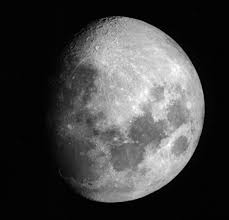
Name the moon phase
a)
waning crescent
b)
waxing crescent
c)
waning gibbous
d)
waxing gibbous
24.

Which type of Eclipse is shown in the picture?

a)

Lunar

b)

Solar

25.

Which type of Eclipse is shown in the picture?

a)

Lunar

b)

Solar

26.

Wha type of tide would this arrangement of earth-moon-sun create?

a)

full moon tide

b)

new moon tide

c)

neap tide

d)

spring tide

27.
Which phase of the moon is represented in this diagram?
a)
new moon
b)
first quarter
c)
full moon
d)
last quarter/third quarter
28.
What type of tides would this arrangement of earth-moon-sun create?
a)
neap tide
b)
spring tide
c)
new moon tide
d)
full moon tide
29.
Which body has the greater effect on Earth's tides?
a)
Sun
b)
Saturn
c)
Moon 
d)
Venus
30.
How many low tides and high tides happen in a day?
a)
1 low tide, 1 high tide
b)
4 low tides, 4 high tides
c)
3 low tides, 3 high tides
d)
2 low tides, 2 high tides
31.
The Moon has a greater influence on Earth tides than the Sun because...
a)
it is smaller than the Sun
b)
it revolves around the Earth
c)
it is closer to the Earth
32.
What is a difference between spring and neap tides?
a)
Spring tides occur when the earth and sun are IN LINE with the new or full moon. 
b)
Spring tides occur when moon in 3rd or 1st quarter phases
c)
Spring tides are LOWER than neap tides
d)
Spring tides occur in Spring and neap tides can occur in any season
33.

which direction does the sun rise on Dec 21

a)

W

b)

SW

c)

SE

d)

E

34.

Which seasons does the sun rise and set due East and due west?

a)

winter

b)

summer

c)

fall

d)

spring

35.

what day is represented by this diagram

a)

dec 21

b)

Jun 21

c)

mar 21

d)

sept 21

36.

Why is the same side of the moon always facing Earth?

a)

Earth rotates

b)

Moon stay still

c)

Earth and moons rotation are the same

d)

moons rotation is the same as moons revolution

37.

Why are there two high tides and two low tides per day?

a)

Earth's Revolution

b)

Earth's Rotation

c)

Moon's revolution

d)

Moon's rotation

38.

Which position will a waxing crescent be viewed from Earth?

a)

2

b)

8

c)

4

d)

6

39.

Which position will a waning gibbous be viewed from Earth?

a)

2

b)

8

c)

4

d)

6

40.

A line, real or imaginary, around which something spins

a)

rotation

b)

axis

c)

compass

41.

The time it takes the Earth to make one complete rotation on its axis (24 hour period)

a)

rotation

b)

axis

c)

compass

42.
What motion of the Earth takes 365 days?
a)
Rotation
b)
Tilting 
c)
Revolution
d)
Spinning
43.
The Foucault pendulum is proof of Earth's
a)
revolution around the sun
b)
revolution around its axis
c)
rotation around the sun
d)
rotation around its axis
44.
The coriolis effect is another proof of earth's rotation. This effect causes winds and ocean currents to be deflected to the _____________ in the Northern Hemisphere.
a)
right
b)
left
c)
north
d)
south
45.
If the earth rotated slower, how would that affect the length of the day?
a)
longer day
b)
shorter day
c)
same time,  24 hours