wayground logo

Free Printable Worksheets

NEW

Font size

S
M
L
XL
Worksheets

Tournament of Knowledge Protein Synthesis

Total questions: 55

Worksheet time: 36mins
Name
Class
Date
1.
How many nucleotides code for each amino acid?
a)
1
b)
2
c)
3
d)
64
2.
What happens in RNA processing and where does it occur?
a)
5' cap and 3' poly A tail added, in nucleus
b)
3' cap and 5' poly A tail added, in cytoplasm
c)
introns cut out and exons reattached, nucleus
d)
introns cut out and exons reattached, cytoplasm
3.
What is an exon?
a)
section of mRNA that codes for protein
b)
section of mRNA that does not code for protein
c)
section of tRNA that codes for protein
d)
section of rRNA that codes for protein
4.
Where are anticodons found?
a)
on mRNA
b)
on DNA
c)
on rRNA
d)
on tRNA
5.
Where is the TATA box found?
a)
in the promoter sequence of prokaryotes
b)
in the terminator sequence of prokaryotes
c)
in the promoter sequence of eukaryotes
d)
in the terminator sequence of eukaryotes
6.
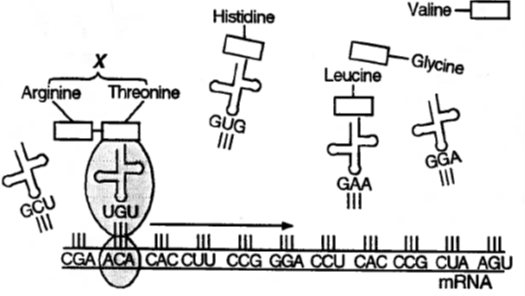
What process is going on in this photo? 
a)
Transcription 
b)
Translation 
c)
Replication 
d)
All the above 
7.
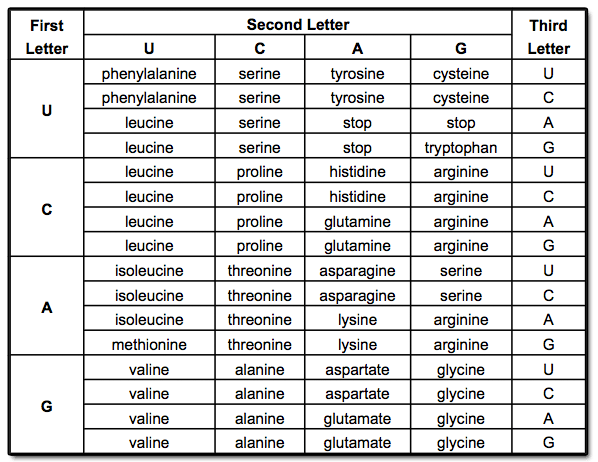
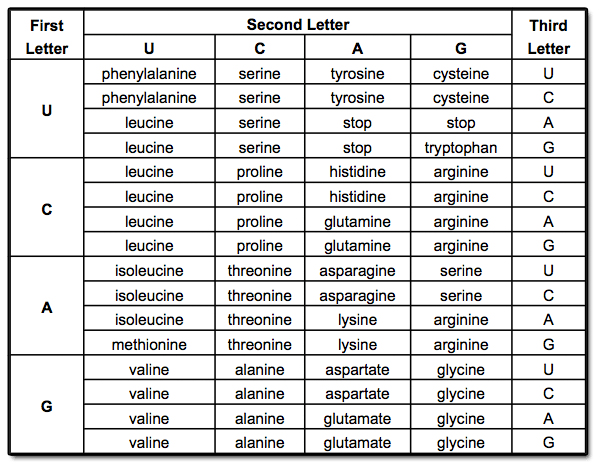
What is the correct amino acid sequence for the mRNA code AUGCCAGUAUGA
a)
Met-Pro-Ala-Val
b)
Met-Pro-Val
c)
Tyr-Gly-His
d)
Tyr-Gly-Arg-His
8.
Transcription begins at sequences called
a)
Start Codons
b)
Promoters
c)
Origins
d)
Introns
9.
Protein synthesis takes place in two parts:
a)
Transcription then translation
b)
Replication then transcription
c)
Translation then transcription
d)
Replication then translation
10.
Which of these nitrogenous bases is NOT in DNA?
a)
Uracil
b)
Thymine
c)
Cytosine
d)
Guanine
11.
Which of the following represent the order that a codon goes through the ribosome sites?
a)
A->P->E
b)
P->A->E
c)
E->A->P
d)
A->E->P
12.
The end of the growing RNA strand in transcription to which RNA polymerase can add nucleotides?
a)
3'
b)
5'
c)
1'
d)
2'
13.
Area of the ribosome that holds the tRNA that is carrying the growing polypeptide chain?
a)
A
b)
P
c)
E
d)
X
14.
What helps RNA polymerase attach to a gene in transcription?  Also, name the gene section.
a)
transcription factors, elongator
b)
transcription factors, promoter
c)
enzymes, terminator
d)
enzymes, promotoer
15.
Which represents the correct order of "the central dogma of molecular biology"?
a)
protein to DNA to mRNA to trait
b)
DNA to mRNA to protein to trait
c)
DNA to protein to mRNA to trait
d)
trait to DNA to protein to mRNA
16.
Which ribosome part contains a tRNA after it has dropped off its amino acid & is about to exit?
a)
A site
b)
P site
c)
E site
d)
B site
17.
Transcribe this DNA sequence to mRNA: AAACCGGCC
a)
UUUGGCCGC
b)
TTTGGCGGG
c)
TTTGGCCGG
d)
UUUGGCCGG
18.
What makes up a spliceosome and what does a spliceosome do?
a)
proteins & snRNPs, cuts out DNA pieces
b)
proteins & snRNPs, cuts out exons & reconnects introns
c)
proteins & snRNPs, cuts out introns & reconnects exons
d)
many nucleosomes, cuts the cheese
19.
Which enzyme copies a segment of DNA called a gene to make a mRNA molecule?
a)
DNA polymerase
b)
DNA primase
c)
RNA primase
d)
RNA polymerase
20.
mRNA is read in chunks of three, called...
a)
quadralets
b)
anticodons
c)
codons
d)
capsids
21.
DNA codes for...
a)
cholesterol
b)
proteins
c)
fatty acids
d)
a sandwich
22.
The process of making mRNA from DNA is called.
a)
Replication
b)
Transcription
c)
Translation
d)
Protein synthesis
23.
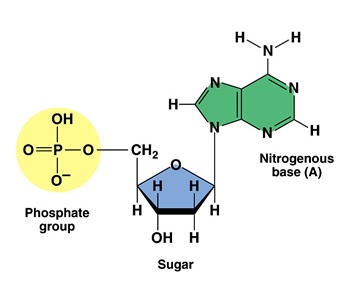
What is a monomer of DNA and/or RNA called?
a)
Nucleotide
b)
Nitrogenous base
c)
Sugar-phosphate backbone
d)
Adenosine Triphosphate
24.
Genes found on DNA contain instructions for creating...?
a)
Proteins
b)
Cytoplasm
c)
Anti-Codons
d)
Codons
25.
What are the monomers of proteins?
a)
glycerol
b)
monosaccharides
c)
amino acids
d)
fatty acids
26.
How can a person's muscle cells have the same exact DNA sequences as their nerve cells even though the look and perform completely different?
a)
The two different cells become mutated
b)
The proteins expressed in each cell are different
c)
They actually have different DNA in the two types of cells.
d)
The genome of the different cells changes
27.

What amino acid is coded for by the codon UUA?

a)

Phenylalanine

b)

Tyrosine

c)

Leucine

d)

Stop codon

28.

What amino acid would the DNA triplet TTT code for?

a)

LYS

b)

PHE

c)

VAL

d)

NONE

29.

What amino acid does the mRNA codon AGG code for?

a)

SER

b)

ARG

c)

VAL

d)

PRO

30.
Which process is used to copy DNA in the nucleus?
a)
replication
b)
transcription
c)
translation
31.
Which process is used to make mRNA from the DNA in the nucleus?
a)
transcription
b)
translation
c)
replication 
32.
Which RNA bases would pair with TACGAA in transcription
a)
AUGCUU
b)
ATGCTT
c)
GCATCC
d)
GCAUCC
33.
Where does transcription take place?
a)
nucleus
b)
cytoplasm
c)
ribosome
34.
How many amino acids are coded for by this sequence of nucleotides:
ATG GGA ACT CCA
a)
4
b)
2
c)
6
d)
12
35.
What is occurring in this picture?
a)
Translation
b)
Replication
c)
Translocation
d)
Transcription
36.
One difference between DNA and RNA is that....
a)
Only RNA has the base Uracil
b)
only RNA contains the base Thymine
c)
only RNA contains the base Cytocine
d)
only RNA contained the base Guanine
37.
What process is being shown here?
a)
Replication
b)
Translation
c)
Transcription
38.
what does mRNA do?
a)
carry info from genes to ribosomes
b)
carry amino acids to ribosomes
c)
help with RNA splicing
d)
make up ribosomes
39.
Does the order of amino acids in a protein matter?
a)
YES!
b)
NO!
40.
Which is NOT required to make proteins
a)
DNA
b)
RNA
c)
Ribosomes
d)
lysosomes
41.
The genetic code is essentially the same for all organisms. From this, one can logically assume which of the following?
a)
The same codons in different organisms translate into the different amino acids.
b)
A gene from an organism can theoretically be expressed by any other organism.
c)
All organisms have experienced convergent evolution.
d)
DNA was the first genetic material.
42.

Which molecule brings amino acids to the ribosome?

a)

mRNA

b)

tRNA

c)

miRNA

d)

rRNA

43.

Which of the following is true?

a)

Introns code for the protein, while Exons do not

b)

Exons are removed from the final mRNA and do not leave the nucleus.

c)

Exons are spliced together to form the final mRNA that goes to the Ribosome

d)

Introns are not transcribed or translated.

44.

Which term describes the following: Pairing of the tRNA anticodon with the mRNA codon proceeds from the 5' end of the codon. Once the first two positions are paired, exact base pairing of the third position is less critical. The third (5') base of the anticodon can typically pair with either member of the purine or pyrimidine pair in the codon as appropriate.

a)

Splicing

b)

Wobble

c)

Universality

d)

Elongation

45.

Which part of the cell makes rRNA?

a)

Nucleolus

b)

Ribosome

c)

Cytosol

d)

Membrane

46.

What is a "charged" tRNA?

a)

One that is attached to its amino acid

b)

One that is negative

c)

One that is positive

d)

One that is exiting the ribosome

47.

Which of the following processes are anabolic and therefore endothermic?

a)

DNA replication

b)

Translation

c)

Transcription

d)

All of these

48.

Alternative splicing results in

a)

New mutations

b)

More than one protein being created from a single DNA segment

c)

New species

d)

Random protein formation

49.

During elongation of translation, which site on the ribosome is the tRNA in when the peptide bond is formed between amino acids?

a)

A

b)

P

c)

E

d)

X

50.

What type of bond is formed between amino acids during translation?

a)

glycosidic linkage

b)

phosphodiester bond

c)

peptid bond

d)

Hydrogen bond

51.

Where does translation occur?

a)

In the cytoplasm or the ER

b)

In the nucleus or the ER

c)

In the nucleolus or the ER

d)

In the lysosome or the ER

52.

What happens to an amino acid sequence once it is put together by the translation process?

a)

It immediately breaks down into amino acids

b)

It folds into its tertiary structure.

c)

It denatures.

d)

It gets transcribed.

53.

A string of adenine nucleotides is added to _________ after transcription

a)

the 5' end of the mRNA

b)

the 3' end of the mRNA

c)

the 5'end of the tRNA

d)

The 3'end of the tRNA

54.

What happens to the 5' end of an mRNA after transcription?

a)

A poly A tail is added

b)

A guanine cap is added

c)

telomeres are added

d)

codons are added

55.

RNA processing

a)

only happens in prokaryotes.

b)

only happens in eukaryotes.

c)

happens in both prokaryotes and eukaryotes.