wayground logo

Free Printable Worksheets

Font size

S
M
L
XL
Worksheets

Physics review

Total questions: 101

Worksheet time: 2hrs 46mins

Name
Class
Date
1.
What is a current?
a)
A constant flow of electricity 
b)
A path that a current can flow along
2.
What is a circuit?
a)
A constant flow of electricity 
b)
A path that a current can flow along
3.
If you replace the paper clip with a plastic spoon, what happens?
a)
The bulb doesn't light
b)
The bulb is dimmer
c)
The wires get hot
d)
There is no change
4.
A series circuit has ____ path(s) that the electric current can take. 
a)
One
b)
Two 
c)
Three 
d)
Four
5.
In a parallel circuit, if one connection is broken, all of the connections stop working.
a)
True
b)
False
6.
Which statement is true?
a)
The light bulb will light up because the  circuit is complete.
b)
The light bulb will light up because the  circuit is broken.
c)
The light bulb will not light up because the  circuit is complete.
d)
The light bulb will not light up because the  circuit is broken.
7.
Would would best complete this circuit?
a)
A wire
b)
A switch
c)
A battery
d)
A light bulb
8.
Electricity is the flow of _________.
a)
Protons
b)
Neutrons
c)
Electrons
9.
What kind of circuit is this?
a)
series
b)
parallel
10.
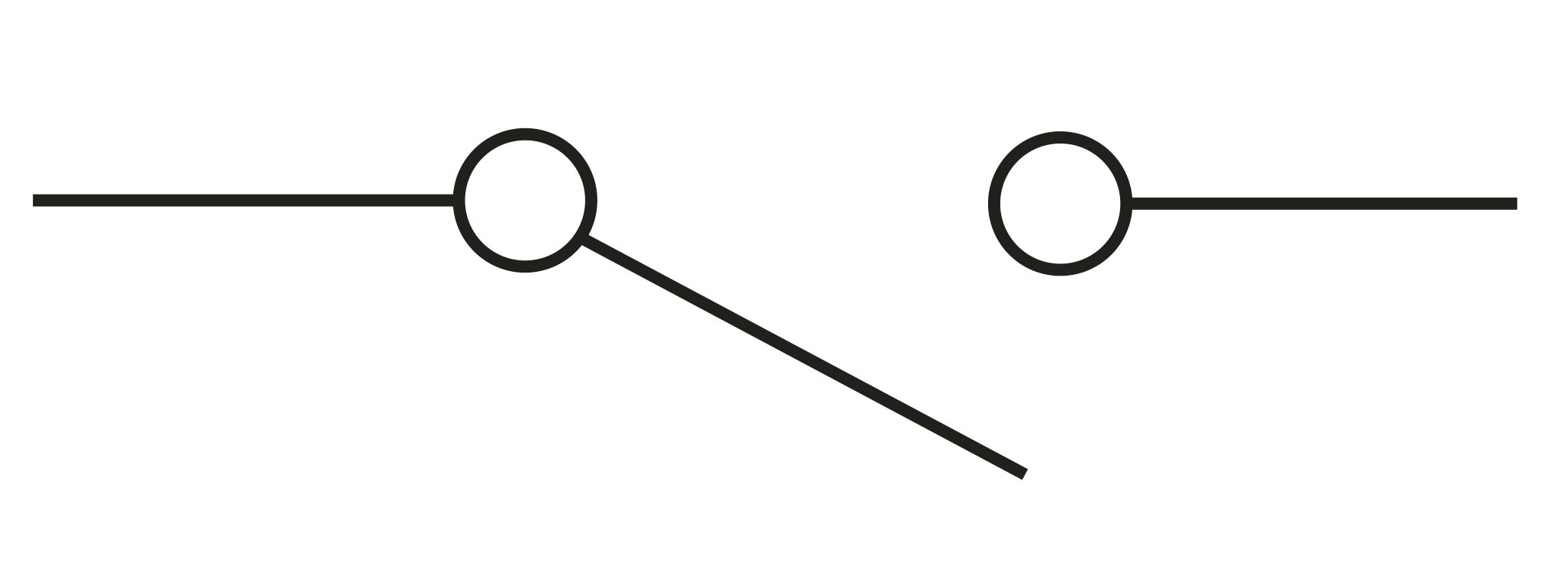
this is the symbol for a _____?
a)
switch
b)
light 
c)
battery
d)
wires
11.
What kind of circuit is this?
a)
Series
b)
Consecutive
c)
Parallel
d)
Training
12.
What is a switch's function in a circuit?
a)
to make the current hotter or colder
b)
turn on and off the flow of current
c)
the pathway that current flows
d)
to add more power to the circuit
13.
What happens when two north poles of a magnet are placed together?
a)
they repel
b)
they attract
c)
they cancel each other out
d)
the strength of the magnet is doubled
14.
A north pole and a south pole will attract.
a)
True
b)
False
15.
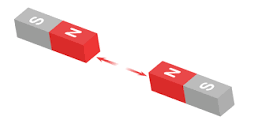
What will happen when these magnets are brought close together?
a)
They will attract each other.
b)
They will repel each other.
c)
Both magnets will turn to the left
d)
Both magnets will turn to the right
16.
The AREA around a magnet where you feel a pulling force.
a)
Gravity
b)
Magnetic Field
c)
Magnetism
17.
Magnets can attract to certain...
a)
Paper
b)
Woods
c)
Metals
18.
The Earth is the Largest Magnet of All.
a)
True
b)
False
19.
Magnets are _____ to objects that contain Iron, Nickel, Cobalt or Steel
a)
Attracted
b)
Repelled
20.
What is Magnetism?
a)
A Tesla car
b)
An Electric Magnet
c)
A Force where objects are attracted to each other or repelled
d)
A magical force
21.
How is an electromagnet different from a permanent magnet?
a)
An electromagnet is smaller and less powerful.
b)
An electromagnet's magnetism can be turned off.
c)
An electromagnet can be built without using metal.
d)
An electromagnet does not attract objects containing iron.
22.
A simple electromagnet can be made with which of the following?
a)
an electric current
b)
a turbine and nail
c)
a nail, a wire, and a battery
d)
a compass and a battery
23.
How can the strength of an electromagnet be increased?
a)
by rubbing it with a stronger magnet
b)
by increasing the coils of wire around the iron
c)
by increasing the length of the wire from the battery
d)
by loosening the coil of wire around the iron
24.
A coil that is magnetized only when an electric current flows through it is_______.
a)
a battery
b)
a generator
c)
a conductor
d)
an electromagnet
25.
How are electromagnets different from magnets?
a)
magnets can be turned on/off
b)
you can turn an electromagnet on/off
c)
magnets are more powerful
d)
magnets have a North and South pole
26.
The further two magnets are apart, the __________________ the force of magnetism.
a)
stronger
b)
weaker
c)
same
27.
True or False: A magnetic field is invisible.
a)
True
b)
False
28.
The transfer of what type of atomic particle is responsible for the static charges on objects?
a)
neutrons
b)
protons
c)
electrons
d)
none of these
29.
What types of charges repel?
a)
Positive and Positive
b)
Positive and Neutral
c)
Negative and Neutral
d)
Neutral and Neutral
30.
If a substance has a higher number of electrons than protons on its surface, what type of charge does it have?
a)
A positive charge.
b)
A negative charge.
c)
A neutral charge
d)
No charge at all
31.
Which part of the atom is positively charged?
a)
Proton
b)
Neutron
c)
Electron
32.
A balloon has a negative charge.  The glass rod has a positive charge.  What will happen when the glass rod is brought near the balloon?
a)
The balloon will be attracted to the rod
b)
The balloon will be repelled by the rod
c)
The balloon will remain in place
d)
The balloon will spin in circles
33.
To demonstrate static electricity, a teacher takes an inflated balloon and rubs it against his hair.  The rubber balloon picks up electrons from his hair, which makes his hair have
a)
a net negative charge
b)
a magnetic force
c)
a net positive charge
34.

The electric field lines for a positive charge is always directed away from the charge. True or False?

a)

True

b)

False

35.
If you wrap more coils around an electromagnet, it will become...(think about the Webquest.)
a)
brighter
b)
stronger
c)
weaker
d)
invisible
36.
What is the flow of electricity?
a)
electric motor
b)
Electric current
c)
Electric eel
d)
electric circuit
37.
What is the PATH for electricity called?
a)
electric current
b)
electric circuit
c)
electric eel
d)
electric motor
38.

The picture above is an example of what?

a)

Magnetic field

b)

Electric field

c)

Repulsion

d)

Attraction

39.

a magnet is magnetic because...

a)

it just is

b)

the electrons are spining around the nucleus of the atom

c)

all the electrons are spinning the same direction around the nucleus

d)

magic

40.
Jack has a rock. The rock has a mass of 14g and a volume of 2cm3. What is the density of the rock?
a)
7 mL
b)
7 g/cm3
c)
28 g/cm3
d)
1/7 g/cm3
41.
What is the volume of Object X?
a)
10.0 cm3
b)
15.0 cm3
c)
20.0 cm3
d)
25.0 cm3
42.
Which lab tool might you use to measure the volume of a liquid?
a)
electric scale
b)
bunsen burner
c)
test tube
d)
graduated cylinder
43.
True or False:  The density of a specific type of material never changes.  
a)
True
b)
False
44.
I have two objects with the same volume but different masses.  Which object will be more dense?
a)
The object with less weight.
b)
The object with more weight.
c)
The object with more mass.
d)
The object with less mass.
45.
What is the formula for density?
a)
density = mass x volume
b)
density = mass / volume
c)
density = mass + volume
d)
density = mass - volume
46.
Frank has an eraser. It has a mass of 4g, and a volume of 2cm3. What is its density?
a)
8 g/cm3
b)
2 g/cm3
c)
1/2 g/cm3
d)
24 g/cm3
47.
Frank has a paper clip. It has a mass of 9g and a volume of 3cm3. What is its density?
a)
3 g/cm3
b)
1/3 g/cm3
c)
27 g/cm3
d)
39 g/cm3
48.
A block has a mass of 54g and a volume of 20cm3.  What is the density of the block?
a)
74 g/cm3
b)
1080 g/cm3
c)
34 g/cm3
d)
2.7 g/cm3
49.
A can of Coke will sink in a bowl of water.  A can of Diet Coke will float in a bowl of water.  What does this tell you about the density of the Diet Coke?
a)
it is bigger than 1
b)
it is smaller than 1
c)
it is equal to 1
d)
it is equal to -1
50.
Why do ice cubes float in a  glass of water?
a)
the ice cubes are more dense than the water
b)
the water is more dense than the ice cubes
c)
the water is more dense than the glass
d)
the ice is more dense than the glass
51.
Veal finds a gold colored rock in a river.  It has a mass of 9.65 grams and a volume of 0.5 cm3.  What is the density of the rock?
a)
10.15 g/cm3
b)
19.3 g/cm3
c)
9.15 g/cm3
d)
4.825 g/cm3
52.
Which property of matter is determined by dividing its mass by its volume?
a)
elasticity
b)
buoyancy
c)
density
d)
viscosity
53.
The following liquids are poured together in a beaker: alcohol (density=0.79), corn syrup (density=1.38), water (density=1.0), and cooking oil (density=0.93).  Which of these liquids will sink to the bottom of the beaker?
a)
alcohol
b)
corn syrup
c)
water
d)
cooking oil
54.
What is the density of water?
a)
0 g/ml
b)
1 g/ml
c)
10 g/ml
d)
100 g/ml
55.
What is volume
a)
How many molecules are in an object
b)
how much space an object takes up
c)
how heavy and object is
d)
how loud the music is
56.
How are regular shaped objects measured?
a)
On a triple beam balance
b)
in grams
c)
LxWxH
d)
cm3/g
57.
How are irregular shaped objects measured
a)
in water with grams changed to cm3
b)
in water with ml changed to cm3
c)
in water then changed to density
d)
they cant be measured
58.
What is mass?
a)
The amount of matter in an object
b)
The amount of space an object takes up
c)
An object's ability to sink or float
d)
An object's weight
59.
What is this object used to measure?
a)
Density
b)
Mass
c)
Volume
d)
Amount
60.
What is the object pictured used to measure?
a)
Weight
b)
Density
c)
Volume
d)
Mass
61.
How long is this nail?
a)
7.0 centimeters
b)
7.3 centimeters
c)
7.3 millimeters
d)
7.3 inches
62.
What is the volume of water inside this graduated cylinder?
a)
10.3 mL
b)
13.0 mL
c)
14.0 mL
d)
15.0 mL
63.
What is the volume of the fish inside the graduated cylinder?
a)
38 mL
b)
6 mL
c)
32 mL
d)
Not enough information to solve
64.
Mass is measured in
a)
grams
b)
liters
c)
meters
d)
g/cm3
65.
What is the volume of water in this graduated cylinder?
a)
47 mL
b)
50 mL
c)
45 mL
d)
45.4 mL
66.
Which box has a higher density?  
a)
Box A
b)
Box B
c)
cannot be determined
d)
they are the same
67.
The name of the liquid measurement line that is read for liquid volume is known as the _____.
a)
bubble
b)
meniscus
c)
water line
d)
none of these
68.
The displacement method is used to:
a)
determine the mass of various objects
b)
determine the weight of various objects
c)
determine the volume of regular solids
d)
determine the volume of irregular solids
69.
Sound travels FASTEST through which of these materials?
a)
Air
b)
Empty space
c)
Metal
d)
Water
70.
Sound is caused by? 
a)
force
b)
vibrations
c)
instruments
71.
What is vibration?
a)
how loud a sound is
b)
the back and forth movement of matter
c)
how high or low a sound is
d)
the loudness or softness of a sound
72.
What is frequency?
a)
the number of vibrations per second
b)
how high or low a sound is
c)
the loudness or softness of a sound
d)
the back and forth movement of matter
73.
Sound is a form of? 
a)
energy
b)
pitch
c)
volume
74.
Measure of how high or low a sound is
a)
amplitude
b)
compression
c)
speed of sound
d)
pitch
75.
To make a sound from a stringed instrument louder you must
a)
hit it
b)
pluck it harder
c)
hold it higher
d)
pluck it softer
76.
The highest pitch is made by the _______ instrument.
a)
biggest
b)
wooden
c)
smallest
d)
shiniest
77.
Why is sound able to travel faster through a solid than a gas?
a)
Gas molecules are packed tightly.
b)
Sound does not travel faster through a solid than a gas.
c)
Solid molecules are packed tightly.
d)
Gas molecules move slowly.
78.
What is volume?
a)
how high or low a sound is
b)
the loudness or softness of a sound
c)
the number of vibrations per second
d)
vibrations
79.
What medium does sound travel through slowest?
a)
gas
b)
solid
c)
liquid
d)
trees
80.
Sound does not travel in space because
a)
Space is too far away.
b)
There is no matter in space.
c)
Space is the final frontier
d)
Space has planets.
81.
What is frequency?
a)
the number of vibrations per second
b)
how high or low a sound is
c)
the loudness or softness of a sound
d)
the back and forth movement of matter
82.
Why is the school library covered with carpet?
a)
So everyone can make a lot of noise
b)
to help absorb sounds to keep it quiet
c)
because it looks good
d)
to help absorb sounds so it can stay noisy
83.
A disturbance that travels through a medium as a longitudinal wave
a)
sound
b)
wavelength
c)
pitch
d)
frequency
84.
The number of wavelengths that pass a point each second
a)
frequency
b)
wavelength
c)
pitch
d)
amplitude
85.
Material (matter) through which a wave travels
a)
medium
b)
Doppler Effect
c)
sound
d)
pitch
86.
How high or low a sound is; depends on the frequency (greater frequency= higher pitch)
a)
pitch
b)
frequency
c)
sound
d)
medium
87.
When the sound source moves, the frequency changes
ex. police car siren sounding lower pitch after the car passes
a)
pitch
b)
frequency
c)
Doppler Effect
d)
medium
88.
A wave in which the vibration is in the same direction as that in which the wave is traveling; sound waves
a)
longitudinal wave
b)
ocean wave
c)
transverse wave
d)
mechanical wave
89.
The part of a longitudinal wave where the particles of the medium are close together.
a)
rarefaction
b)
compression
c)
crest
d)
trough
90.
A part in a longitudinal wave where the particles are spread apart
a)
compression
b)
rarefaction
c)
crest
d)
trough
91.
The number of wavelengths that pass a point each second
a)
crest
b)
amplitude
c)
frequency
d)
pitch
92.
A disturbance that transfers energy from one place to another without transferring energy
a)
wave
b)
trough
c)
pitch
d)
sound
93.
A reflected sound wave
a)
frequency
b)
pitch
c)
echo
d)
rarefaction
94.
Highest point of a wave
a)
crest
b)
trough
c)
wavelength
d)
frequency
95.

How are ocean waves different from sound waves?

a)

Ocean waves are transverse waves, sound waves are longitudinal waves.

b)

Ocean waves are longitudinal waves, sound waves are transverse waves.

c)

Ocean waves are electromagnetic waves, sound waves are mechanical waves.

d)

Ocean waves are mechanical waves, sound waves are electromagnetic waves.

96.

What is compression?

a)

When air molecules move apart from one another.

b)

When air molecules collide with one another.

c)

When air molecules become packed tightly together.

d)

When air molecules move around freely.

97.

What would a wave with a low amplitude sound like?

a)

It would sound quiet.

b)

It would sound loud.

c)

It would sound tinny.

d)

It would sound deep.

98.

Where would sound travel the slowest?

a)

In New York City

b)

In the pine forests of Georgia

c)

At the North Pole

d)

At the equator

99.

What is the relationship between frequency and sound?

a)

Frequency affects a sound's volume.

b)

Frequency affects a sound's amplitude.

c)

Frequency affects a sound's loudness.

d)

Frequency affects a sound's pitch.

100.

Which of these would absorb the most sound?

a)
b)
c)
d)
101.

Where was Ms. Croke born

a)

Colorado

b)

California

c)

Montana

d)

Washington