

wayground logo

Free Printable Worksheets

Font size

S
M
L
XL
Worksheets

Kepler's Laws and Satellite Motion

Total questions: 36

Worksheet time: 20mins
Name
Class
Date
1.
Planets orbit the Sun in a shape called a(n)
a)
circle
b)
ellipse
c)
focus
d)
perihelion
2.
An ellipse is drawn around two points called
a)
aphelion
b)
perihelion
c)
foci
d)
axis
3.
When a planet orbits the Sun, one of the foci of the elliptical orbit is 
a)
the axis
b)
the perihelion
c)
the center
d)
the Sun
4.
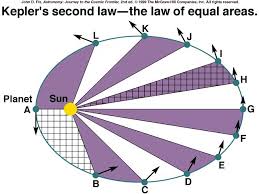
Where is the planet moving faster
a)
Position A to B
b)
Position B to C
c)
Position H to I
d)
Position I to J
5.
What is true about the area between points A, B and the Sun, and the area between points H, I and the Sun?
a)
The area between A, B and the Sun is the largest.
b)
The area between H, I and the Sun is the largest
c)
Both areas are equal in size
d)
There is not enough information to determine the areas
6.
What has an eccentricity of zero
a)
a straight line
b)
a large ellipse
c)
a circle
d)
a small ellipse
7.
Kepler's 2nd Law deals with 
a)
the shape of the planets' orbits
b)
the speed/area the planet travels 
c)
the length of time it takes the planet to orbit the sun
8.
The "Law of Harmonies" is which of Kepler's Laws?
a)
1st
b)
2nd
c)
3rd
d)
4th
9.
A planet moves __________ when it is farthest from the sun.
a)
faster
b)
slower
10.
Kepler's first law states that the orbits of the planets are oval in shape or 
a)
ellipses
b)
perfect circles
11.
The farther away a planet is from the sun, the _______ it takes it to orbit the sun once. 
a)
longer
b)
shorter
12.
The path a planet travels around the sun is called its 
a)
orbit
b)
ellipse
c)
barycenter
d)
precession
13.

Which ellipse has an eccentricity of almost 0?

a)
b)
c)
14.
What did Kepler discover about planets and their orbital speed?
a)
Planets closest to the Sun will orbit with the fastest orbital speed.
b)
Planets with the greatest mass will orbit the Sun with the fastest orbital speed.
c)
Planets furthest from the Sun will orbit with the fastest orbital speed.
d)
Planets with the least mass will orbit the Sun with the fastest orbital speed.
15.
In simplest terms, what does Kepler's 3rd law state? 
a)
planets take a long time to orbit the sun
b)
there is no relationship between the distance of planet from the sun and the time it takes to orbit the sun
c)
there is a mathematical relationship between the distance of a planet from the sun and the time it takes to orbit the sun
d)
every planet has the same orbital period
16.
what doe heliocentric mean? 
a)
Earth centered
b)
Helium centered
c)
Sun centered
d)
Proof of the Big Bang
17.
Any object with mass has gravity.
a)
True
b)
Sometimes
c)
False
d)
Never
18.

Kepler’s first law states that the planets move in circular orbits, with the Sun at the center.

a)

true

b)

false

19.

The square of a planet’s period is directly proportional to the cube of its ____.

a)

a. mass

b)

b. orbital velocity

c)

c. distance from the sun

d)

d. acceleration

20.
Kepler's third law of planetary motion describes a relationship between the
a)
shape of orbit and location of Sun.
b)
orbital velocity and position in orbit
c)
distance from the Sun and length of year.
d)
path of epicycle and position.
21.
Why do astronauts in space appear weightless? 
a)
There is no gravity in space. 
b)
Air resistance opposes gravity. 
c)
They have no mass in space.
d)
They are in free fall. 
22.
What is the acceleration of a satellite that has an altitude =  3 times the Earth’s radius?
a)
3.27 m/s^2
b)
1.09 m/s^2
c)
2.45 m/s^2
d)
0.612 m/s^2
23.
What states that "every object in the universe attracts every other object"?
a)
Law of Universal Gravitation
b)
Newton's First Law of Motion
c)
My mother
d)
Inertia & gravity
24.
Which of the following is Newton's Law on Gravitation?
a)
F=Gm1m2/r
b)
F = Gm1m2/r2
c)
F = Gm1m2/2r
d)
F = m1m2/2r
25.
The moon and other satellites rotate around the earth. Identify the force that keeps these satellites in orbit.
a)
gravity
b)
friction
c)
a strong force
d)
electromagnetic force
26.
Two factors effecting the magnitude of the force of gravity between 2 objects are...
a)
mass and distance 
b)
mass and matter
c)
distance and weight 
d)
weight and mass
27.
Any object with mass is surrounded by a gravitational field.
a)
True
b)
Fallse
c)
False
d)
Tru
28.
The period of a satellite refers to the satellite's  _______.
a)
mass
b)
speed
c)
time of orbit
d)
gps shift
29.
The mass of a satellite influences the velocity at which the satellite orbits  a planetary body.
a)
true
b)
false
30.

What is eccentricity?

a)

how flat an ellipse is

b)

how pointy a square is

c)

how big an ellipse is

d)

how tall a triangle is

31.

A circle's eccentricity is always ___ while an ellipse's eccentricity can be as high as 1.

a)

0

b)

.25

c)

.5

d)

.75

32.

A unit of interplanetary distance that is based on the average distance of Earth from the sun. (1.50 × 10^8 km)

a)

Astronomical Unit (AU)

b)

lightyear (ly)

c)

parsec (pc)

d)

space mile (spm)

33.
Which diagram shows a planet with the least eccentric orbit?
a)
1
b)
2
c)
3
d)
4
34.
During what month is the earth moving the fastest around the sun? 
a)
July
b)
March
c)
January
d)
September
35.

Callisto orbits Jupiter at a distance of 1.883x10^9 m from Jupiter. Jupiter's mass is 1.898x10^27 kg. What is Callisto's orbital velocity?

a)

8200 m/s

b)

8200 km/hr

c)

6.7x10^7 m/s

d)

6.7x10^7 km/hr

36.

Callisto orbits Jupiter at a distance of 1.883x10^9 m from Jupiter. Jupiter's mass is 1.898x10^27 kg. What is Callisto's orbital period?

a)

16.7 days

b)

4008 days

c)

24 days

d)

144.3 days
