wayground logo

Free Printable Worksheets

NEW

Font size

S
M
L
XL
Worksheets

M3 U2 Unit Review

Total questions: 50

Worksheet time: 3hrs 56mins
Name
Class
Date
1.

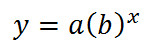
In an exponential function, what does the 'a' represent?

a)

Future Value

b)

Time

c)

Initial Quantity

d)

Growth or Decay Factor

2.

In an exponential function, what does the 'b' represent?

a)

Future Value

b)

Time

c)

Initial Quantity

d)

Growth or Decay Factor

3.

In an exponential function, what does the 'y' represent?

a)

Future Value

b)

Time

c)

Initial Quantity

d)

Growth or Decay Factor

4.

In an exponential function, what does the 'x' represent?

a)

Future Value

b)

Time

c)

Initial Quantity

d)

Growth or Decay Factor

5.
What is a, the starting term, for the function: f(x) = 300(1.16)x?
a)
300
b)
1.16
c)
.16
d)
x
6.

What is b, the growth factor, for the function: f(x) = 300(1.16)x?

a)

300

b)

1.16

c)

.16

d)

x

7.
A population of 2200 beetles is too large to sustain and decreases in population each month at a rate of 5%. How would you write your decay factor, b?
a)
-5
b)
-.05
c)
.95
d)
.05
8.
The value of a car is $15,000 and depreciates at a rate of 8% per year. What is the decay factor?
a)
.08
b)
1.08
c)
.92
d)
8
9.
Which of the following functions shows an initial amount of $15 and an increase of 35% each year?
a)
y = 15(35)x
b)
y = 15(1.35)x
c)
y = 15(0.35)x
d)
y = 35(1.15)x
10.
Classify the model as Exponential GROWTH or DECAY.
A=10(1.01)3
a)
Growth
b)
Decay
11.
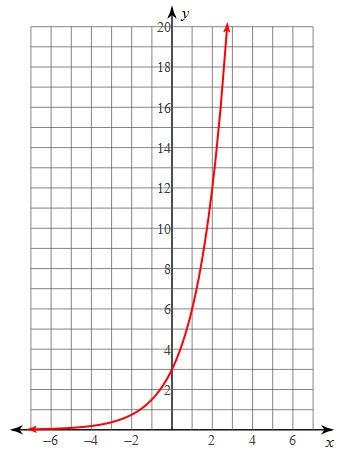
Is the pictured graph growth, decay, or linear or none?  
a)
Exponential Growth
b)
Exponential Decay
c)
Linear
d)
None
12.
What type of function is y = 7(5/4)x?
a)
Exponential Growth
b)
Exponential Decay
c)
Linear
d)
None of the above
13.
Write an equation that models the following situation:
Samantha's hair was known to grow very rapidly. It began at a length of 6 in and grew at a rate of 14% a week.
a)
y=6(0.14)x
b)
y=6(1+14)x
c)
y=6(1.14)x
d)
y=6(0.86)x
14.
Suppose a culture of bacteria begins with 5000 cells and dies by 30% each year. Write an equation that represents this situation.
a)
y=5000(0.7)x
b)
y=30(5000)x
c)
y=5000(1.3)x
d)
y=5000xx
15.

A population is decreasing by 9% each year. How would you determine the decay factor?

a)

(1 + 0.09) = 1.09

b)

(1 - 0.09) = 0.91

c)

(1 + 0.9) = 1.9

d)

(1 - 0.9) = 0.1

16.
Semi-Annually means how many times a year?
a)
b)
2
c)
1
d)
6
17.

Olivia would like to buy some new furniture for her home. She decides to buy the furniture on credit with 9.5% interest compounded quarterly. If she spent $7,400, how much total will she have paid after 8 years.

Equation: A = P (1 + r/n)nt

a)

$15,415.94

b)

$15,683.28

c)

$15,927.56

d)

$16,109.05

18.

Principal: $5000

Interest Rate: 3.75%

Time: 25 years

Compounded Monthly

State the future account balance.

Equation: A = P (1 + r/n)nt

a)

$12712.31

b)

$12,749.30

c)

$12,657.59

d)

$12550.84

19.

What does A represent in the above formula?

a)

The starting amount of money

b)

The end amount of money

c)

The interest rate amount

d)

The amount of time

e)

The number of times money is compounded each year

20.

What does P represent in the above formula?

a)

The starting amount of money

b)

The end amount of money

c)

The interest rate amount

d)

The amount of time

e)

The number of times money is compounded each year

21.

What does r represent in the above formula?

a)

The starting amount of money

b)

The end amount of money

c)

The interest rate amount

d)

The amount of time

e)

The number of times money is compounded each year

22.

What does n represent in the above formula?

a)

The starting amount of money

b)

The end amount of money

c)

The interest rate amount

d)

The amount of time

e)

The number of times money is compounded each year

23.

What does t represent in the above formula?

a)

The starting amount of money

b)

The end amount of money

c)

The interest rate amount

d)

The amount of time

e)

The number of times money is compounded each year

24.
Rewrite 34 = 81 in logarithmic form.
a)
log34 = 81
b)
log813 = 4
c)
log381 = 4
d)
log481 = 3
25.

Change to exponential form.

loga2 = 5

a)

a2 = 5

b)

52 = a

c)

a5 = 2

d)

25 = a

26.

Change to logarithmic form.

3h = w

a)

logw3 = h

b)

log3w = h

c)

logh3 = w

d)

log3h = w

27.
Rewrite log28 = 3 in exponential form.
a)
28 = 3
b)
23 = 8
c)
32 = 8
d)
83 = 2
28.

If $1,000 is invested at 16% interest, compounded continuously, for five years, what is the ending balance?

Equation: A = P ert

a)

$1,225,54

b)

$2,225.54

c)

$22,255.40

d)

$225.54

29.

You desire to have One Million dollars in 25 years. How much money would you need to invest today at 12% interest if it is compounded continuously?

Equation: A = P ert

a)

$40,000

b)

$33,333

c)

$49,787

d)

$100,000

30.
Solve: 7-x = 49
a)
x = 1
b)
x = -1
c)
x = 2
d)
x = -2
31.
Solve: 2x = 4x+1
a)
x = -2
b)
x = 2
c)
x = -3
d)
x = 3
32.

Sovle for x:

5-3x - 1 = 25

a)

x = -1

b)

x = -4

c)

x = -3

d)

x =1

33.
Solve for x.
log770=log7(10x-30)
a)
x=1
b)
x=2
c)
x=10
d)
x=-2
34.
ln(9x-2)=ln(x+14)
a)
x=2
b)
x=.156
c)
x=-3
d)
x=0
35.
log2x=4
a)
x=8
b)
x=16
c)
Does Not Exist
d)
x=.546
36.
et=3
a)
1.237
b)
-2.337
c)
1.099
d)
0.475
37.
a)

x = 2

b)

x = 29

c)

x = 7

d)

x = 32

38.
Solve
a)
5
b)
13
c)
84
d)
-20
39.

Solve 5 ln x = 35

a)

about 1096.63

b)

about 1086.63

c)

about 1096.36

d)

about 1046.11

40.
Log with a base "e" (loge) is the same thing as...
a)
"e"
b)
Natural Logarithm (LN)
c)
Common Logarithm (Log)
d)
Natural Log, base "e"
LNe
41.
log(x+6) = 1
a)
4
b)
4.222
c)
-5
d)
-9.550
42.
What is the y-intercept of the function?
a)
2
b)
3
c)
1
d)
-2
43.

What is the asymptote of the graph?

a)

x=2

b)

y=-2

c)

y=0

d)

y=-1

44.

What is the asymptote?

a)

y=0

b)

x=2

c)

y=1

d)

x=0

45.
Classify the following graph.
a)
Exponential Growth
b)
Exponential Decay
c)
Logarithmic
46.
Where is the asymptote?
a)
x = 1
b)
y = 1
c)
x = -1
d)
y = -1
47.
List the range for the following.
a)
(-∞,∞)
b)
(-1, ∞)
c)
(5,∞)
d)
(1, ∞)
48.
List the domain for the following.
a)
(-2, ∞)
b)
(-∞, ∞)
c)
(- ∞,4)
d)
(1/5, ∞)
49.
What is the domain?
a)
(-∞, ∞)
b)
(0, ∞)
c)
[1, ∞)
d)
(1, ∞)
50.
Match the graph with its equation
a)
y = log4 (x)+2
b)
y = log4 (x + 2) + 1 
c)
y = log4 (x - 1) + 2
d)
y = log4 (-x + 2)