wayground logo

Free Printable Worksheets

Font size

S
M
L
XL
Worksheets

Sound Waves

Total questions: 50

Worksheet time: 33mins

Name
Class
Date
1.
The number of wavelengths that pass a point each second
a)
frequency
b)
wavelength
c)
pitch
d)
amplitude
2.
A wave in which the vibration is in the same direction as that in which the wave is traveling; sound waves
a)
longitudinal wave
b)
ocean wave
c)
transverse wave
d)
mechanical wave
3.
The number of wavelengths that pass a point each second
a)
crest
b)
amplitude
c)
frequency
d)
pitch
4.
A reflected sound wave
a)
frequency
b)
pitch
c)
echo
d)
rarefaction
5.
Highest point of a wave
a)
crest
b)
trough
c)
wavelength
d)
frequency
6.
Sound does not travel in space because
a)
Space is too far away.
b)
There is no matter in space.
c)
Space is the final frontier
d)
Space has planets.
7.
What is vibration?
a)
how loud a sound is
b)
the back and forth movement of matter
c)
how high or low a sound is
d)
the loudness or softness of a sound
8.
Which wave has a greater frequency?
a)
A
b)
B
9.
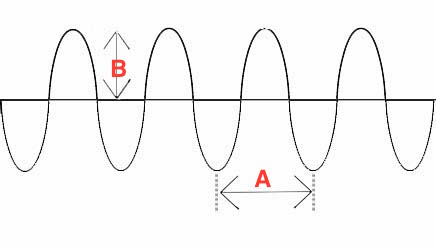
What property of the wave is represented by the letter "B"?
a)
amplitude
b)
crest
c)
trough
d)
wavelength
10.

What is the relationship between frequency and sound?

a)

Frequency affects a sound's volume.

b)

Frequency affects a sound's amplitude.

c)

Frequency affects a sound's loudness.

d)

Frequency affects a sound's pitch.

11.
Which wave is pictured?
a)
Transverse
b)
Longitudinal
c)
Both
d)
Neither
12.

What do waves carry?

a)

Molecules

b)

Energy

c)

Matter

d)

Water

13.

In a transverse wave, how do the particles move?

a)

They don't move

b)

Sideways

c)

Up and down

d)

In a square

14.

The larger the amplitude, the less energy

a)

true

b)

false

15.

All waves can be reflected

a)

true

b)

false

16.
What is the wave's amplitude?
a)
4 cm
b)
5 cm
c)
6 cm
d)
8 cm
17.

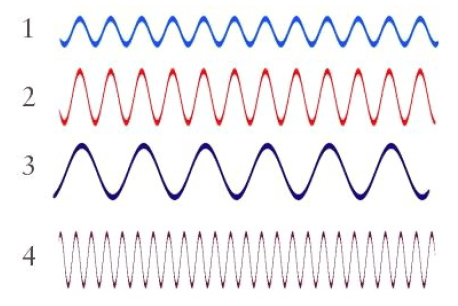
Which wave in the diagram has the highest/greatest frequency?

a)

1

b)

2

c)

3

d)

4

18.
Which box has a higher density?  
a)
Box A
b)
Box B
c)
cannot be determined
d)
they are the same
19.

H02 comes in three different states: ice, water and water vapor. In which state are the particles the densest?

a)

Ice

b)

Water

c)

Water vapor

20.

What's another word for stationary?

a)

Moving

b)

Not moving

21.

Look at this illustration of a wave. Which points on the wave are the trough and the crest?

a)

Point C is a trough; Point Y is a crest.Point W is a trough; Point Y is a crest.

b)

Point D is a trough; Point B is a crest.

c)

Point A is a trough; Point G is a crest.

d)

Point B is a trough; Point D is a crest.

22.

The illustration shows a transverse wave. Which bar measures the wavelength of the wave?

a)

bar 4

b)

bar 3

c)

bar 1

d)

bar 2

23.
Which wave has a greater frequency?
a)
A
b)
B
24.
Amplitude reflects the amount of ____________________ in a wave.
a)
energy
b)
compression
c)
rarefaction
d)
speed
25.
The number of waves produced in one second is known as the 
a)
Wavelength
b)
Amplitude
c)
Frequency
d)
Crest 
26.
Waves are produced by:
a)
Tides
b)
Vibrations
c)
Sound
d)
Molecules
27.

As the wavelength increases, the frequency

a)

decreases

b)

increases

c)

remains the same

d)

decreases, then increases

28.

Waves transfer

a)

matter

b)

particles

c)

water

d)

energy

29.

The lowest point of a transverse wave is called the

a)

trough

b)

crest

c)

compression

d)

rarefaction

30.

As frequency of a wave increases, __________________ also increases.

a)

wavelength

b)

volume

c)

energy

d)

amplitude

31.
Sound is a form of
a)
energy
b)
light waves
c)
objects
d)
movement
32.
The term that describes how often a wave passes a given point.
a)
Hertz
b)
Frequency
c)
Period
d)
decibal
33.
The distance from the crest to crest of a transverrse wave is called
a)
wavelength
b)
wave
c)
diffration
d)
rarefractoin
34.
This wave is formed by the process of vibrating molecules that collide with each other transferring energy
a)
sound waves
b)
refraction
c)
ultraviolet
d)
gamma
35.
What unit measures the frequency of a sound?
a)
Hz
b)
Decibals
c)
m/s
d)
s
36.
________ is the degree of loudness of a sound.
a)
Pitch
b)
Volume
37.

The lowest part of the wave is?

a)

crest

b)

trough

c)

rarefaction

d)

wavelength

38.
________ are rapid back and forth movements that create sound.
a)
Pitches
b)
Vibrations
39.
Sound travels more quickly through a liquid than a gas.
a)
False
b)
True
40.
Why can't we hear sound in space?
a)
can't take our helmet off to hear
b)
Space has no mass / no gas/ solids/ liquids
c)
because it's dark
d)
Don't know, I've never been to space
41.
Sound travels FASTEST through which of these materials?
a)
Air
b)
Empty space
c)
Metal
d)
Water
42.
What is frequency?
a)
the number of vibrations per second
b)
how high or low a sound is
c)
the loudness or softness of a sound
d)
the back and forth movement of matter
43.
Sound is a form of? 
a)
energy
b)
pitch
c)
volume
44.
Measure of how high or low a sound is
a)
amplitude
b)
compression
c)
speed of sound
d)
pitch
45.
A longer string makes a _______ pitch than a short string.
a)
louder
b)
softer
c)
higher
d)
lower
46.

What would a wave with a low amplitude sound like?

a)

It would sound quiet.

b)

It would sound loud.

c)

It would sound tinny.

d)

It would sound deep.

47.

What is the relationship between frequency and sound?

a)

Frequency affects a sound's volume.

b)

Frequency affects a sound's amplitude.

c)

Frequency affects a sound's loudness.

d)

Frequency affects a sound's pitch.

48.
Pitch can be changed by changing how fast the object _____________.
a)
vibrates
b)
changes
c)
velocity
d)
shifts
49.
True or false: You can hear me scream in space.
a)
true
b)
false
50.
Another word for volume is _____.
a)
frequency
b)
pitch
c)
amlplitude