wayground logo

Free Printable Worksheets

Font size

S
M
L
XL
Worksheets

Mid Year Review

Total questions: 197

Worksheet time: 4hrs 1mins

Name
Class
Date
1.

The type of plate boundary where two plates come together is a .....

a)

Convergent Boundary

b)

Divergent Boundary

c)

Transform Boundary

d)

Fault Boundary

2.
Which of the following causes Earth's tectonic plates to move?
a)
Energy from the Sun
b)
Magnetic Pole Reversal
c)
Convection currents in the mantle
d)
Faults in Mountain Ranges
3.

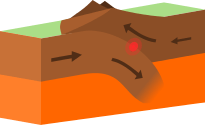
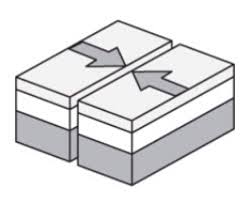
What type of plate boundary is this?

a)

Physical

b)

Divergent

c)

Convergent

d)

Transform

4.
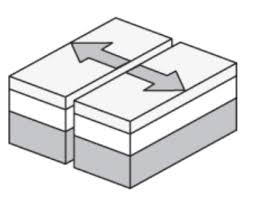
What type of event will occur at this boundary?
a)
Earthquake
b)
Volcano Eruption
c)
Tornado
d)
Mountain Building
5.

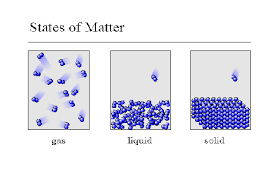
A divergent boundary occurs when plates ....

a)

Pull apart

b)

Come together

c)

Slide past each other

d)

Subduct

6.
Which of the following is NOT evidence to support the theory of plate tectonics?
a)
Fossils
b)
Mountains
c)
Glaciers
d)
Sand Erosion
7.
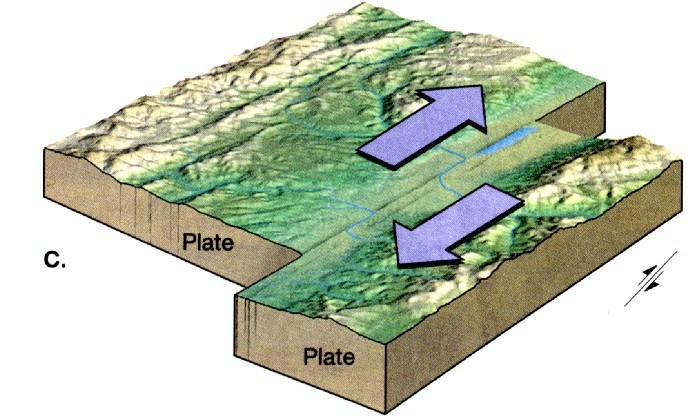
What type of plate boundary is this?
a)
Transform
b)
Convergent
c)
Divergent
d)
Plate
8.

Islands can form from magma which is pushed up at a __________ plate boundary

a)

Divergent

b)

Convergent

c)

Transform

9.
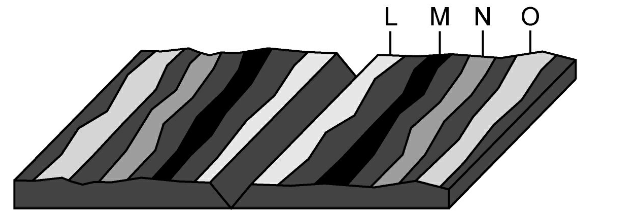
Where would the oldest rock be found?
a)
L
b)
M
c)
N
d)
O
10.
How is it possible for new crust to be formed without increasing the surface area of the Earth?
a)
Crust is destroyed at the same time it is created
b)
New crust is underwater where it sinks
c)
New crust breaks more easily than old crust
11.
Mountains are created when....
a)
Two continental plates collide
b)
Two oceanic plates pull apart
c)
An Oceanic plate subducts under a Continental Plate
d)
Two continental plates pull apart
12.
This layer of Earth is solid Iron and Nickel
a)
Outer Core
b)
Mantle
c)
Inner Core
d)
Crust
13.
The Great Rift Valley in Africa and the Mid-Ocean Ridge were all created by this boundary
a)
Divergent
b)
Convergent
c)
Reform
d)
Transform
14.
This layer of Earth is the thickest part
a)
crust
b)
outer core
c)
mantle
d)
inner core
15.
What are the two types of crust
a)
continental and oceanic
b)
ocean and upper
c)
lower and upper
d)
pizza and subway
16.
Which layer has convection currents?
a)
Inner Core
b)
Outer Core
c)
Mantle
d)
Crust
17.
Earthquakes and volcanoes are most likely found in which locations?
a)
At plate boundaries
b)
in oceans
c)
in the middle of continents
d)
in the middle of plates
18.
The Himalayas in Asia are an example of what type of plate boundary?
a)
divergent
b)
continent-to-continent convergent
c)
ocean-to-continent convergent
d)
transform
19.
Transform boundaries are most likely to produce what phenomenon?
a)
volcanoes
b)
deep sea trenches
c)
underwater mountain ranges
d)
earthquakes
20.
When an oceanic plate and a continental plate collide, which one will subduct?
a)
oceanic
b)
continental
c)
neither
21.
The area where two tectonic plates meet.
a)
mantle
b)
focus
c)
plate boundary
d)
convection
22.
This landform can occur at a divergent plate boundary.
a)
ocean trench
b)
mid-ocean ridge
c)
tall mountains
d)
transform fault
23.
A continental rift valley can be formed from stretching continental crust at...
a)
transform plate boundaries
b)
convergent plate boundaries
c)
divergent plate boundaries
d)
all plate boundaries
24.
A mid-ocean ridge occurs at a ________ plate boundary.
a)
transform
b)
convergent
c)
divergent
25.
What type of boundary is the SAN ANDREAS FAULT on?
a)
Covergent
b)
Transformers
c)
Divergent
d)
Transform
26.
What is the name of the plate boundary that slides past each other?
a)
Divergent
b)
Convergent
c)
Transform
d)
Mr. C the Slide Man
27.
The mantle of Earth is made partly of magma. When magma rises and sinks, this is called ______________. 
a)
a conduction current
b)
a hot spot
c)
a volcanic eruption
d)
a convection current
28.
As you travel from the inner core to the crust, how would temperature, pressure and density of the material change?
a)
They would all increase
b)
They would all decrease.
c)
They would stay the same.  
d)
Temperature would decrease, but pressure and density would increase. 
29.
What would happen to the convection currents if the heat from the inner core disappeared? 
a)
They would stop. 
b)
They would change directions. 
c)
It would not change. 
d)
They would speed up. 
30.
Where does the heat come from that drives this convection current in the mantle? 
a)
The sun
b)
The crust
c)
the mantle
d)
the core
31.
Mountains form from ...
a)
plates sliding past one another
b)
collision of plates
c)
plates moving away from each other
32.
The area around the pacific plate where boundaries form is called...
a)
death ring
b)
fire zone
c)
ring of fire
d)
zone of fire
33.
Which is true about hotter material in the mantle?
a)
more dense, sinks
b)
less dense, sinks
c)
less dense, rises
d)
more dense, rises
34.
During sea floor spreading, molten material rises up from the mantle...
a)
along the continents
b)
at the mid ocean ridges
c)
deep ocean trenches
d)
at north and south poles
35.
Which of the following is where one plate slides under another plate?
a)
submarine zone
b)
divergence zone
c)
subduction zone
d)
lower zone
36.
Associated with transform boundaries.
a)
Volcanoes
b)
mountains
c)
trenches
d)
earthquakes
37.
Name the boundary
a)
convergent boundary
b)
divergent boundary
c)
transform boundary
d)
sergent boundary
38.
Name the boundary
a)
convergent boundary
b)
divergent boundary
c)
transform boundary
d)
sergent boundary
39.
Which ocean is expanding due to a mid-ocean ridge (divergent boundary)?
a)
Indian
b)
Dead Sea
c)
Atlantic
d)
Artic
40.
Which layer of the Earth is liquid iron?
a)
Crust
b)
Mantle
c)
Outer Core
d)
Inner Core
41.
200-300 million years ago, the continents were joined in a single land mass called...
a)
Pan America
b)
Pangaea
c)
Pan Acean
d)
'Murica
42.
Who is known as the "Father of Continental Drift"?
a)
Harry Hess
b)
Abraham Ortelius
c)
Alfred Wegner
d)
John Tuzo Wilson
43.
What are the deepest places on Earth formed by pushing oceanic crust under continental crust?
a)
mid-ocean ridges
b)
rift valleys
c)
trenches
d)
mountain ranges
44.
This theory states that Earth's  plates move on top of the mantle at a slow and constant rate due to convection currents
a)
plate tectonics
b)
continental drift
c)
seafloor spreading
d)
pangaea
45.
Most geologists rejected Alfred Wegener's idea of continental drift because...
a)
it did not agree with their current theory
b)
Wegener was interested in what Earth was like millions of years ago
c)
Wegener used several different types of evidence to support his hypothesis
d)
Wegener could not identify the force that moved the continents
46.
According to Wegener's hypothesis of continental drift, 
a)
Earth's surface is made up of seven major landmasses
b)
the continents DO NOT move
c)
Earth is slowly cooling and shrinking
d)
the continents were once joined together in a single landmass
47.
What were magnetic stripes on the ocean floor used to show?
a)
the seafloor was spreading outward from the mid-Atlantic ridge
b)
the seafloor was spreading inward toward the mid-Atlantic ridge
c)
the seafloor was effectively stationary
d)
natural magnetic rocks always form in the mantle of the Earth
48.
The youngest rocks on the seafloor are most likely found...
a)
closest to a mid-ocean ridge
b)
farthest from a mid-ocean ridge
c)
near the coastlines
d)
closest to a deep sea trench
49.
At higher temperatures
a)
particles in an object have less energy
b)
particles in an object move faster
c)
a gas contracts
50.
As molecules gain energy, they move _____ and spread apart, and vise versa.
a)
faster
b)
slower
c)
less
d)
inside
51.
Alex noticed that a metal door that sticks on hot days does not stick when it cools off at night. This is because the metal contracts as it cools. The reason for this is that, as the metal cools, the atoms:
a)
become smaller and take up less space
b)
 slow down and move closer together
c)
merge together to form fewer atoms
d)
speed up and move farther apart
52.
The liquid in the thermometer rises when it is placed in the hot water because ___________. 
a)
it gains heat from the hot water and expands.
b)
loses heat from the hot water and contracts. 
c)
the surrounding air is too warm. 
d)
the liquid is boiling. 
53.
Which box has a higher density?  
a)
Box A
b)
Box B
c)
cannot be determined
d)
they are the same
54.
In general what is the most dense form of matter?
a)
solid
b)
liquid
c)
gas
d)
plasmas
55.
Which state of matter has tightly packed molecules?
a)
solid
b)
liquid
c)
gas
56.
Thermal energy ALWAYS moves from _____ to _____.
a)
solid to liquid
b)
ice to water
c)
hot to cold
d)
solid to gas
57.
Heat moves by ______ when it travels through waves.
a)
radiation
b)
conduction
c)
insulator
d)
convection
58.
Heat moves by ______ when it travels from one solid to another solid.
a)
radiation
b)
convection
c)
thermal energy
d)
conduction
59.
If an object has particles that are moving very quickly, the object 's temperature is probably _____.
a)
cold
b)
slow
c)
big
d)
hot
60.
If an object has particles that are moving very slowly, the object's temperature is probably ______.
a)
hot
b)
small
c)
cold
d)
big
61.
To measure the temperature difference between two cups of water, you would use a _____.
a)
measuring cup
b)
ruler
c)
thermometer
d)
balance scale
62.
Glass, steel, and aluminum are good examples of ______.
a)
insulators
b)
thermal energy
c)
conductors
d)
radiation
63.
Plastic foam, wood, and rubber are good examples of ______.
a)
conductors
b)
insulators
c)
solar energy
d)
convection
64.
The heat from a hot burner to a pot is transferred by ______.
a)
convection
b)
insulation
c)
radiation
d)
conduction
65.
A metal spoon placed in a bowl of hot soup is heated by _____.
a)
radiation
b)
conduction
c)
friction
d)
convection
66.
When holding a cup of ice water, your warm hand becomes cold. How does the heat transfer?
a)
From the cold cup to your hand
b)
From the cold cup to the warm air
c)
From the ice to your hand
d)
From your warm hand to the cold cup.
67.
How are heat from the sun and heat from a campfire alike?
a)
They move by radiation.
b)
They move by convection.
c)
They move by conduction.
d)
They are solar energy.
68.
Which gas in our atmosphere is most abundant?
a)
Argon
b)
Oxygen
c)
Nitrogen
d)
Carbon Dioxide
69.
The air in the troposphere has a greater density than the air in any other layer of the atmosphere,
a)
True
b)
False
70.
Temperature decreases as altitude increases in the Thermosphere.
a)
True
b)
False
71.
Temperature in the stratosphere warms as altitude increases.
a)
True
b)
False
72.
Which layer of the atmosphere contains the greatest amount of water vapor?
a)
Thermosphere
b)
Troposphere
c)
Mesosphere
d)
Stratosphere
73.
In which layer of the atmosphere does weather occur?
a)
Mesosphere
b)
Thermosphere
c)
Stratosphere
d)
Troposphere
74.
What causes the temperature to increase in the stratosphere?
a)
Nitrogen
b)
Ozone
c)
Water Vapor
d)
carbon dioxide
75.
What decreases as you go up in the atmosphere?
a)
Altitude
b)
Atmosphere
c)
Meteors
d)
Air Pressure
76.
Where is the temperature the highest?
a)
1
b)
2
c)
3
d)
4
77.
Where is the air pressure the greatest?
a)
1
b)
2
c)
3
d)
4
78.
Where is the altitude the greatest?
a)
1
b)
2
c)
3
d)
4
79.
The layers of the atmosphere are classified according to changes in _________.
a)
altitude
b)
density
c)
composition
d)
temperature
80.
James plans to climb to the top of Mount Everest.  Which of the following statements about his climb will be the most accurate?
a)
Air pressure will rise and the temperature on a thermometer will increase.
b)
Air pressure will fall and the temperature on a thermometer will decrease.
c)
Air pressure will rise and the temperature on a thermometer will decrease.
d)
Air pressure and thermometer will not change.
81.
Which of the following is NOT a reason why the atmosphere is important?
a)
It is made of many layers.
b)
It provides gases living things need.
c)
It provides warm temperatures.
d)
It protects us from UV rays and meteors.
82.
Which of the following is the correct order of the atmosphere layers from Earth to space?
a)
troposphere, stratosphere, mesosphere, thermosphere, exosphere
b)
troposphere, mesosphere, thermosphere, exosphere, stratosphere
c)
thermosphere, stratosphere, mesosphere, troposphere, exosphere
d)
troposphere, stratosphere, mesosphere, exosphere, thermosphere
83.
As you go higher in the troposphere, the temperature _______________.
a)
decreases
b)
increases
c)
stays the same
d)
gets very hot
84.
What is the function of the ozone layer?
a)
to allow UV rays to get to Earth
b)
to block UV rays from getting to Earth
c)
To keep oxygen in
d)
to allow meteors to get to Earth
85.
Where I find clouds.
a)
thermosphere
b)
stratosphere
c)
troposphere
d)
ionosphere
86.
Which layer is the outermost layer?
a)
troposphere
b)
thermosphere
c)
exosphere
d)
mesosphere
87.
The higher you go, the air becomes _____ _____.
a)
More dense
b)
Less dense 
88.
This is the layer where meteors, or shooting stars, burn up.
a)
Troposphere
b)
Stratosphere
c)
Mesosphere
d)
Thermosphere
89.
What happens to the density (thickness)/air pressure of the air as you increase in altitude?
a)
density increases
b)
density decreases
c)
density stays the same
d)
density disappears
90.
Which layer of the atmosphere do most satellites orbit the Earth?
a)
Stratosphere
b)
Mesosphere
c)
Exosphere
d)
Ionosphere
91.
Which layer of the atmosphere contains the ozone layer? 
a)
Mesosphere
b)
Stratosphere
c)
Ionosphere
d)
Exosphere
92.
A mixture of gases and particles that surround a planet, held by gravity is called the-
a)
greenhouse effect
b)
atmosphere
c)
jet stream
d)
blanket
93.
What is the measure of the force with which air molecules push on a surface?
a)
Air pressure
b)
Barometer
c)
Atmosphers
d)
Thermosphere
94.
Why is it harder to breathe in high altitude?
a)
The concentration of gases is lower
b)
The concentration of gases is higher
c)
it is colder
d)
it is warmer
95.
Which layer of the atmosphere do we live in?
a)
Troposphere
b)
Mesosphere
c)
Decosphere
d)
Stratosphere
96.
What tool is used to measure air pressure?
a)
Barometer
b)
Thermometer
c)
Altimeter
d)
Sphygmomanometer
97.
What is the definition of weather?
a)
tiny solid and liquid particles of dust, smoke, salt and chemicals
b)
condition of the Earth's atmosphere at a particular time
c)
the envelope of gases that surrounds the planet
d)
water in the form of gas
98.
What is the atmosphere?
a)
the envelope of gases that surrounds the plane
b)
the amount of mass in a given volume of air
c)
the result of the weight of a column of air pushing on an area.
d)
the distance above sea level
99.
What is water vapor?
a)
the amount of mass in a given volume of air
b)
tiny solid and liquid particles of dust, smoke, salt and chemicals
c)
condition of the Earth's atmosphere at a particular time
d)
water in the form of gas
100.
What is the definition of density?
a)
the distance above sea level
b)
the amount of mass in a given volume of air
c)
the envelope of gases that surrounds the planet
d)
condition of the Earth's atmosphere at a particular time
101.
What is the definition of altitude?
a)
the middle layer of the atmosphere
b)
the inner of lowest level of the Earth's atmosphere
c)
the result of the weight of a column of air pushing on an area
d)
the distance above sea level
102.
Where the warm and cold air meet and stall, clouds and fog form, and it may rain or snow.  It could bring many days of clouds and precipitation.  
a)
Warm Front
b)
Cold Front
c)
Occluded Front 
d)
Stationary Front 
103.
This is the symbol for a... 
a)
Cold Front
b)
Warm Front
c)
Stationary Front
d)
Occluded Front 
104.
This is the symbol for a... 
a)
Occluded Front
b)
Stationary Front
c)
Warm Front
d)
Cold Front 
105.
This is the symbol for a... 
a)
Stationary Front
b)
Occluded Front
c)
Cold Front
d)
Warm Front
106.
Identify the type of front that is shown in the image.
a)
Occluded Front
b)
Cold Front
c)
Stationary Front
d)
Warm Front
107.
This is the symbol for a... 
a)
Stationary Front
b)
Occluded Front
c)
Cold Front
d)
Warm Front 
108.
Identify the type of front that is shown in the image.
a)
Occluded Front
b)
Cold Front
c)
Stationary Front
d)
Warm Front
109.
Identify the type of front that is shown in the image.
a)
Occluded Front
b)
Cold Front
c)
Stationary Front
d)
Warm Front
110.
Identify the type of front that is shown in the image.
a)
Occluded Front 
b)
Cold Front
c)
Stationary Front
d)
Warm Front
111.
A severe storm that involves strong winds and forms over warm water is:
a)
tornado
b)
thunderstorm
c)
hurricane
d)
blizzard
112.
A severe storm which involves a funnel cloud forming from a cumulonimbus cloud:
a)
hurricane
b)
tornado
c)
thunderstorm
d)
blizzard
113.
Humidity is the...
a)
Amount of Water Vapor in the Air
b)
Amount of Wind in the Air
c)
Amount of Precipitation in the Air
d)
Amount of Pressure in the Air
114.
________________ are made of water vapor that condenses in the troposphere.
a)
dew
b)
clouds
c)
evaporation
d)
transpiration
115.
Warm air near the Earth’s surface rises and then cools and drops, this creates a _________________ in the atmosphere.
a)
run-off
b)
Greenhouse Effect
c)
convection current
d)
water cylce
116.
Because the earth is spinning on its axis, the global winds appear to curve. This is known as the __________ ________.
a)
Coriolis Effect
b)
Greenhouse Effect
c)
Climate Effect
d)
Atmosphere Effect
117.
What kind of weather is usually associated with a low pressure system?
a)
Sunny weather
b)
Precipitation (rain, snow, etc.)
118.
What kind of weather is usually associated with a high pressure system?
a)
Sunny weather
b)
Precipitation (rain, snow, etc.)
119.
In what direction do winds always blow?
a)
From areas of high pressure to areas of low pressure
b)
From areas of low pressure to areas of high pressure
120.
What type of cloud looks like cotton and is in the lower altitudes?
a)
Cumulus
b)
Stratus
c)
Cirrus
121.
Hot air (RISES / FALLS) __________.
a)
RISES
b)
FALLS
122.
Cold air (RISES/ FALLS)  _________.
a)
RISES
b)
FALLS
123.
When a warm air mass gently slides on top of a cold air mass, and you have drizzly rain and then warmer weather, what type of front is it?
a)
warm front
b)
cold front
c)
occluded front
d)
stationary front
124.
What is climate?
a)
 What's going on with the atmosphere at any particular time
b)
The type of weather that occurs during a particular season
c)
An area's pattern of weather over a long period of time
d)
How much sunshine an area gets 
125.
Which term best describes how the earth's atmosphere is heated?
a)
Spirally
b)
Unevenly
c)
Circularly
d)
Kinetically
126.
What causes wind to blow?
a)
Differences in longitude 
b)
Shock waves from clouds 
c)
Differences in air temperature and pressure 
d)
The rotation of the earth
127.
What creates the air pressure difference between the equator and the poles?
a)
The length of the seasons
b)
The shape of the earth 
c)
the duration of the solar year
d)
The amount of direct sunlight each area receives 
128.
When heat rises cools then sinks 
a)
high pressure 
b)
convection current 
c)
low pressure 
d)
stratospheric pressure  
129.
Where does the initial source of energy come from that creates winds?
a)
the moon
b)
the sun
c)
the Earth's surface
d)
the rotation of the Earth
130.
How do differences in air pressure affect the movement of air?
a)
Air always moves from areas of high pressure to areas of low pressure.
b)
Air always moves from areas of low altitudes to high altitudes.
c)
Air always moves from areas of low pressure to areas of high pressure.
d)
Air always moves from east to west.
131.
Which diagram shows the formation of a land breeze?
a)
diagram Y
b)
diagram X
c)
neither 
d)
both
132.
Land and water absorb and release the sun’s heat in different ways. One result of this is a sea breeze. Which statement is true of sea breezes?
a)
They originate in the day and blow toward the land.
b)
They originate in the day and blow toward the water.
c)
They originate in the evening and blow toward the land.
d)
They originate in the evening and blow toward the water.
133.
What is water doing when it is changed to water vapor?
a)
evaporating
b)
condensing
c)
precipitating
d)
runoff
134.
At position A, which hemisphere would have summer?
a)
Northern hemisphere
b)
Southern hemisphere
135.
What happens when the area in which you live tilts away from the sun?
a)
It is summer.
b)
It is spring.
c)
It is winter.
d)
It is fall.
136.
The term equinox means....
a)
equal amount of day light and equal amount of night
b)
Equal amount of winter and summer
c)
Equal amounts of hot dogs for everyone
d)
The longest day of the year
137.
What do June 21 and December 21 have in common?
a)
equinox dates
b)
the moon is full
c)
solstice dates
d)
the cold fronts blow in
138.
What is the longest day of the year?
a)
winter solstice
b)
summer solstice
c)
fall equinox
d)
spring equinox
139.
Why is the Equator warmest?
a)
Because it is closest to the sun.
b)
Because it receives the most direct sunlight
c)
Because no clouds form here.
d)
Because it is far from the sun
140.
Which season is taking place in the Northern Hemisphere in Position 1?
a)
Winter
b)
Spring
c)
Summer
d)
Fall
141.
Which season is taking place in the Northern Hemisphere in Position 2?
a)
Winter
b)
Spring
c)
Summer
d)
Fall
142.
Which season is taking place in the Northern Hemisphere in Position 3?
a)
Winter
b)
Spring
c)
Summer
d)
Fall
143.
Which season is taking place in the Northern Hemisphere in Position 4?
a)
Winter
b)
Spring
c)
Summer
d)
Fall
144.
What are the reasons for the season?
a)
Earth's tilt & rotation
b)
Earth's tilt & revolution
c)
Earth's rotation & rovolution
d)
Earth's tilt & resolution
145.
The hemisphere where you live 
a)
equator
b)
southern
c)
northern
d)
eastern
146.
What causes there to be longer number of hours of light during the summer
a)
Earth tilt's away from the sun in summer
b)
Earth's revolves slower in summer
c)
Earth tilts toward the sun in summer
d)
Earth is closer to the sun
147.
Why is it warmer in the summer?
a)
Closer to the sun
b)
More direct light from Earth's tilt
c)
Stronger light from the sun
d)
Earth spins slower
148.
Warm ocean currents generally come from
a)
The North Pole
b)
The South Pole
c)
The Equator
d)
Both A and B
149.
Cold ocean currents generally come from
a)
The North Pole 
b)
The South Pole
c)
The Equator
d)
Both A and B
150.
The climate in cities that are close to a large body of water tends to be:
a)
Cooler in the summer and warmer in the winter than inland cities
b)
Cooler in the winter and warmer in the summer than inland cities
c)
Cooler in the winter and the summer than inland cities
d)
Warmer in the winter and the summer than inland cities
151.
 The more inland (away from the ocean and coast) climates are subject to more extreme or _______ temperatures.
a)
mild
b)
harsh
152.
Coastal climates, which are insulated by nearby water are generally _______.
a)
mild
b)
harsh
153.
Which best describes why cities near oceans are often warmer in the winter than cities far from the ocean at the same latitude?
a)
Oceans cool more slowly than land.
b)
Ocean waves move more quickly in the winter.
c)
The moon heats the air over the ocean.
154.
Ocean water and currents affect ______ because it takes far more energy to change the temperature of water than land or air, water warms up and cools off much more slowly than either.
a)
climate
b)
mountains
c)
plate tectonics
d)
land
155.
Which best explains why the air moves in the direction shown in the diagram?
Hint: Decide if this is a land breeze or a sea breeze.
a)
The ocean warms more rapidly than the land.
b)
Air over the ocean is warmer than the air over the land.
c)
The land is warmer than the ocean water.
156.
Which of the following have been linked to climate change?  
a)
droughts
b)
flooding
c)
melting of polar ice caps
d)
all of the above
157.
Visible light reaches Earth’s surface while infrared light is trapped as heat. Which characteristic of Earth’s atmosphere causes this to happen?
a)
the hole in the ozone
b)
the greenhouse effect
c)
atmospheric pressure
d)
the inversion layer
158.
The average temperature of the surface of Earth has increased approximately 1°C in the past century. Which reason best explains this increase in temperature?
a)
lower levels of ozone in the atmosphere
b)
lower levels of nitrogen in the atmosphere
c)
higher levels of carbon dioxide in the atmosphere
d)
higher levels of oxygen in the atmosphere
159.
Which is a primary energy source used by power plants to generate electricity?
a)
coal
b)
wood
c)
gasoline
d)
batteries
160.
Which of the following is the best conclusion that can be made from this graph?
a)
atmospheric carbon dioxide levels have been decreasing since 1960
b)
Hawaii has a lot of carbon dioxide
c)
humans have been working hard to decrease carbon dioxide levels
d)
atmospheric carbon dioxide levels have increased steadily since 1960
161.
Some greenhouse gases are naturally present in the Earth's atmosphere
a)
True
b)
False
162.
Melting of glaciers and polar ice caps....
a)
will result in cooler temperatures in the Arctic
b)
will result in sea-levels rising
c)
Will have no effect on ecosystems
d)
None of the above
163.
What is the definition of weather?
a)
a period of abnormally dry weather that lasts at least 2 years
b)
the specific condition of the atmosphere at a particular place and time
c)
a complex community of organisms and the community's environment
d)
a release of toxic gas
164.
What is the average weather for a particular time and region called?
a)
drought
b)
weather
c)
emissions
d)
climate
165.
The warming of the atmosphere by the trapping of heat being radiated to space is called
a)
evaporation
b)
condensation
c)
the greenhouse effect
d)
radiation
166.
The second layer of the atmosphere up from Earth, where the ozone layer is that protects us from harmful UV rays, is the
a)
thermosphere
b)
stratosphere
c)
troposphere
d)
mesosphere
167.
Global warming refers specifically to an increase in 
a)
the number of storms on Earth.
b)
precipitation from Earth’s atmosphere.
c)
temperatures everywhere on Earth.
d)
Earth’s average surface temperature.
168.
What is the biggest danger posed by global warming to people living in coastal areas?
a)
increased precipitation
b)
increased acidity of sea water
c)
lack of carbon dioxide in the atmosphere
d)
rising sea level
169.
How can the planting of new trees help reduce climate change?
a)
Trees help create breezes.
b)
Trees release moisture that cools the atmosphere.
c)
Trees take in carbon dioxide from the atmosphere during photosynthesis.
d)
Trees block the release of greenhouse gases from soil.
170.
Gases such as water vapor and carbon dioxide that trap heat near Earth are known as 
a)
global gases.
b)
greenhouse gases.
c)
proxy gases.
d)
offset gases.
171.
Which human activity contributes the most carbon dioxide to the atmosphere?
a)
fishing
b)
breathing
c)
burning fossil fuels
d)
farming
172.
The concentration of carbon dioxide in the atmosphere is decreasing. 
a)
True
b)
False
173.
The ____________________ is a natural process in which certain gases in the atmosphere trap heat near Earth and prevent it from radiating back into space.
a)
Greenhouse Zone
b)
Greenhouse Effect
c)
Tropic Layer
d)
Heat Zone
174.
What is the difference between climate and weather?
a)
 Climate averages the weather conditions in a specific place over a long period of time, while weather describes the state of the atmosphere at a specific moment in time.
b)
Weather averages the weather conditions in a specific place over a long period of time, while Climate describes the state of the atmosphere at a specific moment in time.
c)
Climate describes the weather conditions at night, while weather describes the conditions during the daytime.
d)
There is not a difference between climate and weather.
175.
What is a consequence that increasing human population could have on the Earth's climate?
a)
decreasing global temperatures due to decreased fossil fuel use
b)
increased global temperatures due to increased use of fossil fuels
c)
a decreased heat island effect, due to less people living and working in urban areas
d)
all of these
176.
The annual fluctuation in carbon dioxide concentration can best be explained by the
a)
use of fossil fuels
b)
volcanic activity
c)
deforestation 
d)
seasonal photosynthesis
177.

What is an effect of global warming?

a)

melting glaciers and rising sea levels

b)

population is increasing

c)

fewer forest areas

d)

all of the above

178.
Any amount of CO2 (Carbon Dioxide) in the atmosphere is bad for our planet.
a)
True
b)
False
179.
Increasing quantities of CO2 (Carbon Dioxide) in the atmosphere will cause air temperatures to be _____. 
a)
warmer
b)
cooler
180.
Which of the following is NOT evidence of global warming?
a)
Sea level rising
b)
Loss of Arctic Sea Ice
c)
Less Water Vapor in the Air
d)
More extreme weather events
181.
Which of the following is NOT a greenhouse gas?
a)
Carbon dioxide CO2
b)
Methane CH4
c)
Water vapor
d)
Nitrogen N2
182.

How do scientists collect evidence about climate?

a)

Using remote sensing from space with satellites

b)

By ground-based measurements of surface temperature, carbon dioxide concentration and sea level

c)

By collecting "proxy data" from tree rings, ice cores and historical records

d)

All of the above

183.

When did climate change (CO2 in the atmosphere) increase significantly?

a)

1800s Industrial Revolution

b)

1600s Industrial Revolution

c)

1800 Crusades

d)

1600 Crusades

184.

In the 1800's why did CO2 levels increase significantly?

a)

New factories were being built that caused more pollution

b)

The civil war caused more pollution

c)

Scientists figured out how to clean up pollution in the air

d)

It did not increase

185.

What is the definition of renewable energy sources?

a)

sources of energy that will never go away or be used up

b)

Sources of energy that can go away and be used up

c)

Wind, Solar, Hydro, Geothermal

d)

Coal, Oil, Gas

186.
Gravity attracts all objects towards one another.
a)
False
b)
True
c)
It depends
187.
Any object with mass has gravity.
a)
True
b)
Sometimes
c)
False
d)
Never
188.
A person would weigh less on on the Moon than on the Earth because . . .
a)
Moon has more mass, and therefore more gravity
b)
Moon has less mass, and therefore more gravity
c)
Moon has more mass, and therefore less gravity
d)
Moon has less mass and therefore less gravity
189.
Two factors effecting the magnitude of the force of gravity between 2 objects are...
a)
mass and distance 
b)
mass and matter
c)
distance and weight 
d)
weight and mass
190.
If Earth's mass was cut in half, what would happen to your weight?
a)
Increase because gravitational force increases
b)
decrease because gravitational force decreases
c)
decrease because gravitational force increases
d)
nothing, weight is not affected by gravitational force
191.
If Earth's mass was cut in half, what would happen to your mass?
a)
increase because gravitational force increases
b)
decrease because gravitational force decreases
c)
decrease because gravitational force increases
d)
nothing, mass is not affected by gravitational force
192.
A[n] ______________ tide occurs when the sun is at right angles to the line between Earth and the moon. 
a)
high
b)
neap
c)
low
d)
spring
193.
Differences in the moon's and sun's pull on different sides of the Earth cause _________.
a)
gravity
b)
lunar phases
c)
tides
d)
dabbing
194.
A[n] ___________ tide occurs when the sun, Earth, and the moon are nearly in a line. 
a)
spring
b)
high
c)
low
d)
neap
195.
The bulge of water on the side of the Earth closest to the moon produces ___________.
a)
high tide
b)
low tide
c)
neap tide
d)
spring tide
196.
A neap tide is a tide with the greatest difference between low and high tides
a)
true
b)
false
197.
Which body has the greater effect on Earth's tides?
a)
Sun
b)
Saturn
c)
Moon 
d)
Venus