wayground logo

Free Printable Worksheets

NEW

Font size

S
M
L
XL
Worksheets

AP Biology Genetics & Protein Synthesis

Total questions: 50

Worksheet time: 47mins

Name
Class
Date
1.
Suppose that in sheep, a dominant allele (B) produce black hair and a recessive allele (b) produce white hair. If you saw a black sheep, you would be able to identify
a)
its phenotype for hair color
b)
its genotype for hair color
c)
the genotype of only one of its parents
d)
the phenotype of both of its parents
2.
One of the main reasons genes assort independent of one another  is that 
a)
they produce unrelated traits
b)
they produce related traits
c)
they are on the same chromosome
d)
they are on different chromosomes.
3.

A child has type O blood, if mother has type A blood, what would the father's blood type be?

a)

A,B, or O

b)

AB or A

c)

AB or B

d)

O only

4.
In mice, the homozygous mice are black and white. The heterozygous mice are gray. What pattern of inheritance is expressed in fur color in mice?
a)
complete dominance and recessiveness
b)
co-dominance
c)
incomplete dominance
d)
pleiotropy
5.
In humans, if a non-disjunction event leads to an individual that is XXY, they would
a)
be female because they have 2 X chromosomes
b)
be male because they have a Y chromosome
c)
not survive
d)
have both male and female characteristics
6.
If a female was a carrier for sex-linked color blindness, what percentage of her male children would also be color blind?
a)
0%
b)
25%
c)
50%
d)
100%
7.
Chromosomes that do NOT play a role in determining the sex of an individual are called
a)
sex chromosoems
b)
X and Y
c)
autosomes
d)
A and B are correct
8.
In a sex-linked inheritance pedigree you would expect to see
a)
more affected females
b)
all carrier males
c)
more affected males
d)
an equal number of affected males and females
9.
Red x white = pink
a)
codominance
b)
multiple alleles
c)
incomplete dominance
d)
epistasis
10.

When crossing a homozygous recessive with a heterozygote, what is the chance of getting an offspring with the homozygous recessive phenotype?

a)

0%

b)

25%

c)

50%

d)

75%

e)

100%

11.

What would be the correct pathway for an amino acid in the cytoplasm during translation?

a)

tRNA -->P site-->A site-->polypeptide chain

b)

rRNA-->tRNA-->polypeptide chain

c)

mRNA-->tRNA-->polypeptide chain

d)

tRNA-->A site-->P site-->polypeptide chain

12.

Translation of mRNA into protein is initiated by a start codon AUG. What sequence of tRNA would pair with this codon?

a)

AUG

b)

UAC

c)

GUA

d)

TAC

13.

DNA is known to be antiparallel. To what does this refer?

a)

A purine will always pair with a pyrimidine

b)

In the phosphate-sugar backbone, the phosphate group is perpendicular to the sugar group.

c)

Bases are only added to the 5’ end.

d)

One strand runs 3’ to 5’ while the other runs 5’ to 3’.

14.

Which of the following best explains how mutations in DNA can result in the expression of a new phenotype?

a)

A different polypeptide is produced.

b)

The polarity of the tRNA becomes the opposite of the DNA.

c)

Nucleic acids are methylated

d)

The gene is read in the 3' to 5' direction.

15.

Which of the following is an example of polygenic inheritance?

a)

pink flowers in snapdragons

b)

The ABO Blood group in humans

c)

Skin color in humans

d)

Huntington's disease in humans

16.

Females with Turner's syndrome have a high incidence of hemophilia, a recessive, X-linked trait. Based on this information, it can be inferred that females with this condition

a)

Have an extra X chromosome

b)

Have an extra Y chromosome

c)

Lack a X chromosome

d)

Have red blood cells that tend to clump.

17.

What type of point mutation causes translation to be terminated prematurely, resulting in a shorter polypeptide than was encoded by the normal gene?

a)

nonsense mutation

b)

missense mutation

c)

frameshift mutation

d)

deletion

18.

Which of the following statements is true of linkage?

a)

The closer two genes are on a chromosome, the lower the probability that a crossover will occur between them.

b)

The observed frequency of recombination of two genes that are far apart from each other has a maximum value of 100%.

c)

All of the traits that Mendel studied–seed color, pod shape, flower color, and others–are due to genes linked on the same chromosome.

d)

Linked genes are found on different chromosomes.

19.

Cytosine makes up 42% of the nucleotides in a sample of DNA from an organism. Approximately what percentage of the nucleotides in this sample will be thymine?

a)

8%

b)

16%

c)

31%

d)

42%

20.

What amino acid sequence will be generated, based on the following mRNA codon sequence?

5' AUG-UCU-UCG-UUA-UCC-UUG 3'

a)

met-arg-glu-arg-glu-arg

b)

met-glu-arg-arg-glu-leu

c)

met-ser-leu-ser-leu-ser

d)

met-ser-ser-leu-ser-leu

21.

What is the role of DNA ligase in the elongation of the lagging strand during DNA replication?

a)

It synthesizes RNA nucleotides to make a primer.

b)

It catalyzes the lengthening of telomeres.

c)

It joins Okazaki fragments together.

d)

It unwinds the parental double helix.

22.
Where does transcription occur in eukaryotic cells?
a)
Nucleus
b)
Ribosome
c)
Cytoplasm
d)
Rough E.R.
23.
The genetic code is essentially the same for all organisms. From this, one can logically assume which of the following?
a)
The same codons in different organisms translate into the different amino acids.
b)
A gene from an organism can theoretically be expressed by any other organism.
c)
All organisms have experienced convergent evolution.
d)
DNA was the first genetic material.
24.
 A frameshift mutation could result from 
a)
a base insertion only.
b)
a base deletion only. 
c)
a base substitution only. 
d)
either an insertion or a deletion of a base.
25.
Original: ATC CAT
Mutation: ATC GCAT
What mutation occurred?
a)
deletion
b)
insertion
c)
silent
d)
transverse
26.
When an area of a chromatid is exchanged with the matching area on a chromatid of its homologous chromosome, _________________ occurs
a)
crossing over
b)
mutagenesis
c)
hybridization
d)
fertilization
27.
What is the flow of genetic information in cells from DNA to protein? (Central Dogma)
a)
RNA to DNA to protein
b)
DNA to RNA to protein
c)
protein to DNA to RNA
d)
RNA to protein to DNA
28.
In a heterozygous genotype, the ___________ allele takes over in the phenotype.
a)
recessive
b)
dominant
c)
lower case letter
d)
both 
29.
In mitosis cells are genetically _______, but in meiosis cells are genetically ______.
a)
different, identical
b)
identical, different
c)
identical, identical
d)
different, different
30.
Which genes would show the highest frequency of crossing over?
a)
A-B
b)
A-D
c)
D-C
d)
B-C
31.
direction new nucleotides are synthesized on the new strand
a)
5' to 3' (new nucleotides added to the 3' end)
b)
3' to 5' (new nucleotides added to the 5' end)
32.
This is an example of
a)
Complete dominance
b)
Mendelian Genetics
c)
Codominance
d)
Incomplete Dominance
33.

What is F1 generation?

a)

Parental generation

b)

Second generation of the offspring

c)

none

d)

First generation of the offspring

34.
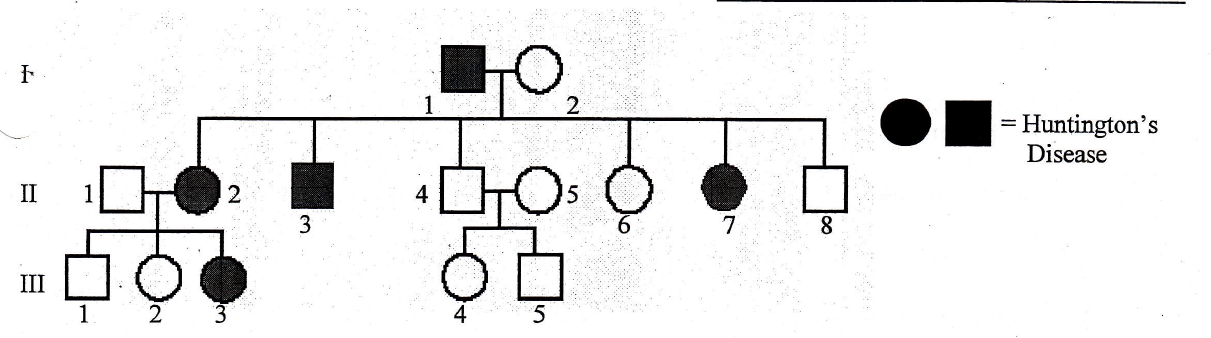
How are individuals III-2 and II-4 related?
a)
Cousins
b)
Dad and Daughter
c)
Uncle and Niece
d)
Grandpa and Granddaughter
35.
There are no carriers for Huntington's Disease- you either have it or you don't. Is Huntington's disease caused by a dominant or recessive trait?
a)
Dominant
b)
Recessive
36.
Does this pedigree show a dominant or recessive trait?
a)
Dominant
b)
Recessive
37.
In a pedigree, what shape represents a male?
a)
circle
b)
square
c)
triangle
d)
diamond
38.
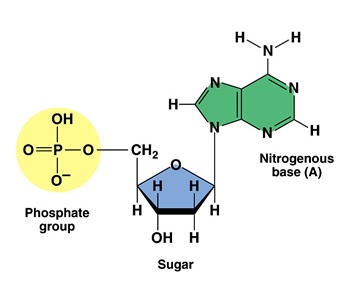
What is a monomer of DNA and/or RNA called?
a)
Nucleotide
b)
Nitrogenous base
c)
Sugar-phosphate backbone
d)
Adenosine Triphosphate
39.
Which of these nitrogenous bases is NOT in DNA?
a)
Uracil
b)
Thymine
c)
Cytosine
d)
Guanine
40.
The process of making mRNA from DNA is called.
a)
Replication
b)
Transcription
c)
Translation
d)
Protein synthesis
41.
Protein synthesis takes place in two parts:
a)
Transcription then translation
b)
Replication then transcription
c)
Translation then transcription
d)
Replication then translation
42.

What happens in RNA processing and where does it occur?

a)

5' cap and 3' poly A tail added, introns spliced out; in nucleus

b)

3' cap and 5' poly A tail added, in cytoplasm

c)

Exons cut out and introns reattached, cytoplasm
43.
What is an exon?
a)
section of mRNA that codes for protein
b)
section of mRNA that does not code for protein
c)
section of tRNA that codes for protein
d)
section of rRNA that codes for protein
44.
Where are anticodons found?
a)
on mRNA
b)
on DNA
c)
on rRNA
d)
on tRNA
45.
Where is the TATA box found?
a)
in the promoter sequence of prokaryotes
b)
in the terminator sequence of prokaryotes
c)
in the promoter sequence of eukaryotes
d)
in the terminator sequence of eukaryotes
46.
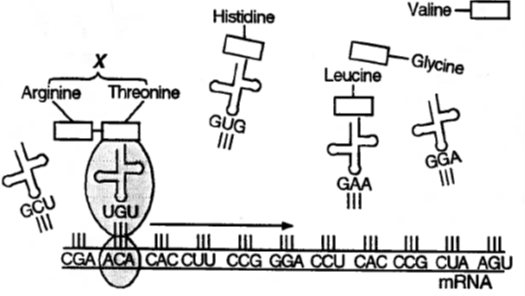
What process is going on in this photo? 
a)
Transcription 
b)
Translation 
c)
Replication 
d)
All the above 
47.
Transcription begins at sequences called
a)
Start Codons
b)
Promoters
c)
Origins
d)
Introns
48.
What are the 3 parts of any nucleotide?
a)
amino acid, sugar, nitrogen base
b)
sugar, phosphate, nitrogen base
c)
sugar, phosphate, amino acid
d)
sugar, phosphate, glycerol
49.
Exons are
a)
left in the mRNA
b)
removed from the mRNA
50.
What is the function of the poly-A tail in mRNA?
a)
to add modified guanin to the 3' end of the mRNA
b)
to indicate the site of translational termination
c)
to code for the binding of RNA polymerase to the DNA
d)
to help protect the mRNA from degradation by hydrolytic enzymes