
 Worksheets
IBESS 2.4 AquaticEcosystems
Total questions: 44
Worksheet time: 21mins

Coral secrete _______________ that creates the structure of the coral reef.
Sediments
Zooxanthellae
Calcium carbonate
Sodium bicarbonate

Corals who have zooxanthellae (choose all that apply)
have color
can build reefs
need shallow, nutrient-poor water
have a wide range of tolerance

Coral bleaching is (choose all that apply)
When the zooxanthellae leave the coral polyp
How marine scientists clean up the coral
A disease that attacks the coral
An overgrowth of algae

Algae use photosynthesis to make food but it also contributes to the corals
Vibrant color
Hardness
Attracting fish
Being poisonous

What can cause the symbiotic zooxanthellae-coral relationship to break down? (choose all that apply)
Decreased runoff from surrounding land
Nutrient-poor water
Rising Temperatures
Ozone layer destruction
Decreasing pH levels

How do zooxanthellae help corals?
Providing sugars to corals
Providing pretty colors
Providing oxygen to corals
Providing protection to corals

What is ocean acidification?
A reduction in the pH of the ocean
An increase in the pH of the ocean
When salinity increases
When salinity decreases
Ocean acidification can
Make it hard for corals to grow skeletons
Make it harder for scientists to see coral growth
Make coral have a really strong skeleton
Make algae grow in excess

What can you do to help coral reefs?
Wear sunscreens that don't contain oxybenzone
Don't touch corals
Support sustainable fishing practices globally
All of these
Which of the following is not a source of food and other essential nutrients for corals
Nutrients released by zooxanthellae
Calcium carbonate from shells
Dissolved organic matter (DOM) from the water
Capture of food using nematocysts (stinging cells)
A land area that is covered with water for most of the year is called:
Lake
Wetland
River
Why are wetlands traditionally difficult to protect? (choose all that apply)
health threat of West Nile & Zika viruses
unpleasant odors
close proximity to a source of water
potential real estate development
Wetlands do which of the following:
Help control floods by soaking up water
Filter water
Provide a home for wildlife
All of these
Which of the following is a reason why wetlands are important? (choose all that apply)
It acts as a filtering system
It's a place where birds die
It lets water pass through quickly
It is a habitat & feeding ground for migrating organisms
Wetlands help control flooding by (choose all that apply)
absorbing runoff from heavy rains
quickly releasing water
What causes water to move faster? (choose all that apply)
The slope of the land
The type of soil
The addition of tributary water
The presence of meanders
What are meanders?
Large curves caused by erosion and deposition
Small curves caused by rocks
The layout of the land
_________ is when water filters into tiny pores of soil/rock
Infiltration
leaching
precipitation
runoff
"I am a smaller river joining a larger river" What am I?
Source
Tributary
Meander
Delta

Land that gets flooded when a river overflows is called a ______. You can often find _____ here.
Levee - wetlands
Delta - tributaries
Floodplain - wetlands
Meander - floodplains
A river starts at the ______ and ends at the ______.
tributary - delta
tributary - mouth
mouth - headwaters
headwaters - mouth
Which is FALSE about river's characteristics?
In headwaters, DO is higher and temperature is lower.
Flow is slower near the mouth, and meanders are more common.
The main energy source is detritus in the headwaters, and photosynthesis near the mouth.
Turbidity is higher in headwaters than near the mouth.
A semi-enclosed area where fresh water from a river meets salty water from the sea.
Watershed
Groundwater
Estuary
Ocean


What is this organism, and where does it live?
sea grass, lives in tropical water
sea grass, lives in cooler water
mangrove, lives in tropical water
mangrove, lives in cooler water
How are mangroves and sea grasses similar? (choose all that apply)
They are storm/wave impact buffers
Their roots help minimize erosion
They live in freshwater
They are habitats for diverse species
The Benthic zone is/are
All zones found on the Ocean bottom
water that is found only in deep ocean trenches
Spongebob's home
Which is FALSE about plankton?
They are drifters
They are small or microscopic
They do not eat other plankton
Some can grow into other animals
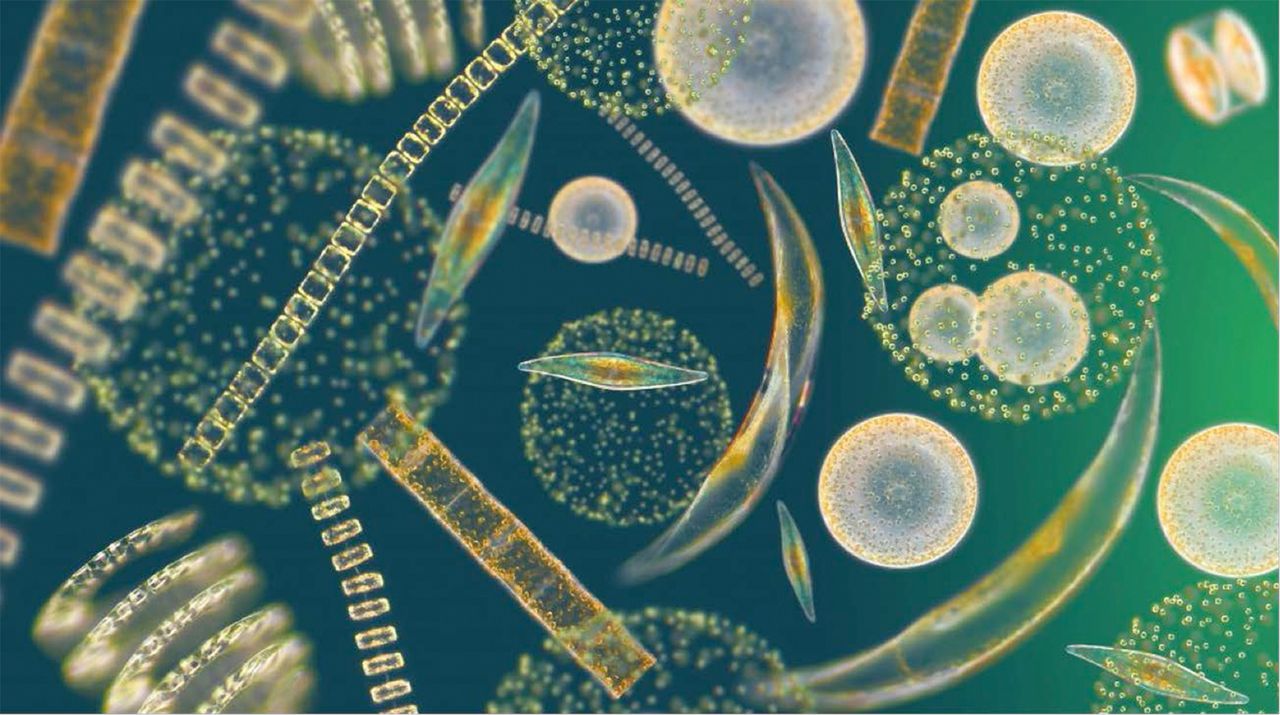
Which are there more of, zooplankton or phytoplankton?
Phytoplankton
Zooplankton
What is true about kelp forests? (choose all that apply)
Sea Otters control urchin populations, thereby protecting the kelp.
Urchin populations are benthic herbivores, so they can destroy kelp forests if they have a population boom.
They are in relatively deep water environments.
Kelp provides the physical structure of the ecosystem here.
The ____ zone is below low tide, reaching as far out as possible where the water isn't deeper than 200 meters
Intertidal
Neritic
Pelagic
Euphotic

Though light can only penetrate about _____ deep, the euphotic zone extends to ____ deep.
2000 m / 200 m
200 m / 150 m
150 m / 100 m
What is true about the profundal zone? (choose all that apply)
It lacks sunlight and is cold
Photosynthesis is common
Detritus is the main energy source
Nutrients do not cycle easily
It is aerobic
What is true about the Limnetic zone? (choose all that apply)
It is analogous to the Pelagic Zone of the ocean
Most common producer is phytoplankton
Smaller, streamlined fish are more common
More productive than Profundal zone
It has more rooted plants than Littoral zone.
The _____ is found along the flat/deep ocean floor, while the _____ zone is specifically in deep ocean trenches.
Hadal, Abyssal
Profundal, Limnetic
Abyssal, Hadal
Hadal, Profundal
_____ causes eutrophication
excess nutrients
fertilizer runoff
excessive decomposition
sewage spills
all of these
Be sure you can fully describe the 5 steps of the Eutrophication Process, including the three sources of the enrichment.
Roger that, Chief.
Negative, Ghostrider. I don't need review.
Which of the following are harmful to coral? (select all that apply)
temperature and pH fluctuation
increased use of chemicals in some sunscreens (oxybenzone)
turbidity decrease
dissolved CO2 increase in water
UV decrease

