
NEW
Font size
S
M
L
XL
 Worksheets
Unit 8 Review
Total questions: 45
Worksheet time: 31mins
Name
Class
Date
1.
What is an example of a Chemical change?
a)
Ripped paper
b)
boiled egg
c)
cracked egg
d)
sugar in water
2.
Which is a physical change?
a)
burning match
b)
vinegar in baking soda
c)
melting butter
d)
cooking an egg
3.
Which of the following is a chemical property of water?
a)
Reacts with pure sodium.
b)
Boils at 100 oC.
c)
Dissolves sugar easily.
d)
Has a density of 1 gm/mL
4.
What characteristic defines all chemical changes?
a)
There is a change of state.
b)
Electricity is produced.
c)
A new material is formed.
d)
Bubbles are produced.
5.

Is being able to melt physical or chemical
a)
physical
b)
chemical
c)
duck
ductile
ductile
d)
malleable
6.
Is hammering wood together to build a house a chemical or physical change?
a)
chemical
b)
physical
7.

Photosynthesis is an example of a
a)
physical change
b)
chemical change
8.

An instant ice pack getting cold when the chemicals are able to touch.
a)
Chemical Change
b)
Physical Change
9.
Which of the following is NOT an example of chemical change?
a)
sour milk
b)
burning wood
c)
breaking a pencil
d)
rust
10.

A change in phase ...
a)
Chemical Change
b)
Physical Change
11.

Bubbles form when two or more substances are combined ...
a)
Chemical Change
b)
Physical Change
12.

Change in size ...
a)
Chemical Change
b)
Physical Change
13.

What is produced as a result of photosynthesis?
a)
Glucose and Chlorophyll
b)
Glucose and Oxygen
c)
Water and Light energy
d)
Carbon dioxide and Water
14.
The substances listed on the right side of a chemical equation are the
a)
Yields
b)
Reactants
c)
Products
d)
Precipitates
15.
CaCO3 represents a chemical
a)
Symbol
b)
Formula
c)
Subscript
d)
Reaction
16.
The substances listed on the left side of a chemical equation are the
a)
Products
b)
Coefficients
c)
Precipitates
d)
Reactants
17.
In chemical reactions, what does the principle of conservation of mass mean?
a)
Matter is not created or destroyed.
b)
The total mass of the reactants is greater than the total mass of the products.
c)
The total mass of the reactants is less than the total mass of the products.
d)
Matter is not changed.
18.
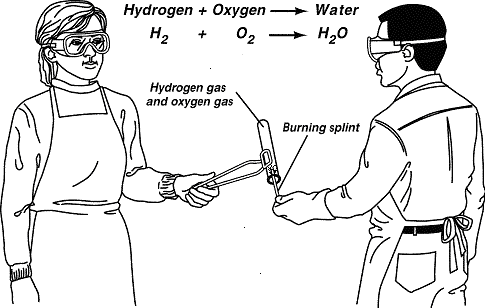
Identify the reactant(s) and product(s) of the reaction.
a)
All three are reactants and none are products.
b)
Hydrogen and water are the reactants, and oxygen is the product.
c)
Water and oxygen are the reactants, and hydrogen is the product.
d)
Hydrogen and oxygen are the reactants, and water is the product.
19.
How many elements are in C6H12O6?
a)
1
b)
2
c)
3
d)
4
20.
How many Hydrogen (H) atoms are in NH3O5
a)
3
b)
4
c)
5
d)
1
21.

What are the products of the chemical reaction pictured?
a)
CH4 and CO2
b)
CH4 and O2
c)
CO2 and H2O
d)
O2 and H2O
22.
If products' mass is 18g , what is the mass of the reactants ?
a)
15
b)
36
c)
81
d)
18
23.
Consider the chemical equation CH4 + 2 O2 → CO2 + 2 H2O. In this equation, CH4 is a
a)
product
b)
reactant
c)
displacement
24.
How many reactants are in A + B ---> C ?
a)
1
b)
2
c)
3
d)
4
25.

This is used to represent the number of each atom being represented.
a)
A Exponent
b)
The Coefficient
c)
A Molecule
d)
The Subscript
26.

This appears on the left side of a chemical formula, and represents how many molecules there are.
a)
An Atom
b)
The Subscript
c)
A Molecule
d)
The Coefficient
27.
Water freezing
a)
Chemical Change
b)
Physical Change
28.
Chewing and tearing apart food into smaller pieces is...
a)
chemical
b)
physical/mechanical
29.
Hydrochloric acid in the stomach breaking down food is...
a)
chemical
b)
physical/mechanical
30.
The stomach pushing and churning food is...
a)
physical/mechanical
b)
chemical
31.
Saliva converting the starch molecules in crackers into simple sugars
a)
physical change
b)
chemical change
32.
Hydrochloric acid and enzymes in the stomach help break down food molecules into smaller molecules
a)
physical change
b)
chemical change
33.
Matter can not be created nor destroyed: it can only be
a)
Destroyed a little bit
b)
Invisible
c)
Transformed, changed
d)
None of the above
34.
Substance made up of chemically combined elements
a)
atom
b)
element
c)
electron
d)
compound
35.
Substance that cannot be broken into simpler substances
a)
element
b)
molecule
c)
gram
d)
proton
36.
Anything that has mass & takes up space
a)
gravity
b)
force
c)
matter
d)
volume
37.
Suppose a reaction were to happen in an open container in a lab. During the reaction, the scientist observes the chemicals bubble, and produce a gas. During the analysis the scientist notices that the reactants weighed 20 g when he started, and the product weighed 18 g. Explain what happened.
a)
His chemical reaction defied the law of conservation of mass
b)
The product destroyed mass during the reaction
c)
The reactants created matter during the reaction
d)
The gas that was produced was not able to be weighed since the container was open.
38.
What will weigh more when a chemical change is complete? The reactants before the chemical reaction, or the product after the reaction is complete?
a)
They both will weigh the same
b)
The product always weighs more than the reactant
c)
The reactant will weigh more than the product
d)
They both will loose mass after the reaction
39.
Fe + O → FeO
According to this reaction, 32 g of O react with Fe completely. 77 g of FeO is produced. What is the mass of Fe as a reactant?
a)
109
b)
45
c)
32
d)
77
40.
How many nitrogen atoms are in
Fe(NO3)2
Fe(NO3)2
a)
1
b)
2
c)
3
d)
6
41.
10 g of a solid chemical reacts with a 10 g of a liquid chemical, the reaction bubbles and changes the color of the liquid. The colored liquid weighs 13 g, what can be concluded?
a)
The gas produced from the bubbles weighed 5 g
b)
The bubbles were evidence of 7 g of matter being destroyed
c)
The gas produced weighed 7 g
d)
The gas produced weighed 13 g
42.
A student notices that an inflated balloon gets larger when it is warmed by a lamp. Which best describes the mass of the balloon as a result of this change?
a)
The mass of the balloon increases because the size of the balloon has increased.
b)
The mass of the balloon increases because the temperature of the balloon has increased.
c)
The mass of the balloon stays the same because the gas inside the balloon still has the same mass after it warms up.
43.
In a closed system, a chemical reaction takes place. The mass of the reactants in the beginning of the reaction is 25g. What does the mass have to be in the end of the reaction in order to follow the law of conservation of mass?
a)
25g
b)
You can't tell with the given information.
c)
30g
d)
15g
44.
There are two reactants in a chemical equation, and one product. The mass of the product is 30g. The mass of the first reactant is 17g. What must the mass of the second reactant be, if the equation is to follow the law of conservation of mass?
a)
47g
b)
13g
c)
23g
d)
You cant tell with the given information
45.
If reaction starts with 20g of reactants it should produce
a)
a total of 40g of products
b)
a total of 10g of products
c)
a total of 80 g of products
d)
a total of 20g of products
Reset

