wayground logo

Free Printable Worksheets

NEW

Font size

S
M
L
XL
Worksheets

Air Masses & Fronts

Total questions: 70

Worksheet time: 1hrs 1mins

Name
Class
Date
1.

Air masses are named by their

a)

Water and temperature

b)

Air pressure

c)

Humidity and temperature

d)

Cold and warm

2.
What kind of breeze is this & what time of day/night would it form?
a)
Land breeze - daytime
b)
Land breeze - nighttime
c)
Sea breeze - daytime
d)
Sea breeze - nighttime
3.
Air travels
a)
from high pressure to low pressure
b)
from low pressure to high pressue
4.
How do we characterize an air mass that forms over the ocean?
a)
Dry
b)
Wet
c)
Cold
d)
Warm
5.
How do we characterize an air mass that forms over land?
a)
Dry
b)
Wet
c)
Cold
d)
Warm
6.

How do we characterize an air mass that forms near the equator?

a)

Dry

b)

Wet

c)

Cold

d)

Warm

7.
How do we characterize an air mass that forms near the poles?
a)
Dry
b)
Wet
c)
Warm
d)
Cold
8.
What types of air masses form over oceans?
a)
Maritime
b)
Continental
c)
Polar
d)
Tropical
9.
What's the humidity and temperature of a continental tropical air mass?
a)
Wet and cold
b)
Dry and warm
c)
Wet and warm
d)
Dry and cold
10.
A wet and cold air mass would be a...
a)
Maritime polar
b)
Continental polar
c)
Maritime tropical
d)
Continental tropical
11.
A dry and cold air mass would be...
a)
Maritime polar
b)
Continental polar
c)
Maritime tropical
d)
Continental tropical
12.
A dry and hot air mass would be...
a)
Maritime arctic
b)
Maritime tropical
c)
Continental tropical
d)
Continental polar
13.
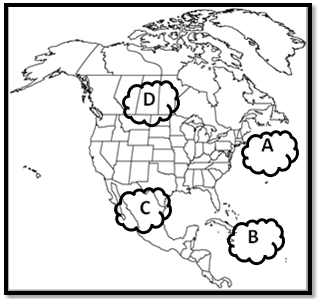
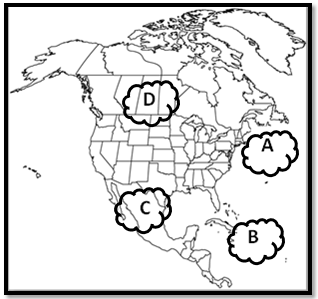
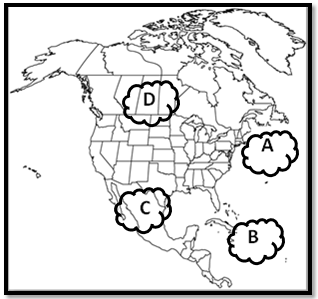
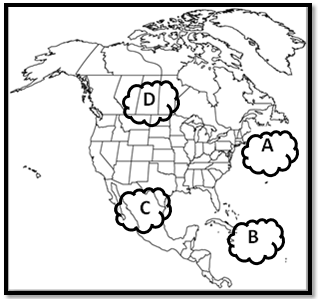
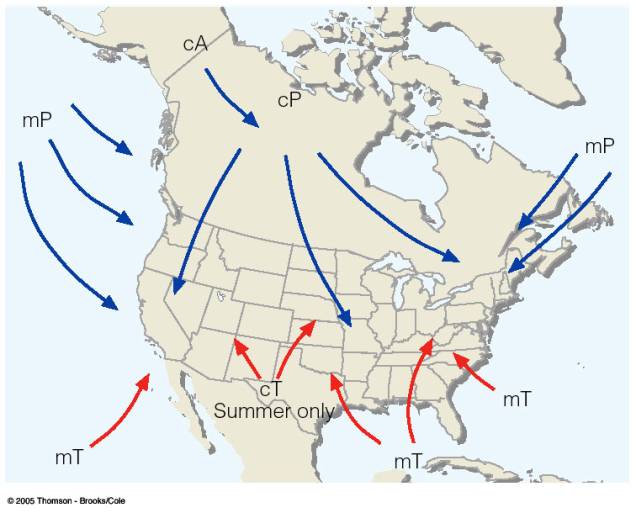
Which type of air would you find at air mass A?
a)
cold, dry
b)
warm, humid
c)
warm, dry
d)
cold, humid
14.
Which type of air would you find at air mass B?
a)
cold, dry
b)
warm, humid
c)
warm, dry
d)
cold, humid
15.
Which type of air would you find at air mass C?
a)
cold, dry
b)
warm, humid
c)
warm, dry
d)
cold, humid
16.
Which type of air would you find at air mass D?
a)
cold, dry
b)
warm, humid
c)
warm, dry
d)
cold, humid
17.
Where would you find a tropical maritime air mass?
a)
over the ocean, near the equator
b)
over the ocean, near the poles
c)
over a continent, near the equator
d)
over a continent, near the poles
18.
Which abbreviation of an air mass can be identified as dry and hot?
a)
cP
b)
mP
c)
cT
d)
mT
19.
Which abbreviation of an air mass can be identified as cold and moist?
a)
cP
b)
mP
c)
cT
d)
mT
20.
This is the symbol for which type of front?
a)
cold front
b)
warm front
c)
occluded front
d)
stationary front
21.
This is the symbol for which type of front?
a)
cold front
b)
warm front
c)
stationary front
d)
occluded front
22.

what is an air mass?

a)

a large body of air that has the same temperature and moisture

b)

when two air masses meet

23.
The symbol on a weather map for a cold front is what?
a)
a line with triangles on it
b)
a line with semi-circles on it
c)
a line with squares on it
d)
a line with circles on it
24.
In a high pressure area, the weather will likely be
a)
cooler and clear skies
b)
warm but cloudy
c)
cold and rainy
d)
snowy and clear
25.

Which system results in rainy or stormy weather?

a)

high pressure

b)

low pressure

c)

hurricane

d)

weather system

26.
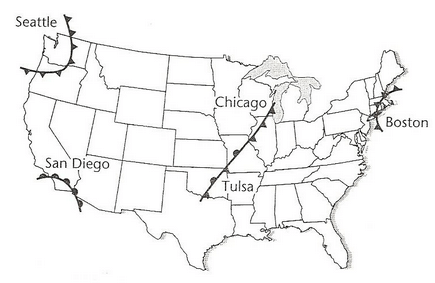
Which type of front is near Seattle?
a)
cold front
b)
warm front
c)
occluded front
d)
stationary front
27.
Which front is located near San Diego?
a)
cold front
b)
warm front
c)
occluded front
d)
stationary front
28.
Which type of front is located near Boston?
a)
warm front
b)
cold front
c)
stationary front
d)
occluded front
29.
What is a boundary area where air masses meet but do not mix?
a)
low pressure system
b)
super cell
c)
front
d)
high pressure system
30.
What type of storm front is this? 
a)
warm front
b)
cold front
c)
stationary front
d)
occluded front
31.
What type of weather would you expect to see after a warm front has passed through an area?
a)
cool and clear skies
b)
warm and humid
c)
thunderstorms
d)
foggy
32.
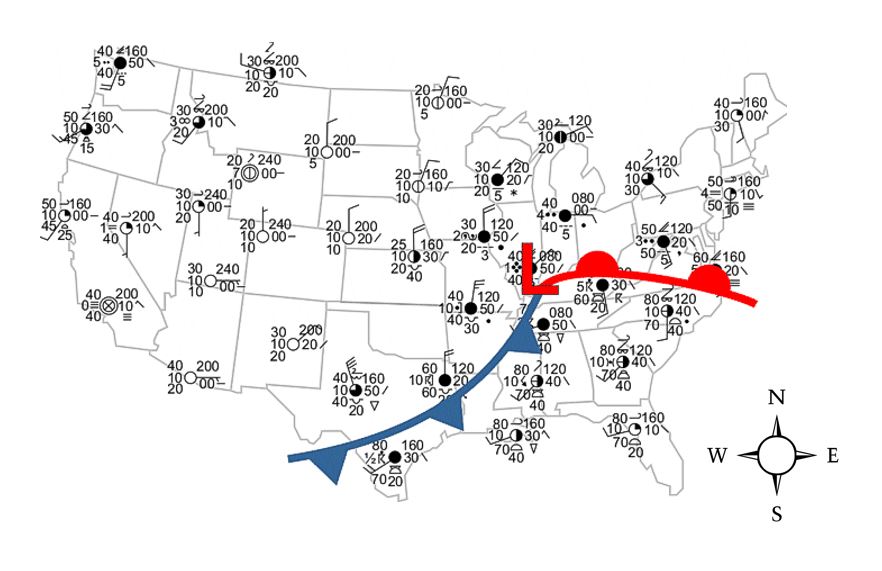
What direction is the warm front moving on the map? 
a)
North
b)
South
c)
East
d)
West
33.
What direction is the cold front moving on the map? 
a)
Southwest
b)
Northwest
c)
Southeast
d)
Northeast
34.
Which type of weather is associated with a cold front?
a)
heavy rain, snow, thunderstorms, and snow for short periods of time 
b)
Steady, light rain or snow can occur for longer periods of time 
35.

What causes wind

a)

humidity

b)

air masses and precipitation

c)

the unheating even of earth's surface

d)

the uneven heatings of earth's surface

36.

What is the coriolis effect

a)

the tilt on air masses

b)

the bending of the ocean currents

c)

the bending of winds due to earth's rotation

d)

the axis of the moon

37.
Winds are named for the direction they are blowing from?
a)
True
b)
False
38.
When air is heated, it will MOST likely
a)
expand and fall
b)
expand and rise
c)
condense and fall
d)
condense and rise
39.
What type of winds blow constantly, predictably, and over long distances?
a)
land breezes
b)
mountain breezes
c)
global winds
d)
land breezes
40.
Which global winds have the greatest impact on the weather in the US?
a)
trade winds
b)
prevailing westerlies
c)
doldrums
d)
polar easterlies
41.
This type of wind helped blow trader's ships from Europe to the Americas. It blows winds from EAST to WEST. 
a)
Polar Easterlies
b)
Trade Winds
c)
Prevailing Westerlies
d)
Horse Latitudes
42.
This type of wind comes from the POLES. It blows from east to west and brings freezing weather. 
a)
Prevailing Westerlies
b)
Polar Easterlies
c)
Polar Westerlies
d)
Horse Latitudes
43.
A front is
a)
where warm air is cooling at earth's surface
b)
a line where hot and cold air are separating
c)
a line where two different air masses meet
d)
where cold air is rising and forming rain clouds
44.
_____________ air is more dense and tends to sink
a)
cold
b)
warm
c)
moist
d)
dry
45.
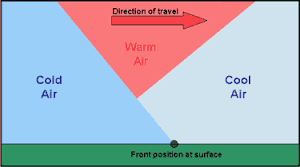
Which type of front is pictured?
a)
Cold front
b)
Warm front
c)
Occluded front
d)
Stationary front
46.
They are highest clouds in the sky. They look curly, white and feathery. Usually mean good weather.
a)
Cumulus
b)
Cumulonimbus
c)
Cirrus
d)
Stratus
47.
This is sometimes called a thunderhead cloud. It looks very tall like mountains and heavy rain comes from it. 
a)
Cumulus
b)
Cirrus
c)
Stratus
d)
Cumulonimbus
48.
These clouds are the closest to the ground. Their name means layer- or sheet like. They bring rain or snow and cover most of the sky. 
a)
Cirrus
b)
Stratus
c)
Cumulonimbus
d)
Cumulus
49.
Why doesn't cloud formation take place until the dew-point temperature is reached?
a)
because dew-point is the temperature at which water vapor condenses into water droplets
b)
cloud formation can take place at any temperature, and does not depend on the dew-point temerature
c)
because water sublimates at the dew-point temperature
d)
the dew-point temperature only applies on Earth's surface, not in the atmosphere
50.

An ocean allows a hurricane to grow by supplying it with

a)

salt from hot waters.

b)

oxygen from cool waters.

c)

snow from freezing waters.

d)

water vapor from warm waters.

51.

What instrument measures the amount of liquid that falls to the ground in a given period of time.

a)

hydrometer

b)

rain gauge

c)

thermometer

d)

barometer

52.

What instrument measures air pressure?

a)

barometer

b)

graduated cylinder

c)

rain gauge

d)

anemometer

53.

What instrument measures wind speed?

a)

thermometer

b)

wind vane

c)

barometer

d)

anemometer

54.

What instrument measures wind direction?

a)

wind vane

b)

psychrometer

c)

rain gauge

d)

barometer

55.

What instrument measures the humidity?

a)

anemometer

b)

rain gauge

c)

barometer

d)

psychrometer

56.
A dry-bulb temperature of 30°C and a wet-bulb temperature of 29°C were recorded at a weather station. What are the relative humidity and the most likely weather conditions?
a)
Relative humidity is 29% with clear skies
b)
 Relative humidity is 29% with a good chance of snow
c)
Relative humidity is 93% with clear skies.
d)
 Relative humidity is 93% with a good chance of rain.
57.

The central part of the United States is probably having...

a)

High Pressure - Warm and cloudy

b)

High Pressure - Cool and dry, sunny skies

c)

Low Pressure - Cloudy and rainy

d)

Low Pressure - Cool and dry, sunny skies

58.

What kind of weather is Orlando most probably having?

a)

Rainy and possible thunderstorms

b)

Clear, sunny skies with light wind

c)

Several days of clouds and rain

59.
Which city is currently experiencing a snow storm?
a)
Seattle
b)
Los Angeles
c)
Chicago
d)
New York
60.
Which city has partly cloudy skies?
a)
Boise
b)
New York
c)
Atlanta 
d)
Dallas
61.
Which city is closest to a high pressure system?
a)
New York
b)
Miami
c)
Minneapolis
d)
Boise
62.
Choose the best forecast for Los Angeles on Saturday.
a)
cooler temperatures
b)
warmer temperatures 
c)
low pressure
d)
snow
63.
Choose the best forecast for Dallas on Saturday.
a)
thunderstorms
b)
snow
c)
warmer temperatures
d)
clear skies
64.
Choose the best forecast for Seattle on Saturday.
a)
rain
b)
sunny skies
c)
warmer temperatures
d)
snow
65.
A _____ is a large, swirling, low-pressure system that forms over the Atlantic Ocean.
a)
blizzard
b)
cold front
c)
tornado 
d)
hurricane
66.

Weather in the United States travels from

a)

east to west

b)

north to south

c)

south to north

d)

west to east

67.

Hurricanes/typhoons/cyclones travel ______ because the Trade winds push them in this direction.

a)

east to west

b)

north to south

c)

south to north

d)

west to east

68.
The lowest layer of the atmosphere, this is also where weather occurs.
a)
Mesosphere
b)
Stratosphere
c)
Troposphere
d)
Thermosphere
69.

A northeast wind comes from the ________ and blows to the ________.

a)

southwest; northeast

b)

northeast; southwest

70.

How do plant leaves lose excess water ?

a)

phtosynthesis

b)

cellular respiration

c)

transpiration

d)

diffusion