wayground logo

Free Printable Worksheets

Font size

S
M
L
XL
Worksheets

Cell Membrane, Homeostasis, and Transport

Total questions: 40

Worksheet time: 32mins

Name
Class
Date
1.

Diffusion goes from..

a)

High to low concentration

b)

Low to high concentration

c)

Outside to inside the cell

d)

Inside to outside the cell

2.

Osmosis is the diffusion of...

a)

water

b)

solutes

c)

ions

d)

amino acids

3.

What is a concentration gradient?

a)

When there is a difference in concentrations between two areas of a solution/two sides of a membrane

b)

Where there is a change in concentration over a period of time between two sides of a membrane

c)

A gradient, or sloped line, showing how concentration decreases over time

d)

A gradient, or sloped line, showing how concentration increases over time

4.

Active transport is transport that requires...

a)

Sodium ions

b)

Energy

c)

Force

d)

Diffusion

5.

Which method of transport is used by iron ions?

a)

Diffusion

b)

Facilitated Diffusion

c)

Endocytosis

d)

Exocytosis

6.

Which of these types of transport are passive?

a)

Phagocytosis

b)

Diffusion

c)

Exocytosis

d)

Facilitated diffusion

7.
Which statement best describes the cell membrane?
a)
The protective outer layer that controls what enters and leaves the cell.
b)
Stores information on DNA molecules / Directs and controls the activities of the cell.
c)
A folded membrane that moves materials around inside cells / Also acts as the site of manufacturing materials needed by the cell.
d)
The smallest organelle with a huge job / Makes proteins, which are the building blocks of the body.
8.
What is NOT TRUE about the cell membrane?
a)
It controls what enters and leaves the cell
b)
Semipermeable
c)
Phospholipid bilayer
d)
Contains digestive enzymes
9.
What does "bilayer" mean?
a)
one layer
b)
two layers
c)
laminated
d)
bilateral
10.
What is embedded in the phospholipid bilayer?
a)
Proteins
b)
Salt
c)
Water
d)
Worms
11.
What forms the channels and pumps in the phospholipid bilayer?
a)
Carbohydrates
b)
Proteins
c)
Hydrophilic heads 
d)
Lipids
12.
True or False:  Regulating what enters and leaves the cell helps the cell maintain homeostasis. 
a)
True
b)
False
13.
Hydrophilic means...
a)
water-loving
b)
water-fearing
c)
nonpolar
d)
lipid soluble
14.
Hydrophobic region of the cell membrane?
a)
E
b)
B
c)
C
d)
15.
What does a cell need to transport particles by active transport?
a)
Sun
b)
Wind
c)
Energy
d)
Channels
16.
Lipid tails are...
a)
Hydrophobic
b)
Hydrophilic
17.
When looking at the cell membrane, where are the phosphate heads located?
a)
Floating between bilayer levels
b)
Outer part of the bilayer
c)
Inner part of the bilayer
d)
Located at different parts throughout the bilayer
18.
When looking at the cell membrane, where are the lipid tails located?
a)
Inner part of the bilayer
b)
Outer part of the bilayer
c)
At the end of the bilayer
d)
Goes through each end of the bilayer
19.
This cell organelle helps organisms maintain homeostasis by controlling what substances may enter or leave cells.
a)
vacuole
b)
nucleus
c)
cell membrane
d)
cell wall
20.
Osmosis is the diffusion of __________.
a)
water
b)
glucose
c)
air
d)
passive transport
21.
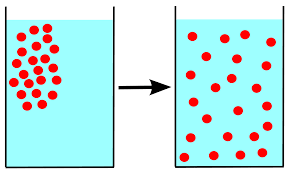
How is diffusion (left) different from the process on the right?
a)
 Diffusion takes place due to osmotic pressure. 
b)
Diffusion requires cellular energy for the transfer of molecules.
c)
Diffusion requires protein channels as a passage-way for particles
d)
Diffusion transfers particles from an area of high to low concentration. 
22.
Permeable means
a)
things can pass through
b)
the concentration levels are different
c)
it is permanent
d)
things are stuck
23.
A person should never drink salty water because their cells would
a)
shrink
b)
expand
24.
What type of transport does not require energy? 
a)
Active Transport
b)
Passive Transport
25.
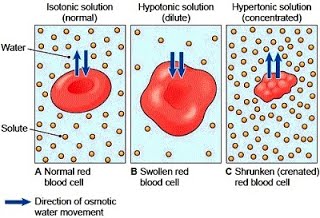
The cell below is in a _________ solution.
a)
Hypotonic
b)
Hypertonic
c)
Isotonic
26.
The cell below is in a _____________ solution.
a)
Hypertonic
b)
Hypotonic
c)
Isotonic
27.
An ISOTONIC solution has a(n) ______________ concentration of solute (dissolved stuff) than inside the cell.
a)
lower
b)
equal
c)
higher
28.
A HYPOTONIC solution has a ______________ concentration of solute (dissolved stuff) than inside the cell.
a)
lower
b)
equal
c)
higher
29.
What type of solution is this cell in?
a)
Isotonic
b)
Hypertonic
c)
Hypotonic
d)
diffused
30.
What type of solution is this cell in?
a)
Isotonic
b)
Hypertonic
c)
Hypotonic
d)
diffused
31.
What type of solution is this cell in?
a)
Isotonic
b)
Hypertonic
c)
Hypotonic
d)
diffused
32.
The picture below is an example of _________________.
a)
osmosis
b)
isotonic
c)
diffusion
d)
active transport
33.
If there is 5 percent water inside a cell and 5 percent water outside a cell
a)
more water will move inside the cell
b)
more water will move outside the cell
c)
There will be no movement of water cells
34.
Endocytosis is defined as
a)
the movement of large molecules from the inside of the cell to the outisde of the cell using channel proteins. 
b)
the movement of large molecules from the inside of the cell to the outisde of the cell membrane vesciles. 
c)
 the movement of large molecules from the outside of the cell to the inside of the cell using membrane vesciles.
d)
the movement of large molecules from the outside of the cell to the inside of the cell using channel proteins. 
35.
Exocytosis is the movement of
a)
any type of substance from outside the cell to the inside of the cell. 
b)
very large substances from outside the cell to the inside of the cell. 
c)
any type of substance from inside the cell to the outside.
d)
very large substances from inside the cell to the outside.
36.
In this image, the cell is using which type of molecular transport?
a)
Osmosis
b)
Diffusion 
c)
Endocytosis
d)
Exocytosis 
37.
A type of active transport that releases particles that were enclosed from a cell when the membrane of the vesicle fuses with that of the cell membrane
a)
Exocytosis
b)
Osmosis
c)
Mitosis
d)
Endoyctosis
38.
This picture represents which type of cellular transport?
a)
passive transport
b)
endocytosis
c)
exocytosis
d)
osmosis
39.
This is a ____.
a)
Golgi body
b)
plasma membrane
c)
lysosome
d)
cell wall
40.
a)
Passive Transport
b)
Active Transport