Wayground logo

Free Printable Worksheets

Font size

S
M
L
XL
Worksheets

aristotle

Total questions: 134

Worksheet time: 6hrs 4mins

Name
Class
Date
1.

It is made of one type of atom all the way through.

a)

molecule

b)

element

c)

atom

d)

substance

2.

a substance made up of at least two different substances

a)

pure substance

b)

malleability

c)

properties

d)

mixture

3.

a table of the chemical elements arranged in order of atomic number

a)

mixture table

b)

element table

c)

atom table

d)

periodic table

4.

made up of one type of atom all the way through

a)

mixture

b)

property

c)

pure substance

d)

element

5.

Chemical Change

a)

Cannot be undone

b)

Can be undone

c)

Done

d)

23

6.

Physical Change

a)

Can be undone

b)

Cannot be undone

c)

Done

d)

23

7.

Why is the Math book so sad

a)

To many problems

b)

To sick

c)

To pretty

d)

To ugly

8.
What is a pure substance that cannot be broken down into any other substance by physical or chemical means. Ex: Gold, Silver, Oxygen, & Nitrogen
a)
element
b)
compound
c)
mixture
d)
salad
9.
What is a  pure substance made of two or more elements chemically combined in a set ratio. Ex: CO2 has a set ratio of 1:2, meaning for every one carbon atom there are two oxygen atoms.
a)
element
b)
compound
c)
mixture
d)
salad
10.

anything that has mass and volume

a)

Matter

b)

Volume

11.
Which 2 kinds of particles make up the nucleus of an atom?
a)
electrons and neutrons
b)
electrons and nuclei
c)
protons and neutrons
d)
protons and kryptons
12.
Which particle carries a negative charge?
a)
protons
b)
neutrons
c)
electrons
13.
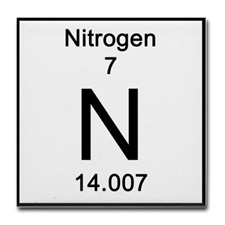
What is the number of protons that the element in this image contain?
a)
14
b)
7
c)
15
d)
18
14.
What is the atomic mass of "F"
a)
9
b)
18
c)
17
d)
19
15.
all matter is made of what 
a)
energy 
b)
atoms 
c)
electrons 
d)
compounds 
16.
The positive particles of an atom are 
a)
electrons 
b)
positrons 
c)
neutrons 
d)
protons 
17.
the central region of an atom where its neutrons and protons are is its 
a)
nucleus 
b)
electron cloud
c)
core 
d)
center 
18.
an atom with atomic number 6 would have how many protons 
a)
6
b)
12
c)
3
d)
cannot be determined 
19.
Which of the following is a positively charged subatomic particle found in the nucleus of an atom?
a)
Electron
b)
Proton
c)
Neutron
d)
Quark
20.
Which of the following is a subatomic particle with no charge that is found in the nucleus of an atom?
a)
Electron
b)
Proton
c)
Neutron
d)
Quark
21.
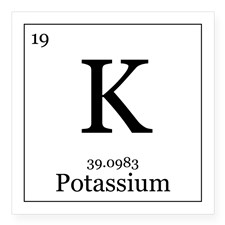
How many neutron are in the atom "K"?
a)
7
b)
2
c)
39
d)
12
22.
The three main regions on the periodic table are ____________.
a)
solid, liquid, gas
b)
metals, nonmetals, meatlloids
c)
radioactive, man-made, poisonous
23.
Atoms can be seen with the naked eye.
a)
True
b)
False
24.
What determines where an element is located on the periodic table?
a)
its atomic mass
b)
its atomic number
c)
its number of electrons
d)
they're arranged alphabeticaly 
25.
Elements on the periodic table that have physical and chemical properties of both metals and nonmetals are called _____________.
a)
metals
b)
nonmetals
c)
metalloids
d)
transition elements
26.
Helium, neon, argon, krypton, xenon, and radon are known as  _____________.
a)
halogens
b)
noble gases
c)
metalloids
d)
transition elements
27.
The sum of the protons and neutrons in the nucleus of an atom
a)
Atomic Number
b)
Compound
c)
Electrons
d)
Mass Number (also called Atomic Mass)
28.
This picture represents which of the following?
a)
element
b)
compound
c)
mixture of elements
d)
mixture of compounds
29.
This picture represents which of the following?
a)
element
b)
compound
c)
mixture
30.
This picture represents which of the following?
a)
element
b)
compound
c)
mixture
31.
How many elements are represented in the compound?
Na2CO3
a)
1
b)
2
c)
3
d)
4
32.

lst shell holds

a)

2

b)

8

c)

18

d)

32

33.

2nd shell holds

a)

2

b)

8

c)

18

d)

32

34.

same number of protons, different number of neutrons

a)

atomic number

b)

mass number

c)

isotope

d)

ion

35.

a charged atom

a)

neutral

b)

isotope

c)

ion

d)

nucleus

36.
Which is the following is NOT a sign of a chemical change?
a)
Releasing a gas
b)
Releasing bubbles
c)
Changing state
d)
Rearranging atoms
37.

Which group includes non-reactive gasses that have a full outer electron shell?

a)

Alkai Metals

b)

Alkaline Metals

c)

Halogens

d)

Noble Gases

38.
A horizontal row in the periodic table is called....
a)
Group
b)
Family
c)
Column
d)
Period
39.
What's a valence electron?
a)
electrons in the second energy level
b)
electrons in the outermost energy level
c)
the atomic number
d)
electrons in the first level
40.
In the modern periodic table elements are arranged by:
a)
atomic mass
b)
atomic number
c)
valence electrons
d)
number of isotopes
41.

Which of the following is an Alkaline Earth Metal?

a)

Calcium (Ca)

b)

Lithium (Li)

c)

Phosphorus (P)

d)

Copper (Cu)

42.

Which of the following is a transition metal?

a)

Iron (Fe)

b)

Oxygen (O)

c)

Neon (Ne)

d)

Barium (Ba)

43.
Xenon (Xe)
a)
alkali metal
b)
alkaline earth metal
c)
halogen
d)
noble gas
44.

Where are the metals on the periodic table?

a)

Blue

b)

Green

c)

Yellow

d)

There are no metals on the periodic table

45.
The yellow atoms are called 
a)
metals
b)
nonmetals
c)
metalloids
d)
noble gases
46.
The family in the periodic table that contains the most reactive metals is the_______
a)
Alkaline Earth Metals
b)
Transition Metals 
c)
Alkali Metals
d)
Other Metals
47.

Most noble gases have _______ valence electrons.

a)

1

b)

2

c)

7

d)

8

48.

Which two elements on the periodic table are in the same period?

a)

Sn and Rb

b)

K and Ba

c)

F and Cl

d)

Se and Te

49.

Which of the following is a metal?

a)

Carbon

b)

Chlorine

c)

Oxygen

d)

Magnesium

50.
What is the family name of this group of elements? 
a)
Alkali metals 
b)
Halogens 
c)
Noble Gases 
d)
Alkali Earth Metals 
51.

When an atom gains an electron, the atom will

a)

lose a proton.

b)

reduce its mass.

c)

become radioactive.

d)

have a negative charge

52.

Two elements in the same group on the periodic table of the elements are MOST similar in their

a)

atomic mass.

b)

number of protons

c)

atomic size.

d)

chemical reactivity.

53.

The number of neutrons in an atom is found by subtracting

a)

atomic number from mass number.

b)

mass number from atomic number.

c)

atomic number from electron number.

d)

isotope number from electron number.
54.
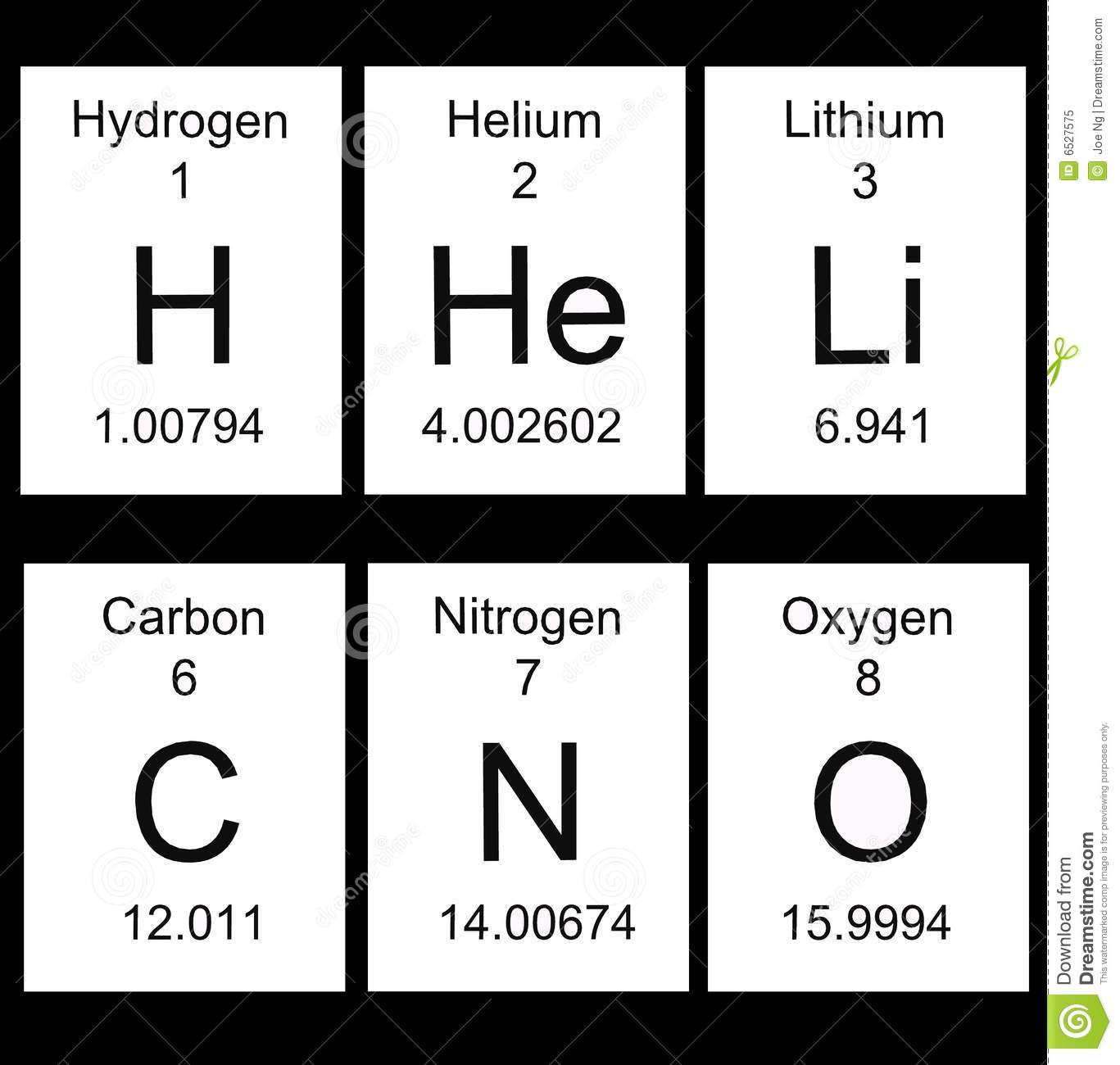
What does the 1.00794 stand for?
a)
Hydrogen
b)
atomic number
c)
atomic mass
d)
atomic explosion
55.
How did Mendeleev arrange the elements?
a)
alphabetical 
b)
density
c)
melting point
d)
atomic mass
56.
What is the chemical symbol for Lithium?
a)
H
b)
He
c)
Li
d)
N
57.
How many elements follow the periodic law?
a)
7
b)
98
c)
110
d)
All of them
58.
A rule that states that repeating chemical and physical properties of elements change periodically with the atomic number of the elements is the _________.
a)
periodic law
b)
alkaline-earth metals
c)
actinide
d)
group rule
59.
All of the actinides are ___________.
a)
stable
b)
radioactive
c)
shiny
d)
named after scientists
60.
Why do some elements have 3 letter chemical symbols?
a)
There are no elements with 3 letter symbols
b)
They are named after scientists
c)
They are named after places
d)
They have a temporary name until scientists agree on a new name.
61.
Which is a halogen?
a)
Helium
b)
Chlorine
c)
Oxygen
d)
Neptune
62.
The periodic table has __ periods.
a)
18
b)
8
c)
2
d)
7
63.
Group 18 elements are known as the _____ _____ and have full valence shells.
a)
royal gases.
b)
supreme solids.
c)
noble gases.
d)
legit liquids.
64.
What period and group is Silver (Ag)? 
a)
Period 2, Group 1
b)
Period 3, Group 16
c)
Period 5, Group 11
d)
Period 2, 14
65.
The periodic table has __ groups.
a)
8
b)
7
c)
18
d)
2
66.
Which is an alkali metal?
a)
Magnesium
b)
Iron
c)
Sodium
d)
Europium
67.
The majority of an atom's mass exists where?
a)
In the nucleus
b)
In the electron cloud
c)
In the space between the nucleus and the electrons
d)
In the neutrons
68.
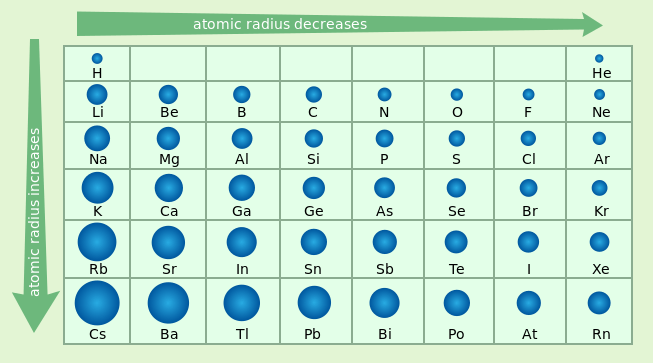
Traveling across a period the atomic radii ______________.
a)
Increases
b)
Decreases
c)
Stays the same
69.
Traveling down a family the atomic radii ______________.
a)
Increases
b)
Decreases
c)
Stays the same
70.
Electronegativity __________ from left to right within a period and __________ from top to bottom within a group.
a)
decreases, increases 
b)
increases, increases
c)
increases, decreases 
d)
stays the same, increases
71.
Atomic radius generally increases as we move __________.  
a)
down a group and from right to left across a period 
b)
up a group and from left to right across a period 
c)
down a group and from left to right across a period 
d)
up a group and from right to left across a period 
72.
Sodium (Na) and potassium (K) are in the same group on the periodic table. Based on their locations, which statement about sodium and potassium is true?
a)
Sodium is less electronegative than potassium. 
b)
Sodium has fewer energy levels than potassium. 
c)
Sodium has a larger ionic radius than potassium. 
d)
Sodium has lower ionization energy than potassium. 
73.
Which of these elements has the greatest atomic radius? 
a)
H
b)
N
c)
Cl
d)
Cs
74.
Which atom has the largest atomic radius?
a)
potassium
b)
rubidium 
c)
francium
d)
cesium
75.
Electronegativity is...
a)
how good an atom is at attracting electrons
b)
the ability of an atom to lose electrons
c)
the energy required to remove an electron from a specific atom
d)
how easy it is to make friends. 
76.
As you move down the periodic table atoms get bigger.  This is because ____________.
a)
The atoms have more mass.
b)
The atoms have more protons.
c)
The atoms have more energy levels
d)
The atoms have more neutrons
77.
Which of these elements has the SMALLEST atomic radius?
a)
H hydrogen
b)
Rb rubidium
c)
Li lithium
d)
Fr francium
78.
As you go down a group in the periodic table, the reactivity of the METALS
a)
increase
b)
decrease
c)
remain the same
79.
As you move across the periodic table atoms tend to get smaller because, ______________.
a)
the atoms have more mass.
b)
the atoms have less mass
c)
the atoms have more protons.
d)
the atoms have less electrons.
80.
The atom with the largest atomic radius in Group 18 is - 
a)
Ar
b)
He
c)
Kr
d)
Rn
81.
Valence Electrons determine an element's _____________.
a)
Reactivity
b)
Location
c)
Identity
d)
Color
82.
Atoms that have a high electronegativity, _______________.
a)
give up their electrons more easily.
b)
hold on to their electrons more tightly.
c)
have more electron shells.
83.

As you move from left to right across each row of the Periodic Table, the size of an atom

a)

Decreases because additional protons and electrons are added to the same principal energy level, resulting in more forces of attraction and pulling the electrons closer to the nucleus.

b)

Increases because electrons are added to energy levels further away from the nucleus, which results in electron shielding.

c)

Decreases because electrons are more easily lost.

d)

Increases because additional neutrons added to the nucleus interfere with the forces of attraction between the protons and electrons.

84.

In which group would an element that is not reactive most likely be located?

a)

1

b)

2

c)

16

d)

18

85.

In which group would an element that is very reactive most likely be located?

a)

1

b)

5

c)

15

d)

18

86.
Ionization energy is...
a)
the energy required to add an electron to a specific atom
b)
how much energy it takes to remove an electron from an atom
c)
the energy required to shield the outer electrons from the nucleus
d)
a measure of the ability of an atom to attract electrons
87.

The most electronegative atom is

a)

Francium (Fr)

b)

Fluorine (F)

c)

Gallium (Ga)

d)

Potassium (K)

88.

Shielding is

a)

How hard an atom resists other atoms

b)

How hard it is to remove an electron

c)

How tight an atom is holding its electrons

d)

How many shells an atom has

89.

Which element has the highest ionization energy?

a)

Silicon

b)

Phosphorus

c)

Fluorine

d)

Sulfur

90.

Which element has the lowest ionization energy?

a)

Potassium

b)

Calcium

c)

Gallium

d)

Germanium

91.

Which element has the largest atomic radius?

a)

Cesium

b)

Rubidium

c)

Francium

d)

Potassium

92.

Which element has the smallest atomic radius?

a)

Beryllium

b)

Magnesium

c)

Calcium

d)

Strontium

93.
As you move across the periodic table atoms tend to get smaller because, ______________.
a)
the atoms have more mass.
b)
the atoms have less mass
c)
the atoms have more protons.
d)
the atoms have less electrons.
94.
Elements that tend to lose electrons for chemical stability have the - 
a)
lowest ionization energy and smallest atomic radius
b)
highest ionization energy and smallest atomic radius
c)
lowest ionization energy and largest atomic radius
d)
highest ionization energy and largest atomic radius
95.

What are two properties that make a metal a good choice to use as wire in electronics?

a)

Conductivity, malleability

b)

Ductility, conductivity

c)

Luster, malleability

d)

Malleability, high density

96.

Which statement is true about oxygen-16 and oxygen-18 ?

a)

They do not have the same number of protons

b)

their atoms have identical mass

c)

they are isotopes of oxygen

d)

they have the same mass number

97.

Which of the following Group 7A elements is the most reactive?

a)

Cl (chlorine)

b)

I (iodine)

c)

F (fluorine)

d)

Br (bromine)

98.

Sulfur is often found in nature as an element, not combined with other elements in a compound. What does this fact tell you about the reactivity of sulfur?

a)

Very reactive

b)

Not reactive

99.
What is the shape of p orbitals? 
a)
Clover leaf shaped
b)
Spherical shaped
c)
Flower shaped
d)
Dumbbell shaped
100.
What is the maximum number of electrons that can be on the p sublevel?
a)
6
b)
3
c)
2
d)
4
101.
What shape for d orbitals?
a)
Peanut shaped
b)
Spherical shaped
c)
Dumbbell shaped
d)
Clover leaf shaped
102.
How many orbitals are there in the "d" sublevel?
a)
1
b)
3
c)
5
d)
7
103.
How many orbitals are there in the "s" subshell?
a)
1
b)
3
c)
5
d)
7
104.
How many orbitals are there in the "p" sublevel?
a)
1
b)
3
c)
5
d)
7
105.
The quantum number "n" represents:
a)
electron spin
b)
orbital
c)
sublevel
d)
energy level
106.
How many electrons can the d sublevel hold?
a)
8
b)
10
c)
2
d)
4
107.
How many quantum numbers are needed to describe the energy state of an electron in an atom?
a)
1
b)
2
c)
3
d)
4
108.
An orbital that can never exist according to the quantum description of the atom is
a)
6d.
b)
3f.
c)
3d.
d)
8s.
109.
The ml quantum number gives information about
a)
Size and Energy of the energy level
b)
shape of the orbital
c)
orientation of the orbital
d)
spin of the electron
110.
Particles whose motions are better described by quantum mechanics can only gain or lose energy in discrete units called
a)
monsters
b)
Quanta
c)
Protons
d)
Electrons
111.
What is the shape of s orbitals?
a)
Dumbbell shaped
b)
Peanut shaped
c)
Spherical shaped
d)
Hybrid structure
112.
Electrons occupy orbitals of lowest energy first is part of what electron configuration rule?
a)
Hund’s Rule
b)
Aufbau Principle
c)
Pauli Exclusion Principle
113.
Hund’s rule states…
a)
Atomic orbitals have opposite spins and 2 electrons each
b)
Electrons occupy orbitals of highest energy first and energy level changes as you go up
c)
Electrons occupy orbitals of lowest energy first, starting with 1s
d)
Electrons occupy orbitals of equal energy, one electron enters EACH orbital ONE AT A TIME until orbitals of the entire energy level have one electron with the SAME SPIN.
114.
How many electrons can the f sublevel hold?
a)
14
b)
10
c)
6
d)
4
118.
Which scientist developed the Quantum Mechanical
a)
E. Schroedinger
b)
W. Heisenberg
c)
J. Dalton
d)
N. Bohr
118.
Which scientist developed the Quantum Mechanical
a)
E. Schroedinger
b)
W. Heisenberg
c)
J. Dalton
d)
N. Bohr
118.
Which scientist developed the Quantum Mechanical
a)
E. Schroedinger
b)
W. Heisenberg
c)
J. Dalton
d)
N. Bohr
118.
Which scientist developed the Quantum Mechanical
a)
E. Schroedinger
b)
W. Heisenberg
c)
J. Dalton
d)
N. Bohr
119.
What is the Pauli Exclusion Principle?
a)
An atomic orbital can only hold a maximum of 2 electrons, each with opposite spins
b)
An atomic orbital can hold a minimum of 6 electrons, each with opposite spins
c)
An atomic orbital can hold a maximum of 6 electrons, each with the same spin
d)
An atomic orbital can hold a minimum of 2 electrons, each with opposite spins
120.
What is the electron configuration of sodium?
a)
2.8
b)
2.8.2
c)
2.8.1
d)
11
121.
What is the electron configuration of calcium?
a)
2.8.8.2
b)
2.8.10
c)
20
d)
2.18.2
122.
What atom matches this electron configuration?
1s22s22p63s23p64s23d10
a)
Zinc
b)
Copper
c)
Nickel
d)
Germanium
123.
What atom matches this electron configuration?
1s22s22p63s2
a)
Neon
b)
Magnesium
c)
Aluminum
d)
Potassium
124.
What electron configuration matches an oxygen atom?
a)
1s22s22p63s2, 3p64s23d104p5
b)
1s22s22p4
c)
1s22s22p6
d)
1s22s22p63s23p64s23d1
126.
What do you start electron configuration with?
a)
1s2
b)
1d10
c)
1f14
d)
1p6
126.
What do you start electron configuration with?
a)
1s2
b)
1d10
c)
1f14
d)
1p6
127.
Which electron configuration belongs to Chlorine (Cl)?
a)
1s2 2s2 2p6 3s2 3p5
b)
1s2 2s2 2p6 3s2 3p6
c)
1s2 2s2 2p6 3s2 3p7
128.
What is the shorthand electron configuration for Sulfur atom?
a)
[Ar] 3p4
b)
[He] 3s23p4
c)
[Ne] 3s23p4
d)
[Na] 3s23p3
129.
Electron arrangement that uses arrows
a)
Electron configuration
b)
Shorthand configuration
c)
Lewis dot structure
d)
Orbital diagram
130.
What is the noble gas configuration for phosphorus?
a)
[Ar] 3p5
b)
[He] 3s2 3p5
c)
[Ne] 3s2 3p3
d)
[Na] 3s2 3p5
131.

What is the electron configuration for phosphorus (P)

a)

1s2 2s2 2p6 3s2 3p3

b)

1s2 1p6 2s2 2p5

c)

1s2 2s2 2p6 3s2 3p6

132.

In 1s2, the 1 means

a)

there is 1 electron

b)

the electrons are in the 1st energy level

c)

the shape is circular

d)

there is a -1 charge

133.

In 1s2, the s means

a)

the shape of the orbital is circular

b)

the shape of the orbital is figure 8

c)

there are six electrons

d)

it is neutral

134.

In 1s2, the 2 means

a)

there are 2 electrons in this level

b)

it is the 2nd energy level

c)

there is a +2 charge

d)

there is a -2 charge