
 Worksheets
Interim Review
Total questions: 74
Worksheet time: 57mins
Name
Class
Date
1.
In the chemical formula for an ionic compound, which item is written first?
a)
positive ion
b)
negative ion
c)
subscript
d)
the female
2.
Which of the following is a characteristic property of ionic compounds?
a)
They form hard, brittle crystals with characteristic shapes
b)
They have low melting points
c)
They have low boiling points
d)
They contain no charged particles
3.
In what form can an ionic compound conduct electricity?
a)
when dissolved in water
b)
as a solid
c)
as a crystal
d)
when warmed slightly
4.
A charged particle that has gained at least one electron is called a(n) _____.
a)
Anion
b)
Cation
c)
Anonion
d)
chemistry cat
5.
Nitrogen will ____ electrons when forming an ionic bond.
a)
gain 1
b)
lose 1
c)
gain 3
d)
lose 3
6.
Ionic bonds form between metals and ____.
a)
metalloids
b)
metals
c)
nonmetals
7.
Which is the correct name for CaBr2?
a)
Calcium Bromine
b)
Bromine Calcium
c)
Calcium Bromide
d)
Carbon and Bromine
8.
which types of elements become cations?
a)
nonmetals
b)
all metals
c)
only transition metals
d)
some metals and some metalloids
9.
What is the formula of Sodium oxide?
a)
Na2O
b)
NaO2
c)
Na2O2
d)
Na2O
10.
What is the formula of calcium oxide?
a)
CaO2
b)
CaO
c)
Ca2O
d)
CO
11.
A covalent bond is formed when two atoms
a)
share one or more electrons
b)
share one or more pairs of electrons
c)
gain electrons
d)
lose electrons
12.
Ionic Bonding involves...
a)
The transfer of protons
b)
The transfer of nuetrons
c)
The transfer of electrons
d)
None Of the above
13.
What do atoms that form positive ions tend to do?
a)
Tend to lose electrons
b)
Tend to lose protons
c)
Tend to gain electrons
d)
Tend to gain protons
14.
What is a valence electron?
a)
an electron that is found in the outermost shell of an atom.
b)
an electron found in the innermost shell of an atom.
c)
an electron found in the middle shell.
15.
Relatively soft
a)
Ionic
b)
Covalent
16.
Low Melting & Boiling Points
a)
Ionic
b)
Covalent
17.
Which bond is not a conductor at any state?
a)
ionic
b)
covalent
c)
metallic
18.
What does malleable mean?
a)
able to be shaped
b)
will break easily
c)
can be used for wire
d)
is shiny
19.
What is the ability of a substance to allow heat, sound, or electricity to flow through it?
a)
Malleability
b)
Ductility
c)
Solubility
d)
Conductivity
20.
Which of these grouping of elements could have the characteristic of luster (shiny)?
a)
Metal
b)
Nonmetal
c)
metalloids
d)
Both metals and metalloids
21.
Which of these grouping of elements could have the characteristic of brittle?
a)
Metal
b)
Nonmetal
22.
Which of the following is a good conductor of heat?
a)
Metal
b)
Nonmetal
c)
Metalloid
23.
Which of these is a property of metals?
a)
It's malleable
b)
It can't conduct electricity
c)
They are used in food
d)
It's very brittle
24.
All of the following would classify an element as a metal except?
a)
Dull
b)
Luster
c)
Malleable
d)
Hard
25.
Which of the following properties refers to the ability of metals to be drawn into wires?
a)
A. malleability
b)
B. compressibility
c)
C. ductility
d)
D. luster
26.
Metals appear to the _______ of the dark ziz-zag line on the periodic table.
a)
A. right
b)
B. middle
c)
C. left
27.
Nonmetals occur to the ________of the dark zig-zag on the periodic table.
a)
A. right
b)
B. middle
c)
C. left
28.
What element in Group 1 is not a metal but a nonmetal?
a)
Helium
b)
Lithium
c)
Hydrogen
d)
Oxygen
29.
Which 2 particles have about the same mass and contribute the entire mass of the atom?
a)
protons & neutrons
b)
neutrons and electrons
c)
protons and electrons
30.
Atoms of the SAME element but with different MASSES are called...
a)
isotopes
b)
anions
c)
ions
d)
cations
31.
What do you add together to get the MASS NUMBER?
a)
protons and neutrons
b)
neutrons and electrons
c)
protons and electrons
d)
all three
32.
If an atom becomes NEGATIVELY charged, what has happened?
a)
gains an electron
b)
gains a proton
c)
loses an electron
d)
loses a proton
33.
Isotopes of the same element contain the same number of protons but different number of...
a)
neutrons
b)
electrons
c)
both
d)
neither
34.
An atom is considered NEUTRAL when it has the same number of _________ and __________.
a)
protons and neutrons
b)
protons and electrons
c)
electrons and neutrons
d)
same number of all three
35.
An element's ATOMIC NUMBER tells you how many ____________ it has.
a)
protons
b)
electrons
c)
neutrons
36.

What is the number of neutrons?
a)
34
b)
79
c)
45
d)
35
37.

What do these isotopes of carbon all have in common?
a)
neutrons & mass number
b)
atomic number and neutrons
c)
atomic number and electrons
d)
protons, atomic number, and mass number
38.
What is an example of an Isotope
a)
Cu
b)
C02
c)
H2O
d)
C-14
39.

which atom has 4 neutrons?
a)
Li-6
b)
Li-7
c)
Li-8
d)
they have the same # of neutrons
40.

What element is this? What is the mass number of this atom?
a)
sodium, 23
b)
magnesium, 23
c)
magnesium, 12
d)
sodium, 11
41.

What group does this element belong to?
a)
Group 1: Alkali metals
b)
Group 18: Noble Gases
c)
Group 2: Alkaline-Earth Metals
d)
Group 17: Halogens
42.
How many neutrons in C-14?
a)
6
b)
7
c)
14
d)
8
43.
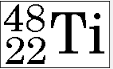
How many protons does this isotope of titanium have?
a)
48
b)
22
c)
26
d)
70
44.

How many neutrons does the isotope of lithium have?
a)
8
b)
3
c)
4
d)
5
45.
How many neutrons does uranium-235 have?
a)
238
b)
92
c)
146
d)
143
46.

In a correctly written symbol what would be located in the "A" position?
a)
number of neutrons
b)
atomic number
c)
number of electrons
d)
mass number
47.
What is the correct chemical formula for rubidium iodide
a)
RbI
b)
Rb2I
c)
RbI2
d)
IRb2
48.
What is the correct chemical formula for potassium oxide?
a)
K2O
b)
KO
c)
KO2
d)
KO4
49.
What is the correct chemical formula of calcium chloride
a)
CaCl2
b)
Ca2Cl
c)
CaCl
d)
Ca2Cl4
50.
What is the correct chemical formula of strontium selenide?
a)
SrSe
b)
Sr2Se
c)
Sr3Se
d)
SrSe2
51.
What is the correct chemical formula of lithium arsenide
a)
Li3As
b)
LiAs
c)
LiAs3
d)
Li2As
52.
What is the correct chemical formula of aluminium oxide?
a)
Al2O3
b)
AlO2
c)
Al3O
d)
Al3O2
53.
In a reaction A + B ----> C, reactant A has 5g and product C has 9g. How many grams does reactant B should have?
a)
4g
b)
5g
c)
9g
d)
14g
54.
Bob puts 200 grams of ice into a pitcher with 900 grams of water. He gets distracted and comes back later to find that the ice has melted in the water. How many grams of water does Bob now have in the pitcher?
a)
200 g
b)
700 g
c)
1,100 g
55.
24 g of magnesium reacts with 38 g of fluorine to produce _____ g magnesium fluoride
a)
62
b)
38
c)
24
d)
14
56.
What is the law of conservation of mass?
a)
The amount of matter changes when reacted or changed.
b)
The mass of all reactants are changed during a physical or chemical change
c)
The mass of the reactants equals the mass of the products
d)
The mass of the products is different than the mass of the reactants.
57.
How many atoms of carbon (C) are in C6H12O6?
a)
3
b)
6
c)
12
d)
24
58.
How many Sodium (Na) are in 6NaCl?
a)
1
b)
12
c)
6
59.
Which of the following shows the correct way to balance the chemical equation?
Fe + O2 -> Fe2O3
Fe + O2 -> Fe2O3
a)
4Fe + 3O2 -> 2Fe2O3
b)
2 Fe + 3O2 -> Fe2O6
c)
4 Fe + O6 -> 2Fe2O3
d)
None of the options are correctly balanced.
60.
Which of the following reactions is balanced?
a)
2CH4 + O2 -> CO2 + H2O
b)
CH4 + 2O2 -> CO2 + H2O
c)
CH4 + 2O2 -> CO2 + 2H2O
d)
None of the chemical equations are balanced.
61.
Balance this equation...
HgO --> Hg + O2
HgO --> Hg + O2
a)
It is balanced
b)
2HgO --> Hg + O2
c)
2HgO --> 2Hg + O2
d)
I don't know...Oh well!
62.
How many HCl molecules do you need to balance this equation?
Mg + __HCl ---> MgCl2 + H2
Mg + __HCl ---> MgCl2 + H2
a)
1
b)
2
c)
3
d)
4
63.
Which coefficients balance this equation:
NH3 + O2 ----> NO + H2O
NH3 + O2 ----> NO + H2O
a)
2,3,5,6
b)
5,5,4,6
c)
4,6,4,5
d)
4,5,4,6
64.
Balance this equation.
_CH4 + _O2 --> _CO2 + _H2O
_CH4 + _O2 --> _CO2 + _H2O
a)
1,2,1,1
b)
2,1,2,1
c)
1,2,1,2
d)
0,2,0,2
65.

The blue numbers in the image below represent ________
a)
I don't know, and don't want to try
b)
coefficients
c)
subscripts
d)
none of the answers are correct
66.

The red numbers in the image below represent ________
a)
subscripts
b)
coefficients
c)
I don't know, and don't want to try
d)
None of the answers are correct
67.
Is the following equation balanced or unbalanced?
Fe + S --> FeS
Fe + S --> FeS
a)
balanced
b)
unbalanced
68.
How many atoms are there TOTAL in:
H2SO4
H2SO4
a)
6
b)
5
c)
7
d)
3
69.
4Si + S8 --> 2Si2S4
a)
Synthesis
b)
Decomposition
c)
Single displacement
d)
Double displacement
70.
3Ca + 2AlCl3 --> 3CaCl2 + 2Al
a)
Synthesis
b)
Decomposition
c)
Single diplacement
d)
Double displacement
71.
3KOH + H3PO4 --> K3PO4 + 3H2O
a)
Synthesis
b)
Decomposition
c)
Single displacement
d)
Double displacement
72.
2Pb(NO3)2 --> 2PbO + 4NO2 + O2
a)
Synthesis
b)
Decomposition
c)
Single displacement
d)
Combustion
73.
Always starts with a hydrocarbon that reacts with oxygen and produces carbon dioxide and water.
a)
Decomposition
b)
Synthesis
c)
Combustion
d)
Single Replacement
74.
The following reaction is an example of _________________
CH4 + O2 —————> CO2 + H2O
a)
Decomposition chemical reaction
b)
Synthesis chemical reaction
c)
Combustion chemical reaction
d)
Double replacement chemical reaction
100 %

