

wayground logo

Free Printable Worksheets

Font size

S
M
L
XL
Worksheets

Domain two

Total questions: 112

Worksheet time: 1hrs 20mins

Name
Class
Date
1.
What is demand?
a)
The desire to own something and the ability to afford it.
b)
A graph that shows the quantity demanded at every price.
c)
The usefulness of a product expressed in a dollar sign.
2.
Which of the following best describes the Law of Demand?
a)
As price goes down, demand goes down. (and vice versa).
b)
As price goes down, demand goes up (and vice versa).
c)
As demand goes down, supply goes up.
d)
As demand goes up, price becomes elastic.
3.
The Law of Demand "works" because of a combination of what two effects?
a)
Substitution and Income Effects
b)
Doppler and Lake Effects
c)
The Ability and Desire Effect
d)
The Substitution and Elasticity Effect
4.
A change in demand is shown
a)
along the demand curve
b)
with a new demand curve above or below the original demand curve
c)
without a demand graph
d)
with a totally vertical line
5.
A change in quantity demanded is shown
a)
at various points on the demand curve
b)
with a new demand curve drawn above or below the original demand curve
c)
with a vertical line
6.
Consuming more of one good because of a change in price of another good is known as the 
a)
income effect
b)
substitution effect
c)
elasticity effect
d)
demand effect
7.
A table that lists the quantity of a good that a single person will buy at each price in a market.
a)
demand schedule
b)
market demand schedule
c)
elasticity chart
d)
supply and demand graph
8.
The demand curve always slopes
a)
down and to the right
b)
straight up and down
c)
down and to the left
d)
up and to the right
9.
What goes on the horizontal axis of a demand graph?
a)
price
b)
quantity demanded
c)
quantity supplied
d)
change in demand
10.
Which of the following would NOT cause a demand curve to shift?
a)
a change in a consumer's income level
b)
a change in population
c)
a change in a consumer's expectations
d)
a change in the price of a product.
11.
Consumers demand more of this type of good when their income rises.
a)
Normal good
b)
Inferior good
c)
Elastic good
d)
Substitution good
12.
Consumers demand less of this type of good when their income rises.
a)
Normal good
b)
Inferior good
c)
Elastic good
d)
Related good
13.
The demand for a good is _____ when a small change in price causes a large change in the quantity demanded.
a)
elastic
b)
inelastic
c)
related
d)
substituted
14.
If a consumer knows that a product will be going on sale this week, how will his/her CURRENT demand be affected?
a)
it will go up
b)
it will go down
c)
it will stay the same
d)
what does this have to do with the price of tea in China?
15.
Demand for a product is said to be _______ when a change in price causes very little change in quantity demanded.
a)
elastic 
b)
inelastic
c)
related
d)
rigid
16.
Demand for a product is said to be _______ when a change in price causes very little change in quantity demanded.
a)
elastic 
b)
inelastic
c)
related
d)
rigid
17.
Goods that are bought and used together are 
a)
complementary goods
b)
substitute goods
c)
income goods
d)
unrelated goods
18.
The study of economics that deals with economic activity in small units and individual decisions.
a)
microeconomics
b)
macroeconomics
c)
demand
d)
supply
19.
Insulin for a diabetic has a/an _______ demand.
a)
elastic
b)
inelastic
20.
Sheetz gas has a/an _______ demand.
a)
elastic
b)
inelastic
21.
Which of the following is NOT a determinant for demand elasticity?
a)
the availability of substitutes
b)
a good's relative importance
c)
whether or not it is a luxury vs. a necessity
d)
change in population
22.
How will the demand curve for iPhone accessories change if the demand for iPhones increases?
a)
shift up and to the right
b)
shift down and to the left
c)
it will not change
23.
In a market economy, who decides on the prices of goods and services?
a)
government
b)
buyers and sellers
c)
firms
d)
local leaders
24.
Which factor causes the demand curve to shift in the following situation: Bobby graduated from college and got a good job, so he decided to buy a new 2016 Passat.
a)
income
b)
population
c)
consumer tastes & advertising
d)
prices of related goods
25.
Stockholder is another name for:
a)
Value holder
b)
Percentage Holder
c)
Retailer
d)
Shareholders
26.
All profits from a sole proprietorship belong exclusive to
a)
Owner
b)
Government
c)
Stockholders
d)
Prem Joshi
27.
Which of the following is disadvantage of a corporation
a)
limited liability
b)
external funding sources
c)
transfer of ownership
d)
Too many legal formalities
28.
Which option from this is not an advantage of sole trader business?
a)
profits remain to yourself
b)
limited sources of fund
c)
you're the boss
d)
everything is under your decisions.
29.
Limited Liability means
a)
The company is not responsible for debts
b)
Where shareholders are illegally responsible for debts
c)
Is there anything like this?
d)
Where shareholders are legally responsible for the debts of a company
30.
One of the disadvantages of a sole trader business is that:
a)
Capital is limited to owner’s savings and bank loans
b)
Decisions take too long to make
c)
As they are government owned there is no profit motive
d)
the owners may disagree
31.
What do shareholders buy:
a)
Chocolate
b)
Laptop
c)
Business
d)
Shares
32.
The simplest form of business ownership is a
a)
Sole Proprietorship
b)
Limited Partnership
c)
Liability Company
d)
Limited Liability Partnership
33.

The form of business organization that has the largest sales volume is the:

a)
Partnership
b)
Co-operation
c)
Corporation
d)
Multinational
34.
A ______________________ automatically ends with the owner dies. 
a)
Liability Company
b)
Limited Partnership
c)
Sole Proprietorship
d)
Limited Liability Partnership
35.

Which one of the following is not a type of business structure?

a)
Limited Liability Company
b)
Limited Proprietorship
c)
limited Partnership
d)
Limited Liability Partnership
36.

Fill in the blank.

            __________ is a form of business that is owned by one person.
a)
Partnership
b)
Shareholders
c)
Sole Trader
d)
Liability
37.
2.   A sole proprietor is not personally liable for the obligations of his or her business.
a)
True
b)
False
38.
Which of the following is an example of NGO
a)
World Wide Fund
b)
Facebook
c)
BJP
d)
Congress
39.

True or False:

            NGOs belong to government?
a)
False
b)
True
40.

The public sector is owned and controlled by _______________________

a)

The government

b)

Individuals and households

c)

Shareholders

d)

The general public

41.

What does limited liability refer to?

a)

Shareholders' personal assets cannot be claimed by creditors for money owed by the firm

b)

The maximum a shareholder can lose is equal to their initial investment, but nothing more

c)

The directors are exempt from adhering to company law and legislation

d)

Both (A) and (B)

42.

If an individual wants full and total control over a firm and wishes to minimize the legal bureaucracy in setting up, which of the following is most suitable?

a)

Partnership

b)

Sole proprietorship

c)

Private limited company

d)

Public limited company

43.

Which of the following is not a valid advantage of a sole proprietorship?

a)

The proprietor has limited liability

b)

The proprietor has total control and more flexibility

c)

Fewer legal formalities are required

d)

The proprietor does not have to share profits with others

44.

Which of the following is not a disadvantage of being a sole trader?

a)

Unlimited liability

b)

Limited availability of, and access to, funds

c)

Time consuming to set up

d)

Continuity challenges

45.

Which of the following is not a characteristic of partnerships?

a)

Limited liability for all members

b)

A deed of partnership is drawn out

c)

Shared control, ownership and profits

d)

Greater continuity

46.

Which of the following is not an advantage of a partnership?

a)

Larger amounts of capital can be raised by selling shares to friends and family

b)

There is greater continuity compared with sole traders

c)

There is a greater wealth of knowledge and expertise than setting up as sole traders

d)

Corporate confidentiality is relatively high as financial statements do not have to be released to the public

47.
Which of the following statements correctly identifies a difference between perfect competition and monopolistic competition? 
a)
In perfect competition there are no barriers to entry, but there are strong barriers in monopolistic competition. 
b)
In perfect competition there are many firms, but in monopolistic competition there are only a few firms. 
c)
In perfect competition the firms all sell products that are exactly the same, but in monopolistic competition each firm sells a slightly differentiated product. 
d)
In perfect competition there are few consumers, but in monopolistic competition there are many consumers. 
48.
There are high barriers to entry in the market in perfect competition.
a)
True
b)
False
49.
An oligopoly is a market dominated by just a few firms.
a)
True
b)
False
50.
How many firms are in a monopoly? 
a)
one
b)
two
c)
three
d)
unlimited
51.
A market structure in which a few large firms dominate a market
a)
Perfect Competition
b)
Monopolistic Competition
c)
Oligopoly
52.
Going to the Madison's Farmers Market to buy apples, you will find this type of market structure.
a)
Monopoly
b)
Perfect Competition
c)
Monopolistic Competition
d)
Oligopoly
53.
Since the airline industry is controlled by only a few very big companies, which type of market structure would best describe it.
a)
Monopoly
b)
Perfect Competition
c)
Monopolistic Competition
d)
Oligopoly
54.

A combination of companies that try to corner the market and act as a monopoly

a)

Trust

b)

Cartel

c)

Monopolistic Competition

d)

Conglomerate

55.

Corporations illegally working together to act as a monopoly

a)

Trust

b)

Cartel

c)

Monopolistic Competition

d)

Conglomerate

56.

Any competition for business that does not involve price (better location, better guarantee, up-scale, better quality etc.)

a)

Pure Competition

b)

Monopolistic Competition

c)

Oligopoly

d)

Non-Price Competition

57.

The above image is an example of...

a)

Pure Competition

b)

Monopolistic Competition

c)

Oligopoly

d)

Non-Price Competition

58.

The market for farm products is mostly pure competition

a)

True

b)

False

59.

Collusion is illegal (not legal) in the U.S.

a)

True

b)

False

60.

A car company merges with a seat belt maker and a tire company, it is called

a)

horizontal merger

b)

vertical merger

c)

horizontal conglomerate

d)

vertical drop

61.

DeBeers used to be the only supplier of diamonds. Which terms best describes this firm?

a)

Merger

b)

Monopolistic Competition

c)

Monopoly

d)

Oligopoly

62.

Although no matter which barber/hair stylist you chose, you will have shorter hair; most people have a preference to going to one stylist or barber over another. This is an MOST LIKELY to be because of

a. c.

b. d.

a)

Perfect Competition

b)

Non-Price Competition

c)

Beauty Contests

d)

Monopolistic Cartels

63.
What caused this to happen to the demand for gummy bears?
a)
Price of gummy worms increases
b)
New T.V. ad illustrates 50% of cavities are bear related
c)
Minimum wage is increased 7%
d)
Gummy bears become the official candy of netflix
64.
Expectations about the future price of a good can shift the demand curve.
a)
True
b)
False
65.
What caused this to happen to the demand for McDonalds french fries?
a)
Price of hamburgers decreases
b)
McDonalds announces fries will be $.50 more expensive starting next week
c)
Wendys has a sale, buy one burger get two fries free for the whole month
d)
A new tax cut increases household income by 14%
66.
What caused this to happen?
a)
Population decreased
b)
Item becomes trendy
c)
People expect the item to be cheaper later
d)
Price of product decreased
67.

In the Market for TV's, a new technology is used to increase the production of TVs. What happens?

a)

Demand will increase

b)

Demand will decrease

c)

Supply will increase

d)

Supply will decrease

68.
The law of demand states that as the price increases then 
a)
quantity demanded increases
b)
quantity demanded decreases
c)
demand increases
d)
demand decreases
69.

Equilibrium in a market means which of the following?

a)

the point at which quantity supplied and quantity demanded are the same and a price point is set

b)

the point at which unsold goods begin to pile up

c)

the point at which suppliers begin to sell supplies

70.

When quantity supplied exceeds quantity demanded.

a)

shortage

b)

fad

c)

search costs

d)

surplus

71.
When quantity demanded exceeds quantity supplied at a certain cost
a)
shortage
b)
fad
c)
search costs
d)
surplus
72.

If there is a shortage, what will price do?

a)

Price will increase.

b)

Price will shift to the right.

c)

Price will stabilize.

73.

What is demand?

a)

The desire to own something and the ability to afford it.

b)

A graph that shows the quantity demanded at expensive prices.

c)

The usefulness of a product expressed in a dollar sign.

74.

Which of the following best describes the Law of Demand?

a)

As price goes down, demand goes down. (and vice versa).

b)

As price goes down, demand goes up (and vice versa).

75.
The diagram represents a
a)
increase in demand
b)
decrease in demand
76.

Point at which supply and demand come together

a)

price ceiling

b)

excess demand

c)

equilibrium

77.

The price of Clif Bars increases. What happens to the market for Powerbars?

a)

Demand increases

b)

Demand decreases

c)

Supply increases

d)

Supply decreases

78.

Pottery Barn runs a sale. What happens to the market for stuff from Crate & Barrel?

a)

Demand increases

b)

Demand decreases

c)

Supply increases

d)

Supply decreases

79.
The picture illustrates
a)
an increase in demand
b)
a decrease in demand
c)
an increase in quantity demanded
d)
a decrease in quantity demanded
80.
The picture illustrates
a)
an increase in supply
b)
a decrease in supply
c)
an increase in quantity supplied
d)
a decrease in quantity supplied
81.
The picture illustrates
a)
an increase in supply
b)
a decrease in supply
c)
an increase in quantity supplied
d)
a decrease in quantity supplied
82.

Which of the following would not cause the demand for ink pens to change?

a)

a change in the price of pencils, a close-substitute

b)

an increase in incomes of buyers of pens, assuming pens are a normal good

c)

a change in the price of pens

d)

a decrease in the price of paper, a complement to pens

83.

Economists predict that, other things equal, a rise in consumer incomes will increase the demand for bicycles. This prediction assumes that bicycles are

a)

an inferior good

b)

a complementary good

c)

a common substitute good

d)

a normal good

84.

A market is in equilibrium, if the demand curve shifts left quantity will

a)

Rise

b)

Fall

85.

A leftward shift of a supply curve might be caused by:

a)

an improvement in the relevant production techniques

b)

an increase in consumer incomes.

c)

some firms leaving an industry.

d)

a decline in the prices of needed inputs

86.
Equilibrium price is the price at which the quantity of a product demanded by consumers and the quantity supplied by producers
a)
are different.
b)
are equal.
c)
is higher for the product demanded.
d)
is higher for the product supplied.
87.

The market equilibrium price of a given good is currently $12. In response to a price ceiling of $14 imposed by the government,

a)

A shortage of this good will occur

b)

A surplus of this good will occur

c)

There will be neither a shortage nor a surplus of this good

d)

Sellers will be required to raise their prices to $14

88.

The equilibrium wage rate on a certain market is $5 per hour and the number employed at that wage is 1000. If the government imposes a minimum wage,

a)

The wage rate will fall and the number employed will rise

b)

The wage rate will rise and the number employed will fall

c)

Both the wage rate and number employed will rise

d)

The wage rate will rise but the number employed will not change

89.

A market is in equilibrium. If the supply curve for this product shifts left, the price of the good will

a)

Rise

b)

Fall

90.
3. Price floors and price ceilings prevent items from obtaining their equilibrium price.
a)
True
b)
False
91.
4. The minimum wage is an example of a government price control.
a)
True
b)
False
92.
A ___ ___ keeps prices form going any higher and causes a ___.
a)
price ceiling; shortage
b)
price ceiling; surplus
c)
price floor; shortage
d)
price floor; surplus
93.
A ___ ___ keeps prices form going any lower and causes a ___.
a)
price ceiling; shortage
b)
price ceiling; surplus
c)
price floor; shortage
d)
price floor; surplus
94.

The relationship between Households and Firms is best described as...

a)

Independent

b)

Interdependent

95.

The term Households, refers to all the consumers in our economy

a)

True

b)

False

96.

Firms sell their resources to Households, and in exchange they are paid an income

a)

True

b)

False

97.

Households sell goods and services to Firms

a)

True

b)

False

98.

Capital...

a)

is the ability to combine all 4 resources

b)

is the human made items used in the production process

99.
Individuals sell __________ to businesses and in return individuals earn an __________.
a)
profit, income
b)
resources, products
c)
resources, income
d)
profit, individuals
100.
Businesses sell __________ to individuals and in return businesses earn a __________.
a)
products, profit
b)
businesses, individuals
c)
resources, profit
d)
income, profit
101.
Money taken by the government from the amount individuals or businesses make at work.  This can be defined as....
a)
Interest Rate
b)
Money
c)
Currency
d)
Income Tax
102.

How do governments get their money?

a)

Tax Businesses

b)

Tax Households

c)

Tax both Businesses and Households

d)

They print their own money

103.

In which market do households sell?

a)

Product Market

b)

Factor Market

c)

Market Economy

d)

Fresh Market

104.

What is another term for businesses according to the Circular Flow?

a)

Firms

b)

Organizations

c)

Companies

d)

Corporations

105.

What do Governments give to both businesses and households?

a)

Taxes

b)

A headache

c)

Goods & Services

d)

Opportunity Costs

106.

What is another term for Households?

a)

Factors

b)

Apartments

c)

Consumers

d)

Private Entities

107.

Why is the Circular Flow in the shape of a circle?

a)

Because of the way it is

b)

Because money flows from businesses to households and back to businesses

c)

Because the circle represents completion

d)

Because circles are the easiest shape to draw
108.
The circular flow model of a market economy shows
a)
how profits are made
b)
what inputs are required for what outputs
c)
how many firms can support the needs of how many households
d)
the interactions between households and  firms in the free market
109.
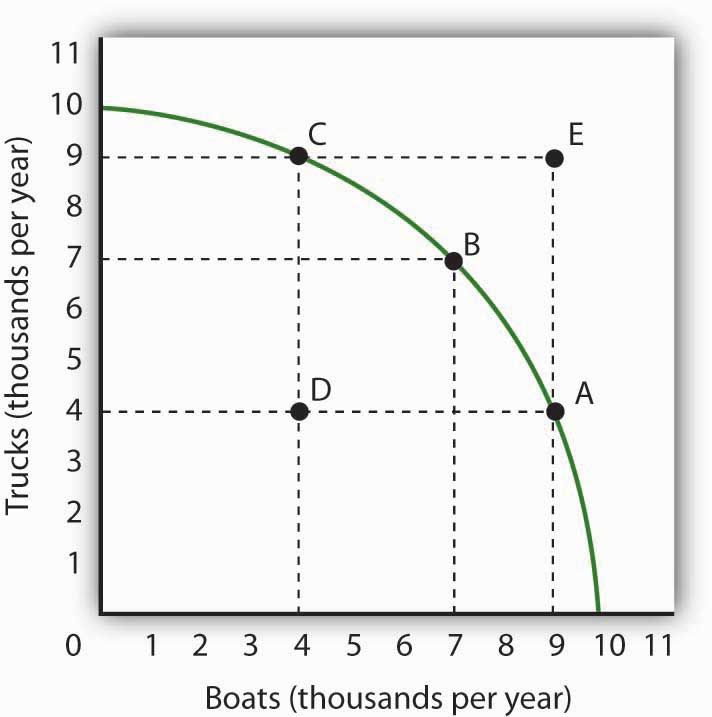
The opportunity cost of increasing production from 7 to 9 trucks is
a)
Scarcity
b)
2 boats
c)
2 trucks
d)
3 boats
110.
What is the production possibilities curve?
a)
a graph that shows how much an economy can produce between 2 goods
b)
how much money something is
c)
the opportunity one has to give up in order to gain something else
d)
land, labor, capital, entrepreneurs
111.
What does point B represent?
a)
Production at greater than the country's minimum potential
b)
Production is less than the country's minimum potential
c)
Production is greater than the country's maximum potential
d)
Production at the country's maximum potential
112.
A point inside the PPC indicates
a)
Full and efficient utilization of resources
b)
inefficient utilization of resources
c)
Unemployment
d)
Both B & C
