
 Worksheets
Plants, Body Systems, and Viruses
Total questions: 53
Worksheet time: 2hrs 43mins

The mimosa plant displays thigmotropism by collapsing its leaves in response to touch, as shown in the pictures below. The plant on the left is undisturbed. The upper stem of the plant on the right has been touched. What is the most likely benefit of this mechanism for the plant?
Protection from a loss of minerals to the environment
Protection from herbivores by becoming less attractive
Protection from overwatering
Protection from poor light availability
Plant hormones serve as chemical messengers between cells and tissues. Auxin is a plant hormone that causes the cells on the shady side of a plant shoot to elongate. The response enabled by auxin is known as —
geotropism
transpiration
phototropism
photosynthesis
Cytokinins are a class of plant hormones that help regulate growth by promoting cell division. Cytokinins are produced mainly in meristematic tissue, where most plant growth occurs. Which system carries cytokinins produced in the roots to the rest of the plant?
Vascular system
Dermal system
Reproductive system
None of these
Animal body systems often coordinate their actions to carry out specific functions for the whole animal. Which of these correctly describes the interaction of two biological systems for a specific purpose in the human body?


Some students are instructed to put a celery stalk in a red dye solution for a lab activity. First the students carefully cut the bottom of the stalk with a scalpel. Then they put the stalk in the beaker with the solution and place the beaker on a shelf in the lab room. The next day they check the stalk and make observations. The students note that the leaves at the end of the stalk have changed color from green to red. The students cut across the celery stalk and use a hand lens to see that the small tube openings along the edge of the celery stalk are also red. How do the plant systems work together to make this movement of liquid possible?
The roots absorb their own water and minerals, while the stem absorbs its water and minerals through the leaves.
The roots absorb water and minerals and move them up to the stem, while the stem moves food produced in the leaves down to the roots in tiny tubes.
The roots anchor the plant in the soil, and the stem holds the leaves up.
The roots lose water vapor to the soil, and the stem loses water vapor through the leaves.
The outermost layer of plant stems in dicotyledons consists of epidermal cells and guard cells that surround openings called stomata. The epidermal cells are usually covered with a waterproof layer that provides protection from injury and water loss. The stomata allow gas exchange. The epidermal cells and stomata have functions similar to those of which two human body systems?
Skeletal and respiratory
Integumentary and respiratory
Cardiovascular and integumentary
Cardiovascular and skeletal

Most plant leaves take in more carbon dioxide as light increases. They give off carbon dioxide if light intensity is too low. The graph shows a plant’s carbon dioxide levels at different light intensities. At point X, the rate of which process is equal to the rate of photosynthesis?
Transpiration
Growth
Reproduction
Cellular respiration

The diagram shows the reproductive system of a plant. Which of the following best describes the interaction that occurs between a plant’s reproductive parts during self-fertilization?
Pollen is released from the anther and is transferred to the stigma. A pollen tube forms and grows through the style. The pollen tube reaches the filament, where the sperm fertilizes the egg.
Pollen moves from the ovule up through the style and is released from the stigma. The pollen is transferred to the anther, where the sperm fertilizes the egg.
Pollen is released from the anther and is transferred to the stigma. A pollen tube forms and grows through the style. The pollen tube reaches an ovule within the ovary, where the sperm fertilizes the egg.
Pollen is released from the stigma and is transferred to the anther. A pollen tube grows down from the anther through the filament and fuses with the ovule, where the sperm fertilizes the egg.
Copper is a micronutrient that can be found in soil. Copper is important for reproductive growth in plants and plays an indirect role in chlorophyll production. Which statement correctly describes the interaction that occurs between the root and the shoot systems of plants to allow reproduction to occur?
Copper that is absorbed by the roots is transported to reproductive tissues by the shoot system.
The shoot system stores copper for later use by the roots and the reproductive structures.
The shoot system transports copper to the roots after it is taken in through stomata in the leaves.
Copper is produced in the roots when copper-containing compounds are hydrolyzed.
Scientists studying illnesses caused by chemically contaminated food conduct research to minimize the effects of these diseases on society. These chemicals harm the body through interactions between the digestive system and the immune system. Scientists conducting this research are likely to describe which of these interactions between the digestive and immune systems?
Chemicals enter the immune system through a break in the skin. The chemical contamination is then passed to the digestive system by the circulatory system.
The immune system transforms the chemicals in the contaminated foods into harmless chemicals. These harmless chemicals are then broken down by the digestive system.
When contaminated foods are eaten, the immune system prevents the chemicals from entering the digestive system.
Chemicals enter the digestive system through contaminated foods. Once in the body, the chemical contaminants impair the body’s ability to fight off infectious diseases.
Leaves are part of a plant’s shoot system. The xylem tissue in leaves transports —
the bacteria needed for nitrogen fixation in root nodules
the water and minerals that are absorbed by the roots
the wax required to coat the surface of actively growing tissue
the oxygen that regulates the rate of carbohydrate production
Changes in water pressure within guard cells cause the cells to open or close the stoma. This response helps the plant maintain homeostasis by —
stabilizing the plant’s temperature through the evaporation of water
allowing oxygen needed for photosynthesis to enter the plant
enabling the plant to release more carbon dioxide at night for photosynthesis
regulating the amount of water the plant loses during transpiration
These structures open and close the stomata
guard cells
cuticle
chloroplast
thylakoids
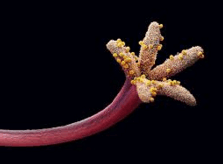

Several structures work together to allow flowering plants to reproduce. The diagram shows a typical flower. Which table correctly identifies the function of each structure or group of structures in the reproduction of the plant?


Plant roots have extensions called root hairs. These root hairs are important in the homeostasis of the plant. Which statement best explains the importance of the root hairs to the stems and leaves of the plant?
Root hairs convert minerals into glucose for immediate use by cells.
Root hairs decrease the need for osmosis and diffusion in vascular tissue.
Root hairs prevent water loss in leaves through transpiration and gas exchange.
Root hairs increase the surface area of the roots for nutrient and water absorption.
Cell differentiation is critical during embryonic development. The process of cell differentiation results in the production of many types of cells, including germ, somatic, and stem cells. Cell differentiation is most directly regulated by —
ATP
DNA
Lipids
Sugars

The acacia ant (Pseudomyrmex ferruginea) lives in the bullshorn acacia plant, as shown below. The acacia ant nests and feeds in the plant’s hollow thorns. The ant helps protect the bullshorn acacia by attacking insects and grazing animals that come near the plant. The relationship between the acacia ant and the bullshorn acacia is an example of which of the following?
Commensalism
Mutualism
Neutralism
Parasitism

A student reads this advertisement for a product containing a plant micronutrient that can be added to soil. Based on this information, the student can conclude that boron is absorbed by plant roots from soil and then —
transported to reproductive tissues by the plant’s shoot system
stored in plant stems until the flowers are pollinated
concentrated in the roots until the plant’s reproductive tissues mature
transported by the phloem to the stomata in leaves, where it attracts pollinators
Common baboons live on the savanna in breeding groups called troops. While females tend to stay with the troop, younger or less dominant males may leave to join a neighboring troop. Which of these is a likely outcome of movement by young males?
Gene flow occurs between populations.
Allele frequencies suddenly change.
Relative genotypic frequencies reach a constant state.
Intermediate phenotypes increase in the species.
Human body cells each have 46 chromosomes in their nuclei. Meiosis is necessary in order to ensure that each gamete produced in the human body has —
12 chromosomes
23 chromosomes
46 chromosomes
92 chromosomes
What two human systems work together to provide body cells with a constant supply of oxygen while removing carbon dioxide waste products?
Nervous and endocrine
Muscular and skeletal
Respiratory and circulatory
Excretory and integumentary

Models of the human immunodeficiency virus (HIV) and an animal cell are shown below. What is the difference in the function of the glycoprotein structures of an HIV virion and the cilia of an animal cell?
The glycoprotein structures are used for attachment, and the cilia are used to move fluids surrounding the cell.
The glycoprotein structures are used to obtain nutrition, and the cilia are used to secrete proteins.
The glycoprotein structures are used to provide physical support for the viral envelope, and the cilia strengthen the cell membrane.
The glycoprotein structures are used for defense, and the cilia are used for locomotion.
Severe acute respiratory syndrome (SARS) is an illness caused by a coronavirus. Symptoms including a high fever, headaches, and body aches typically occur two to seven days after infection by the virus. SARS is more serious in elderly patients. This information suggests that the reproductive cycle of the SARS virus is —
lysogenic, because the virus is a coronavirus
lytic, because the virus causes respiratory illness
lysogenic, because the virus primarily affects older people
lytic, because of the quick onset of symptoms after infection

The picture shows a 3-D model of a virus called a bacteriophage. Bacteriophages can infect bacteria such as E. coli. In what way are the bacteriophage and E. coli alike?
They contain antibodies.
They reproduce by mitosis.
They have identical genomes.
They lack membrane-bound organelles.
Viruses can be transmitted through air, water, food, insect bites, and direct skin contact. Once a virus gains entry to the body, it invades a host cell in order to —
deactivate the host cell’s defenses
synthesize antibodies for defense
metabolize host proteins and grow
access cellular processes for replication
The structure of a virus is simpler than the structure of a cell. A virus may be composed of only —
a genome, a protein coat, and a lipid membrane.
a nucleus, a Golgi apparatus, and cytoplasm.
a cytoskeleton, chloroplasts, and a mitochondrion.
a lysosome, transfer RNA, and enzymes.
An avian virus infects the bird population of an ecosystem. Because of this, the population of locusts and beetles begin to thrive, resulting in a depletion of wild grasses. The loss of bird population negatively affects predatory snakes that feed on eggs of the bird population. Which food web illustrates the flow of energy in this ecosystem?


Acquired immunodeficiency syndrome (AIDS) is caused by the human immunodeficiency virus (HIV). Multiple varieties of HIV affect the human body by —
preventing host cells from fighting other viruses.
causing host cells to stop undergoing mitosis
stimulating host cells to endlessly produce RNA.
draining host cells of all cytoplasm.
Invading the host cell enables the virus to —
synthesize oxygen.
reproduce.
obtain nutrients.
expand.
A virus usually replicates itself in —
the cytoplasm of the host cell.
the nucleus of the host cell.
the cell membrane of the host cell.
in the mitochondrion of the host cell.
A virus can cause cancer by —
signaling the host cell to protect itself from other viruses.
stimulating the host cell to reproduce indefinitely.
causing the host cell to expel the virus.
fusing the DNA of the host cell and surrounding cells.
Read the passage and answer the following question(s).
Directions: The passage below concerns viruses and infections. Use the passage to answer any questions that follow.
When an individual is exposed to a virus that causes infection, the individual becomes ill and experiences the effects of the virus as it runs its course. It is not until the body is able to recognize the virus and stop the virus's replication cycle that a person feels well again. Once the body has recognized the virus, it creates memory cells, which are white blood cells specific for the infectious virus that flow through the body, ready for any future attack by the same type of virus. It is the presence of these memory cells that prevents a person from getting ill from the same virus in the future.
How does the flu vaccine, an injection usually composed of a small amount of live but not harmful viral cells, prevent a person from getting sick from the flu virus?
It prevents the flu virus from converting host cells into pathogenic bacterial cells, which are the source of a person's symptoms, as it is the bacterial cells that damage the respiratory tract.
It initiates the production of memory cells specific for that year's predicted flu virus. When the flu virus is inhaled, it is recognized quickly by memory cells and destroyed.
It stimulates the host cell to produce antiviral toxins, which are released continually into the respiratory tract, to destroy the viral cells even before they are recognized by white blood cells.
It gives a person a mild case of the flu all year long. Since the person already has an active form of the flu virus, it is impossible to infect that person again with another flu virus.
If memory cells are always present after the first exposure to a virus, then why can people get the flu each year?
After its first exposure to the host cell, the flu virus remains dormant in the lysogenic cycle for about a year. Many people whose immune systems are weak have an awakening of the flu virus once a year as it enters into the lytic cycle.
The flu virus is unusual in that it has the ability to convert host cells into bacterial cells. Body cells do not have the ability to create memory cells to defend against bacterial cells, so this results in a new infection by the flu virus each year.
The flu virus lacks a protein coat, which is necessary for cell-to-cell recognition. Without a protein coat, the body cells do not recognize the flu virus and cannot make memory cells specific for the flu virus.
Viruses are composed of genetic material that has the ability to mutate. Some viruses, such as the flu, have the ability to mutate more frequently than other viruses and are not recognized by preexisting memory cells.
Mr. Hernandez shares with his class that his dog has the parvovirus and had to be taken to the vet. A student asks Mr. Hernandez if he too has the virus and if the class should be worried. Which explanation below is the most accurate answer Mr. Hernandez could give?
He is infected and could possibly become sick in the next few days, but because he is an adult, his immune system will protect him.
The virus has entered his body but does not make him sick because he has taken medicine.
Every virus has a specific kind of host cell it attaches to, and this virus only infects dogs, not humans.
A virus cannot transfer from one host to another without direct contact.

Directions: The diagram below shows phases in the cell cycle in the order that they occur. Use the diagram and your knowledge of science to answer any questions that follow.
Cells must manufacture certain proteins called cyclins to start synthesis ("S" phase). Sometimes, cells are stimulated by a virus to manufacture too much of a cyclin. This disruption in the cell cycle typically causes the cell to react by —
producing tumors, which may lead to cancer.
developing organelles, which may lead to bone loss.
taking in water, which may lead to inflammation.
fragmenting into platelets, which may lead to anemia.



