
 Worksheets
IGCSE Physics Megaquizz
Total questions: 102
Worksheet time: 2hrs 42mins
What part of a D.C. electric motor ensures that it rotates in one direction only.
Diode
Split Ring Commutator
What's DC?
The Negative Magnetic Field
What's the best condition for diffraction to occur?
Gap width is greater than wavelength
Frequency is high
Gap width is equal to wavelength
Frequency is low
How is electricity altered so that transporting electricity is most efficient?
Voltage is lowered
Voltage is increased to very high levels.
High current
Double insulated wire is used.
Current is increased to very high levels
What type of waves have oscillations parallel to the direction of energy transfer.
longtitudinal
tranverse
EM
water surface wave
What is density of an anchor with a mass of 4 grams and a volume of 2 cm3
4
1
2
8
What is the relationship known as the transformer equation?
Input voltage/Output voltage = No. primary turns/ No. secondary turns.
Input voltage/Primary turns. = secondary turns/ output voltage
V1R1 = V2R2
Voltage/Resistance = Current
True or False? Insulating your house does not reduce heat transfer.
True
False
Correct
Incorrect
Which of these processes does NOT make use of static electricity.
spray painting bicycle frames.
trapping dust particles in factory chimneys.
making a photocopy of a printed sheet
Television
What is the charge of a proton?
1+
0
1-
2+
What is the charge of an electron?
0
1+
1-
2-
What is the mass of a neutron?
2
Almost zero
1
3
What is the charge of an ion which has lost an electron?
Zero
Plus one
Minus 1
Plus minus
What is the net charge of on a 2+ ion which has gained an electron?
+1
0
-1
-2
What is the atomic number of an atom?
The number of neutrons
The number of protons only
The number of electrons only
The number of protons as well as number of electrons
What is the mass number of an atom?
The number of protons and neutrons
The number of protons and electrons
The number of electrons and neutrons
What are isotopes?
Atoms of the same element with different numbers of electrons
Atoms of the same element with different numbers of protons
Atoms of the same element with different numbers of neutrons
What is the plum pudding model of the atom?
An atom is a ball of positive charge with negative electrons embedded in it
An atom is a ball of negative charge with positive electrons embedded in it
An atom is a ball of positive charge with negative neutrons embedded in it
What is the radius of a typical atom?
1 × 10⁻⁶ m
1 × 10⁻¹⁰ m
1 × 10-14 m
An atom has 13 protons and 14 neutrons. What is its mass number?
14
13
27
An atom has an atomic number of 9 and a mass number of 19. What are its numbers of protons, neutrons and electrons?
Protons = 10, neutrons = 19, electrons = 10
Protons = 9, neutrons = 10, electrons = 9
Protons = 19, neutrons = 10, electrons = 19
Four atoms have the numbers of protons and neutrons given below. Which two atoms are isotopes of the same element?
W: 8 protons and 8 neutrons
X: 8 protons and 10 neutrons
Y: 10 protons and 8 neutrons
Z: 9 protons and 10 neutrons
X and Y
W and X
X and Z
W and Z
A liquid is a substance ...
... with a fixed shape and fixed volume
... with a fixed shape and a variable volume
... with a variable shape and a fixed volume
... with a variable shape and a variable volume

Which row in the table shows the correct name for the change of state indicated?
from solid to liquid is called boiling
from liquid to solid is called melting
from liquid to gas is called freezing
from gas to liquid is called condensing
A solid is heated until it starts to become a liquid. While it is melting, its temperature ...
... increases
... decreases
... stays the same
... expands
In the kinetic model, matter is pictured as consisting of particles. What does the space between the particles contain?
water
air
vacuum
more particles
Which one of the following statements about evaporation is not correct? When a liquid evaporates ...
...its volume decreases
... molecules with more energy leave the surface
... some of its molecules disappear
... its temperature decreases
A gas exerts pressure because ...
... its particles collide with the walls of its container
... a pressure gauge shows the value of the pressure
... the molecules of a gas are farther apart than in a solid
... Brownian motion shows that the molecules are moving

When the piston is pushed in, the volume of gas decreases, but the temperature remains constant. The pressure of the gas...
Increases
Decreases
Stays the same
Contracts

Another way to change the volume of the gas in the cylinder is to cool it. If you cool the cylinder while the pressure of the gas remains constant. The volume of the gas....
Increases
Decreases
Stays the same
Warms up


What is the focal length of the lens?
longer wavelength: blue
longer wavelength: red
longer wavelength: blue
longer wavelength: red


Several different values of i and r are measured, and a graph is drawn of sin i against sin r.
Which graph is correct?


To two decimal places, what is the refractive index of the plastic?
meaning of µ (micro)
10(-9)
10(-8)
10(-7)
10(-6)
write 0.005 in scientific notation
5/1000
5x10⁻³
5x10³
5 millimeters
WHAT IS A PHYSICAL QUANTITY MADE UP OF ?
A NUMBER
A UNIT
A NUMBER AND A UNIT
A UNIT AND TIME
equation for density
mass/volume
volume/mass
mass x volume
mass + volume
SI unit for length
mm
m
cm
km
what does a micrometer have
revolving barrel with a thread
a extra sliding scale
none of these
revolving barrel with an extra scale on it

what is the room temperature?
21
22
23
23℃
a pendulum takes two seconds to make a complete swing . what could one swing be called
time taken
period
change in time
time
The time taken for 20 swings is 46 seconds. What is the "period" for the motion?
0.43478 s
3.2 s
20.46 s
2.3 seconds
Si unit for density
cubic metres
square meters
cubic centimeters
cubic kilometers
Calculate volume of a block of aluminum with mass of 5400kg and a density of 2700kg/m3
0.5 m3
2 m2
2 m3
0.5 m2
A quick method of finding the density of a liquid is to use a?
barometer
manometer
hydrometer
micrometer
Si unit for weight
neutron
gram
kilogram
newton
State an equation that links weight, mass and gravitational field strength.
weight = mass x gravitational field strength
mass = weight x gravitational field strength
gravitational field strength = mass x weight
weight = gravitational field strength / mass
State the equation that links power, work done and time taken.
time taken = power x work done
power = work done / time taken
work done = power / time taken
power = work done x time taken
State and equation that links efficiency, useful power output and total power input.
useful power output = efficiency /total power input
efficiency = useful power output/ total power input
total power output= efficiency / useful power output
efficiency = useful power output x total power input
State the equation that links charge flow, current and time
current = time x charge flow
time = current x charge flow
charge flow = current x time
charge flow = current / time
state and equation that links power, potential difference and current
power = potential difference/ current
power = current / potential difference
power = current x potential difference
current = potential difference x power
Write down an equation that links work done, force and distance
work done = force/ distance
work done = distance / force
distance = force / work done
work done = force x distance
State the equation that links current, resistance, potential difference
current = resistance x potential difference
potential difference = current x resistance
resistance = current x potential difference
potential difference = current / resistance
Weight =
mass x gravitational field strength
gravitational field strength / mass
mass / gravitational field strength
mass
Work done =
force x distance
distance / force
force / distance
energy transferred
pressure =
force (normal to surface) / Area of a surface
force (parallel to surface)/ Area of a surface
area of a surface / force (perpendicular to surface)
area of a surface / force (parallel to surface)
State an equation linking distance, speed and time
distance = speed / time
speed = distance x time
distance = time / speed
time = speed x distance
Write and equation linking time, change in velocity and acceleration
acceleration = change in velocity / time
change in velocity = acceleration / time
time = change in velocity x acceleration
acceleration = (final velocity - initial velocity) / time
State an equation that represents Newton's 2nd Law
force = mass x acceleration
force = work done / distance travelled
force = moment / distance
force = magnetic flux density x current x length
Time, energy transferred and power can be linked together in which of the following equations?
energy transferred = power x time
power = work done / time
time = energy transferred / power
power = time / energy transferred
Wave speed =
wavelength x frequency
wavelength / frequency
frequency / wavelength
wavelength x time period
State an equation that links volume, mass and density
mass = density x volume
density = volume / mass
volume = density / mass
density = volume x mass
What is the unit for work done?
N
J
Nm
W
A hairdryer has a power rating of 500W. How much energy is generated in 2 minutes?
1000J
250J
60 000J
4.16J
An e-scooter is travelling at 5m/s. It has a total mass of 60kg (including the rider). How much kinetic energy does it have?
150J
3000J
7500J
750J

Equilibrium means a state of _________
being at rest
traveling at light speed
balance
pushing or pulling


Recall and apply the relationship moment of a force (or torque) = force × perpendicular distance from the pivot to new situations or to solve related problems

State the principle of moments for a body in equilibrium
State the principle of moments for a body in equilibrium

Apply the principle of moments to new situations or to solve related problems
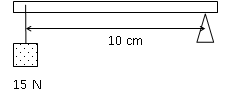

What is the value of F?


In which situation is it IMPOSSIBLE for the object to be in equilibrium?


