wayground logo

Free Printable Worksheets

NEW

Font size

S
M
L
XL
Worksheets

Midterm Review Semester 2

Total questions: 73

Worksheet time: 4hrs 25mins

Name
Class
Date
1.
In the equation 2 Al2O3 --> 4 Al + 3 O2, what is the mole ratio of aluminum to oxygen?
a)
10:6 
b)
3:4
c)
4:3
d)
2:3
2.
Given the reaction: 4Al + 3O2 --> 2Al2O3
How many moles of Aluminum oxide do you have if you have 2 moles of Al?
a)
3 mole
b)
2 mole
c)
1 mole
d)
0.5 mole
3.
4NH+ 5O2-->4NO + 6H2O
What is the total number of moles of H2O produced when 12 mole of NH3 is completely consumed?
a)
15
b)
18
c)
20
d)
24
4.
6CO2 + 6H2O --> C6H12O6 + 6O2 
What is the total number of moles of water needed to make 2.5 moles of C6H12O6?
a)
2.5
b)
6
c)
12
d)
15
5.
What number should be in front of N2 in this chemical equation?
___N2+___F2 --> ___ NF3
a)
1
b)
2
c)
3
d)
4
6.

One mole of water & one mole of glucose contain the same number of molecules.

a)

True

b)

False

7.

One mole of H2 contains the same number of atoms as one mole of CO2.

a)

True

b)

False

8.

Avogadro’s constant is:

a)

6.02 x 10²²

b)

6

c)

6.02 x 10²³

d)

3.01 x 10²³

9.

The relative molecular weight of an oxygen atom is is 16. How much would 1 mole of oxygen molecules (O2)weigh?

a)

8 g

b)

12 g

c)

16 g

d)

32 g

10.

The relative molecular weight of an oxygen atom is is 16, and the relative molecular weight of carbon is 12, how much would 1 mole of carbon dioxide (CO2) weigh?

a)

12

b)

16

c)

44

d)

58

11.
Which conversion factor should be used for the following question " How many molecules are there in 4.00 moles of glucose, C6H12O6
a)
1 mole = 78.12 g
b)
1 mole = 22.4 L 
c)
1 mol = 6.02x 10²³ particles 
d)
more than one
12.
How many molecules are in 9.44 moles of AlCl3?
a)
5.68 molec AlCl3
b)
5.68x1024 molec AlCl3
c)
0.705 molec AlCl3
d)
1.25x10²³ molec AlCl3
13.

How many molecules are in 2.5 mol of NaCl?

a)

1.51x10²³

b)

146

c)

4.15

d)

1.51x1024

14.
How many molecules are there in 31.8 moles of water?
a)
5.28 x 10⁻²³ molecules
b)
1.91 x 1025 molecules
c)
5.28x 10⁻²⁵
d)
1.91 x 10²²
15.
How many moles of copper are 4.57 x 10¹³ atoms of copper?
a)
7.59 x 10⁻¹¹ moles
b)
2.75 x 1037 moles
c)
7.59 x 10¹¹ moles
d)
2.75 x 1033 moles
16.
You need 2 pieces of bread, 1 tablespoon of peanut butter and 2 tablespoons of jelly to make a sandwich.  If you have 10 pieces of bread, 4 tablespoons of peanut butter and 20 tablespoons of jelly, what is the limiting reactant?
a)
bread
b)
jelly
c)
peanut butter
d)
sandwich
17.

Determine the mass of calcium hydroxide produced when calcium carbide reacts with 0.64g of water according ot the following equation

CaC2 + 2H2O --> Ca(OH)2 + C2H2

a)

10.31 g Ca(OH)2

b)

41.31 g Ca(OH)2

c)

1.31 g Ca(OH)2

d)

31 g Ca(OH)2

18.

Determine the mass of lithium hydroxide produced when 0.38g of lithium nitride reacts with water according to the following equation

Li3N + 3H2O --> NH3 + 3LiOH

a)

11.78 g LiOH

b)

0.78 g LiOH

c)

12.78 g LiOH

d)

21.78 g LiOH

19.
Zn + 2HCl → ZnCl2 ​​+ H2​​
15 grams of HCl should theoretically produce 0.42 grams of H2. The reaction actually produced 0.15 grams of H2. What is the percent yield of H2?
a)
2.8%
b)
280%
c)
1%
d)
36%
20.
2NaClO3 (s)  2NaCl (s) + 3O2 (g)  
12.00 moles of NaClO3 will produce how many grams of O2?
a)
256 g of O2
b)
576 g of O2
c)
288 g O2
21.

Determine the % composition of Potassium in the following copound KMnO4

a)

14.8%

b)

34.8%

c)

24.7%

d)

40.5%

22.

Determine the mass of lithium hydroxide produced when 0.38g of lithium nitride reacts with water according to the following equation

Li3N + 3H2O --> NH3 + 3LiOH

a)

11.78 g LiOH

b)

0.78 g LiOH

c)

12.78 g LiOH

d)

21.78 g LiOH

23.
An empirical formula:
a)
is a formula that calculates the coefficients of a compound in a balanced equation.
b)
is the simplest whole-number ratio of moles of elements in the compound.
24.
You are given the following percentages: 40.05% S and 59.95% O. Find the empirical formula for these elements. (keep two decimal places throughout calculations)
a)
SO
b)
SO2
c)
SO3
d)
SO4
25.
What is the empirical formula of the following molecular formula:  C3H6
a)
C3H6
b)
CH2
c)
C2H4
d)
CH3
26.
Which one is empirical?
a)
H2O2
b)
C2H6O12
c)
CaCl2
d)
N2O8
27.
Which pair has the same empirical formula?
a)
NaCrO4 and Na2Cr2O7
b)
C2H4O2 and C6H12O6
c)
C3H6Oand C2H6O2
d)
CH4 and C2H6
28.
What is the percentage of chlorine in sodium chloride? (NaCl)
a)
60.7%
b)
39.3%
c)
60%
d)
40%
29.
Whats the empirical formula of a molecule containing 18.7% of Lithium, 16.3% of Carbon and 65.0% of oxygen?
a)
CO2Li3
b)
Li2CO3
c)
Li3CO2
d)
LiCO5
30.
What is the molecular formula if the empirical formula is CH2O and the molecular molar mass is 180.18?
a)
CH2O
b)
C2H4O2
c)
C4H8O4
d)
C6H12O6
31.
What is the molecular formula for a compound with the empirical formula: K2SOand a molecular mass of 696g.
a)
K2SO
b)
K8SO16
c)
K8S4O
d)
K8S4O16 
32.
Theoretical yield = 73g
Actual yield = 62g
Calculate the percent yield.
a)
1.16%
b)
116%
c)
85%
d)
76%
33.
Zn + 2HCl → ZnCl2 ​​+ H2​​
15 grams of HCl should theoretically produce 0.42 grams of H2. The reaction actually produced 0.15 grams of H2. What is the percent yield of H2?
a)
2.8%
b)
280%
c)
1%
d)
36%
34.
P+ 6Cl--> 4PCl
The reaction of 75.0g P4 with excess chlorine gas produces 110g PClin lab. Find the theoretical yield and calculate percent yield for the reaction. 
a)
78%
b)
64%
c)
27%
d)
33%
35.
Water and Kool-Aid are mixed together. Hot water, coffee and sugar are mixed together. Which substance is the solvent in both?
a)
Water
b)
Coffee
c)
Kool-aid
d)
Sugar
36.
What is a substance that is dissolved in another substance? 
a)
solution
b)
solute
c)
solvent
d)
compound
37.
What is a solvent?
a)
The substance that does the dissolving in a solution.
b)
The substance that is being dissolved in a solution.
c)
The mixing of different substances.
d)
The process in which neutral molecules lose or gain electrons
38.
The concentration of a mixture can be increased in which of the following ways?
a)
Heating the mixture
b)
Adding more water “solvent”
c)
Adding more powder “solute”
d)
Stirring the mixture
39.
In the above picture, a powder is about to be poured into the liquid. Which of the following should be done to make this powder dissolve faster?

a)
stir the powder in the liquid
b)
freeze the mixture
c)
add more powder to the liquid
d)
store the mixture in a dark place
40.
A solution that is considered dilute would be....
a)
Dark in color
b)
Have a strong scent
c)
Have a large amount of solute
d)
Have a small amount of solute
41.
When a certain amount of solvent cannot hold any more solute it is called a ________ solution.
a)
Diluted
b)
Saturated
42.
To make a solute dissolve more quickly i n a solvent which would you do?
a)
Put it in cold water and stir it
b)
Put it in warm water and stir it
43.
Which of the following is not a way to increase the rate of dissolving
a)
evaporation
b)
stirring 
c)
increasing temperature
d)
using a smaller particle size
44.
What is the molarity of 4 g of NaCl (MM=58.45) in 3,800 mL of solution?
a)
0.018 M
b)
0.0011 M
c)
1.052 M
d)
0.062 M
45.
How many grams of solute are dissolved in 125.0 mL of 5.00 M NaCl (MM = 58.45)?
a)
0.625 g NaCl
b)
625 g NaCl
c)
36.5 g NaCl
d)
0.04 mol NaCl
46.
Find the molarity of 186.55 g of sucrose, C12H22O11 (MM = 342) in 250 mL of water.
a)
2.18 M
b)
0.746 M
c)
1.18 M
d)
0.545 M
47.
Which sweet tea would you expect to taste the sweetest?
a)
1M
b)
3M
c)
3.1M
d)
2.5M
48.
How many grams of AgNO3 (MM = 169.87) are needed to prepare 0.125M solution in 250 mL of water? 
a)
.03g
b)
0.5g
c)
5.3g
d)
84.9g
49.
What is the molarity of a solution made by adding 1.565 moles of PbNO3 to 500 mL?
a)
300. M
b)
31.3 M
c)
3.13 M
d)
1.56 M
50.

What is the concentration, in percent by mass, of 0.62 g of solute in 45.0 g of solution?

a)

0.014 %

b)

1.4 %

c)

0.13%

51.

What mass of solute is needed to make 100.0 g of a 3.4% solution?

a)

3.4 g

b)

34 g

c)

2941 g

d)

0.34 g

52.

What is the percent by mass of a solution made by dissolving 10.0 g of NaCl into 180.0 g of water?

a)

5.26 %

b)

5.56 %

c)

180.0 %

d)

20.0 %

53.

What is the percent concentration of sugar in pink lemonade if 28.0 g of sugar is added to 209 g of water?

a)

14.7 %

b)

5.14 %

c)

13.4 %

d)

11.8 %

54.

Which of the following describes the gif of salt dissolving shown above?

a)

Solute

b)

Solvent

c)

Dissociation

d)

Dispersion

55.
The reason why water is able to dissolve many ionic compounds, such as table salt (NaCl), is because
a)
water is polar covalent and the partially positive hydrogens pull the cationios out of the salt crystal
b)
water is polar covalent and the partially negative oxygens pull the cations out of the crystal
c)
water is polar covalent and the partially negative oxygens pull the anions out of the crystal
d)
water is an ionic compound and the negative ion of oxygen pulls out the positive ion of sodium
56.

How does a covalently bound solute dissolve?

a)

The process of solvation

b)

The process of dissociation

c)

Both solvation and dissocitation

d)

Neither solvation or dissociation

57.
The rule that refers to polar molecules dissolving polar and nonpolar dissolving nonpolar is 
a)
this dissolves that
b)
like dissolves like
c)
same dissolves same
d)
here dissolves there
58.
A solute that contains polar molecules will dissolve in a solvent that contains
a)
nonpolar molecules
b)
polar molecules
c)
covalent molecules
d)
equal-sized molecules
59.
Oil molecules are nonpolar. What kind of solvent is required to remove an oil stain?
a)
saturated
b)
unsaturated
c)
polar
d)
nonpolar
60.

Water is polar beacause....

a)

The unequal sharing of electrons gives the water molecule a slight negative charge near its oxygen atom and a slight positive charge near its hydrogen atoms.

b)

The molecule has two poles, at which the it is colder than other regions of the molecule.

c)

The water molecule is neutral.

61.
Solution where more solute can still be dissolved at the given temperature. 
a)
Saturated
b)
Unsaturated
c)
Supersaturated
d)
Homogeneous solution
62.
What is a solution that has the maximum amount of solute dissolved at a specific temperature and pressure?
a)
Supersaturated
b)
Saturated
c)
Unsaturated
d)
Undefined
63.
Something that cannot be dissolved into a solution is called
a)
soluble
b)
insoluble
c)
solution
d)
suspension
64.

How do you know when you have a saturated solution?

a)

You don't see anymore material in the solution. It has dissolved.

b)

The material dissolves and no more will dissolve because you see it collect at the bottom.

c)

The solution is bubbling and cloudy.

d)

The solution is clear and there is nothing at the bottom.
65.

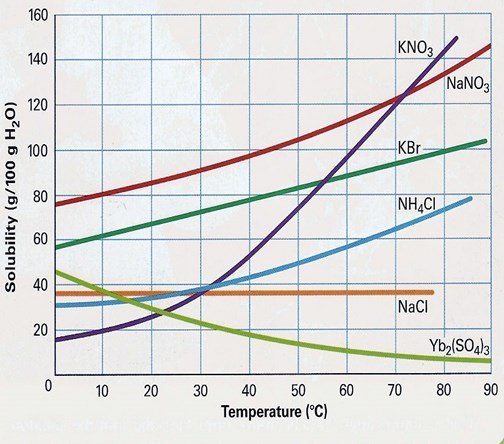
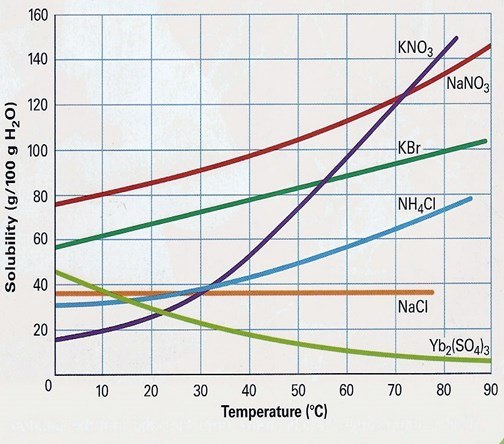
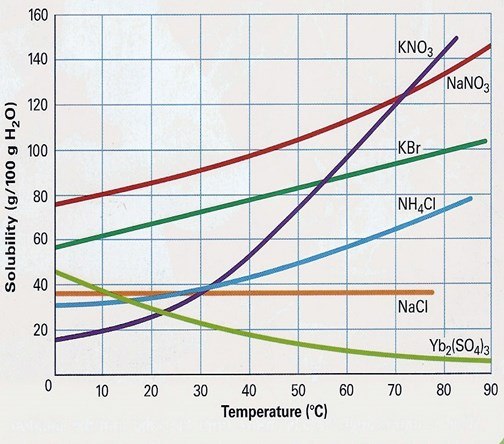
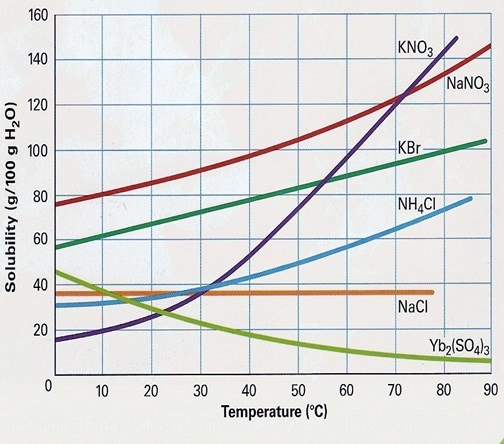
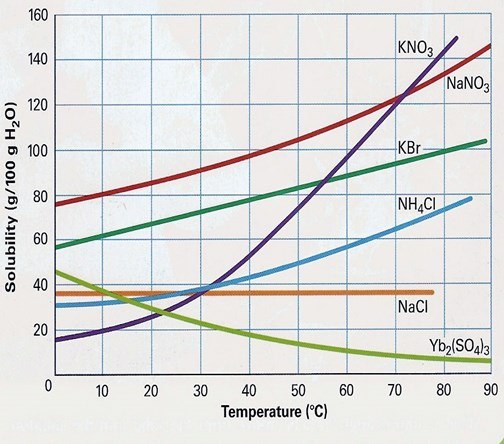
At 30'C, which substance has the lowest solubility?

a)

KNO3

b)

KBr

c)

NaCl

d)

Yb2(SO4)3

66.

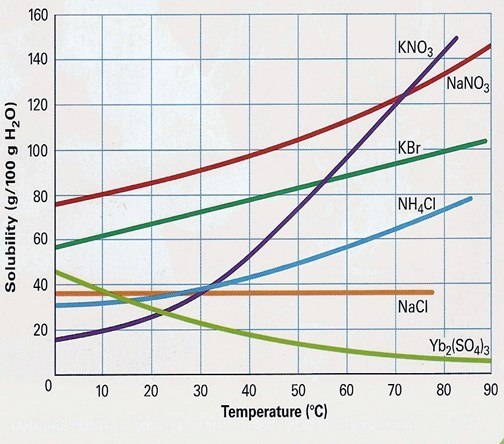
At which temperature do KBr and KNO3 have the same solubility?

a)

60

b)

55

c)

50

d)

Never

67.

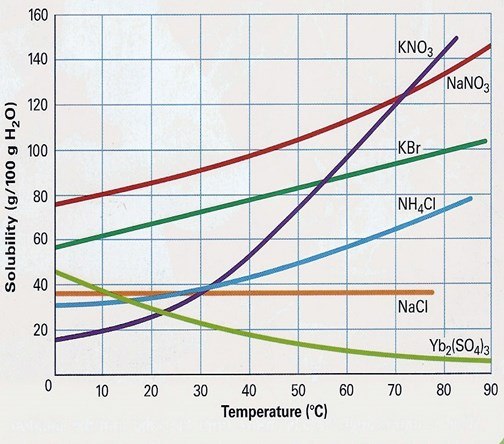
The solubility of Yb2(SO4)3 ________________ with added temperature.

a)

increases

b)

decreases

c)

remains the same

68.

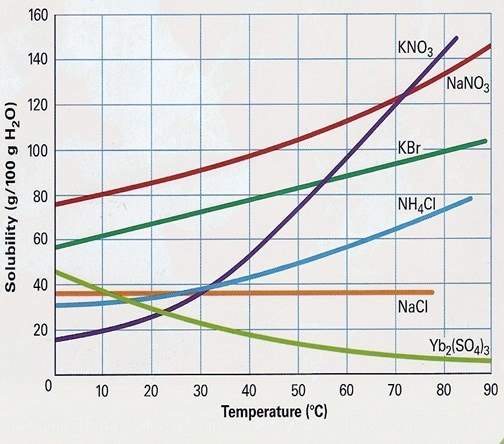
At 80'C, KBr's solubility is:

a)

100

b)

90

c)

80

d)

0

69.

Determine the solubility for the substances at 55'C and arrange them in order from lowest to highest solubility.

a)

NaCl, NH4Cl, KBr, NaNO3

b)

NaCl, NH4Cl, NaNO3, KBr

c)

NH4Cl, NaCl, NaNO3, KBr

d)

NaNO3, KBr, NH4Cl, NaCl

70.

At 10'C, NaNO3's solubility is 80 g/100 g of H2O. Based on this information, what would the solubility be in 50 g of H2O.

a)

40

b)

80

c)

160

d)

16

71.

Identify if the following solution would be saturated, unsaturated, or supersaturated: 103 g KBr at 70'C.

a)

Unsaturated

b)

Saturated

c)

Supersaturated

72.

Identify how many grams of KNO3 is required to make a saturated solution at 40'C.

a)

50 g

b)

45 g

c)

55 g

d)

33 g

73.
Which solute is the least soluble at 90 ⁰C?
a)
SO2
b)
KClO3
c)
KI
d)
HCl