wayground logo

Free Printable Worksheets

NEW

Font size

S
M
L
XL
Worksheets

Ecology - Feeding Relationships

Total questions: 30

Worksheet time: 16mins

Name
Class
Date
1.

Which groups describes only decomposers?

a)

spiders, fungi, grass

b)

ladybug, deer, duck

c)

worm, trees, sunflower

d)

fungi, bacteria, and worms

2.

An organism that makes its own food is called a(n):

a)

autotroph

b)

heterotroph

c)

omnivore

d)

herbivore

3.

An organism that must "eat" another organism for its food is called a(n):

a)

autotroph

b)

heterotroph

c)

producer

d)

phytoplankton

4.

Which two words mean the same thing?

a)

producer & heterotroph

b)

producer & autotroph

c)

producer & decomposer

5.

Which two words mean the same thing?

a)

consumer & heterotroph

b)

producer & heterotroph

c)

autotroph & heterotroph

6.
Which best describes what a food chain shows you?
a)
Energy flow through an ecosystem
b)
Food flowing through an ecosystem
c)
Consumers going into other consumers
d)
Who eats who
7.
What are plants called in a food chain?
a)
Producers
b)
Consumers
c)
Decomposers
d)
Scavengers
8.
What are animals called in a food chain?
a)
Producers
b)
Consumers
c)
Decomposers
d)
Plants
9.
What are the organisms that break down dead stuff?
a)
Producers
b)
Consumers
c)
Decomposers
d)
Organisms
10.
Where does the energy start in this food chain?
a)
Plant
b)
Sun
c)
Deer
d)
Wolf
11.
What is the role of a producer?
a)
Use sunlight to make food
b)
Gain energy from eating other organisms
c)
Keep other species from overpopulating
d)
Breaking down dead stuff 
12.
What's the role of consumers in a food chain?
a)
Use sunlight to make food 
b)
Eat other species and keep them from overpopulating
c)
Break down dead stuff
d)
Add nutrients to the soil
13.
What is the role of decomposers in a food chain?
a)
Use sunlight to make food
b)
Eat other organisms to gain energy
c)
Make the food for the whole food chain
d)
Break down dead organisms and add nutrients to the soil
14.
Which type of consumer eats plants only?
a)
Herbivores
b)
Omnivores
c)
Carnivores
d)
Scavengers
15.
Which type of consumer eats meat only?
a)
Producers
b)
Herbivores
c)
Carnivores
d)
Omnivores
16.
Which type of consumer eats meat and plants?
a)
Herbivores
b)
Carnivores
c)
Omnivores
d)
Plants
17.

Which is the correct food chain order?

a)

Producer, primary consumer, secondary consumer, tertiary consumer, quarternary consumer, top consumer

b)

Producer, apex consumer, primary consumer, secondary consumer, quarternary consumer, top consumer

c)

Apex consumer, primary consumer, secondary consumer, tertiary consumer, quarternary consumer, top consumer

d)

Producer, primary consumer, secondary consumer, quaternary consumer, tertiary consumer, top consumer

18.

Plankton are:

a)

Microscopic plants and animals that float in the ocean

b)

Large plants and animals that float in the ocean

c)

Microscopic decomposers that float in the ocean

d)

Large decomposers that float in the ocean

19.

Phytoplankton are:

a)

plankton that are plant-like

b)

plankton that are animal-like

c)

plankton that are decomposers

20.

Zooplankton are:

a)

plankton that are plant-like

b)

plankton that are animal-like

c)

plankton that are decomposers

21.

What is a trophic level?

a)

the group of organisms within an ecosystem which occupy the same level in a food chain.

b)

the group of organisms within an ecosystem which occupy the different levels in a food chain.

c)

when two or more food chains are combined to make a food web
22.
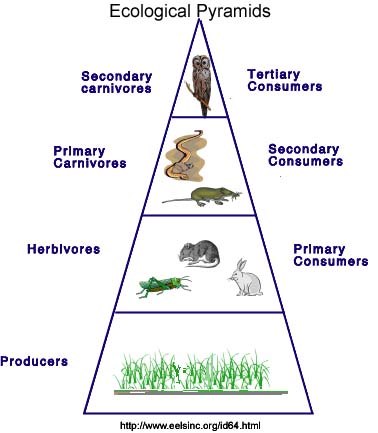
How much energy is passed on to each trophic level in an energy pyramid?
a)
10%
b)
90%
c)
50%
d)
80%
23.
What organisms are at the bottom of an energy pyramid?
a)
Producer
b)
Consumer
c)
Decomposer
d)
Scavenger
24.
Which organisms have the most available energy in an energy pyramid?
a)
Producer
b)
Consumer
c)
Decomposer
d)
Scavenger
25.
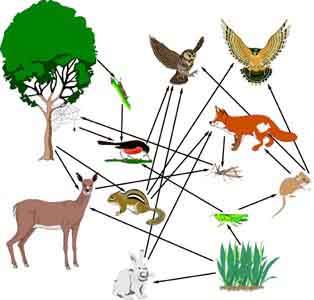
The arrows in a food chain or web represents what?
a)
They point to the organism that is being eaten.
b)
It shows how sunlight flows within an ecosystem.
c)
They show what direction the energy is flowing between organisms. 
d)
They represent how water is transferred within a habitat.
26.
What does a food web represent?
a)
All connections of energy flow throughout all organisms in a habitat.
b)
The specific ways that mutualism is carried out.
c)
A single pathway or energy flow between organisms. 
d)
How carnivores get their food. 
27.
What is a trophic level?
a)
Each level represented within a food chain or web.
b)
Levels of ecosystems that the world is divided into.
c)
Different levels of nutrients present within an organism.
d)
The levels of sunlight an autotroph needs to survive. 
28.
An energy pyramid represents what?
a)
How much sunlight is available for the ecosystem to use. 
b)
How much energy a particular organism needs. 
c)
How much energy is needed to build a pyramid. 
d)
The amount of energy available to the next 'feeder' in a food web.
29.
Why is there a limited amount of energy that can be passed on to the next feeding level?
a)
There is never enough sunlight available. 
b)
Some ecosystems have limited resources. 
c)
Organisms use some of the energy they get from eating.
d)
All the energy is available to be passed on. 
30.
The largest group of organisms found in a food web would be:
a)
Primary Consumers
b)
Producers
c)
Decomposers
d)
Tertiary Consumers