wayground logo

Free Printable Worksheets

Font size

S
M
L
XL
Worksheets

Electricity Test Review

Total questions: 40

Worksheet time: 47mins

Name
Class
Date
1.
Electric charges that are alike _______ each other.
a)
Attract
b)
Repel
2.
The SI unit of charge is
a)
the ampere
b)
the newton
c)
the coulomb
d)
the joule
3.

When a silver atom loses an electron, its net charge (in coulombs) is

a)

+1

b)

-1

c)

+1,6 x 10⁻¹⁹

d)

-1,6 x 10⁻¹⁹

4.
The charge of an electron is 
a)
positive. 
b)
negative. 
c)
Electrons have no charge
5.
An atom loses an electron.  What type of charge does it have now?
a)
positive
b)
negative
6.

When an object gains electrons it becomes __________

a)

Neutral

b)

Positively charged

c)

Negatively charged

7.

An atom of oxygen has 8 protons and 10 electrons, this means the atom is ____________

a)

positively charged because it has excess electrons

b)

negatively charged because it has excess electrons

c)

positively charged because it has a deficiency of electrons

d)

negatively charged because it has a deficiency of electrons

8.
If two balloons have the same charge, what will happen if you place them close to each other?
a)
Nothing
b)
They will be attracted
c)
They will pop
d)
They will push each other away.
9.
Insulators are different than conductors in that insulators ____.
a)
do not contain electrons or protons 
b)
 do not contain any charge
c)
have a weaker affinity for electrons 
d)
do not allow charge to freely move 
10.

If the distance is reduced by 1/4, what happens to the force?

a)

16 times

b)

Reduces by a fourth

c)

no change

d)

Reduces by half

11.
What is the magnitude of the electrostatic force that a charge of +3.0 X 10⁻⁵ coulomb exerts on a charge of +6.0 X 10⁻⁶ coulomb that is 0.30 meter away?
a)
1.8 X 10⁻³ N
b)
5.4 X 10⁻² N
c)
5.4 X 100 N
d)
1.8 X 101 N
12.

Coulomb's law says that the force between any two charges depends

a)

directly on the amount of the charges

b)

inversely on the square of the distance between the charges

c)

both are correct

13.
What equation is this:
FE= (k*q1*q2) / r2 
a)
Coulombs law
b)
Ohms law
c)
Newtons law
14.
How many electrons are necessary to produce 1.0 C of negative charge? (e = 1.60 × 10⁻¹⁹ C)
a)
6.3 × 10¹⁸ 
b)
6.3 × 10
c)
1.6 × 10¹⁹ 
d)
1.6 × 10
15.
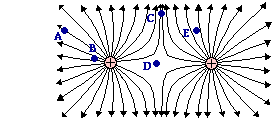
Which of the following labeled points is in the region with the strongest force of electric charge
a)
A
b)
B
c)
C
d)
D
16.
What does it mean when the electric field lines are close together?
a)
the field is positive
b)
the field is negative
c)
The field is strong
d)
the field is weak
17.

which is the field for opposite charges

a)
b)
c)
d)
18.
The direction of a gravitational field is
a)
in the same direction as gravitational attraction.
b)
away from the center of gravity of an object.
c)
opposite to the direction of gravitational attraction.
19.
An asteroid exerts a 360-N gravitational force on a nearby spacecraft. The 360-N force on the spacecraft is directed
a)
toward the asteroid.
b)
away from the asteroid.
c)
toward the Sun.
20.
If an object is placed exactly halfway between Earth and the Moon, it would fall toward the
a)
Earth.
b)
Moon.
c)
neither of these
21.
Consider the electric field lines shown in the diagram below. From the diagram, it is apparent that object A is ____ and object B is ____.
a)
+,+
b)
+,-
c)
-,+
d)
-,-
22.

assume a rubber rod is rubbed against a rabbit fur and the rod gains 5 electrons. which of the following is true?

a)

The fur lost 5 electrons

b)

the fur gained 5 electrons

c)

the fur gained 5 protons

d)

The fur lost 2 electrons

23.
The definition of gravitational field strength is:
a)
The region of space surrounding a body where other bodies will feel an attractive force due to it.
b)
The region of space surrounding a body where other bodies will feel an repulsive force due to it.
c)
The region of space surrounding a charge where other charges will feel an attractive force due to it.
d)
The region of space surrounding a charge where other charges will feel an repulsive force due to it.
24.
The closer together the gravitational field lines.....
a)
the weaker the gravitational field strength
b)
the stronger the gravitational field strength
c)
the more repulsive the gravitational field strength
25.
How far out from a mass should the gravitational field lines go....
a)
to where the gravitational field becomes negligable
b)
to twice the diameter of the mass
c)
infinitely far
d)
to four times the diameter of the mass
26.

Which of the diagrams shows the least gravitational force?

a)

I

b)

II

c)

III

d)

IV

27.

Which of the diagrams shows the greatest gravitational force?

a)

I

b)

II

c)

III

d)

IV

28.
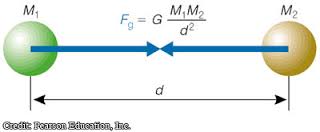
If you decrease the mass of m1 by half, by what factor will the gravitational force change?
a)
F/2
b)
2F
c)
4F
d)
F/4
29.
If you double the mass of m1 and triple the mass of m2, by what factor will the gravitational force change?
a)
F/5
b)
5F
c)
6F
d)
F/6
30.
Complete the following statement: The farther away two planets are the _______ the gravitational force between them.
a)
more
b)
same
c)
dosen't matter
d)
less
31.

Calculate the gravitational force between two objects when they are 0.750m apart. Each object has a mass of 5.00kg.

a)

2.96x10⁻⁹N

b)

3.00x10⁻⁶N

c)

2.22x10⁻⁹N

d)

2.23x10⁻⁸N

32.

Two spherical objects have equal masses and experience a gravitational force of 25 N towards one another. Their centers are 36 cm apart. Determine each of their masses. NOTE: r is given in cm and MUST be converted to meters!!!

a)

2.2 X 10⁵ kg

b)

1.44 kg

c)

2.2 X 101 kg

d)

4.8 X 10¹⁰ kg

33.

What is the electric field strength at a point 0.5 meters away from a charge of +2.0 X 10⁻⁶ coulombs?

a)

3.6 X 10⁴ N/C

b)

7.2 X 10⁴ N/C

c)

9.0 X 10⁴ N/C

d)

1.8 X 10⁴ N/C

34.
In the diagram below, P is a point near a negatively charged sphere. Which direction best represents the direction of the electric field at point P?
a)
Right
b)
Left
c)
Up 
d)
Down
35.

The diagram above shows a point, P, located midway between two oppositely charged parallel plates.

If an electron is introduced at point P, the electron will

a)

accelerate toward the negatively charged plate

b)

travel at constant speed toward the negatively charged plate

c)

travel at constant speed toward the positively charged plate

d)

accelerate toward the positively charged plate

36.

An electron placed between oppositely charged parallel plates A and B moves toward plate A, as represented in the diagram below. What is the direction of the electric field between the plates?

a)

out of the page

b)

toward plate B

c)

into the page

d)

toward plate A

37.

A moving electron is deflected by two oppositely charged parallel plates, as shown in the diagram above.

The electric field between the plates is directed from

a)

C to D

b)

D to C

c)

A to B

d)

B to A

38.

which is the field for opposite charges

a)
b)
c)
d)
39.
A point charge Q is far from all other charges. At a distance of 2 m from Q, the electric field is 20 N/C. What is the force a charge of 5 Coulombs feels?
a)
4 N
b)
100 N
c)
40 N
d)
10 N
40.
An electrostatic force of 2 X 10². newtons is exerted on a charge of 4 coulomb at point P in an electric field. The magnitude of the electric field intensity at P is
a)
8 X 10² N/C
b)
5 N/C
c)
2 X 10⁻² N/C
d)
50 N/C