wayground logo

Free Printable Worksheets

NEW

Font size

S
M
L
XL
Worksheets

PREAP BIO GENETICS UNIT REVIEW

Total questions: 49

Worksheet time: 45mins

Name
Class
Date
1.
Stem cells are
a)
cells that grow uncontrollably.
b)
undifferentiated and can develop into many types of cells.
c)
cells that never go through cell division.
d)
only found in embryos.
2.
Medical researchers are interested in stem cells because they?
a)
are found in all types of tissues
b)
can produce different cells types
c)
are highly specialized
d)
are found only in embryos
3.
What is the difference between embryonic stem cells and adult stem cells?
a)
Embryonic stem cells can differentiate into more cell types than adult stem cells
b)
Adult stem cells are pluripotent, just like embryonic stem cells
c)
Adult stem cells can differentiate into more cell types than embryonic stem cells
d)
Adult stem cells grow bigger than embryonic stem cells
4.
The cells produced via meiosis are called:
a)
sex cells
b)
somatic cells
c)
body cells
d)
skin cells
5.
Unlike mitosis, meiosis in male mammals results in the formation of
a)
one haploid gamete
b)
three diploid gametes
c)
four diploid gametes
d)
four haploid gametes
6.
If the Diploid number of Carrots is 18, the haploid number is
a)
18
b)
9
c)
27
d)
36
7.
Identify the phase.
a)
Metaphase I
b)
Metaphase II
c)
Prophase I
d)
Anaphase II
8.
When an area of a chromatid is exchanged with the matching area on a chromatid of its homologous chromosome, _________________ occurs
a)
crossing over
b)
mutagenesis
c)
hybridization
d)
fertilization
9.
Linked genes are
a)
located on different chromosomes of the same size and shape
b)
located on the same chromosome
c)
rarely inherited together
10.
Which of the following is an example of a GENOTYPE?
a)
25%
b)
Blue
c)
1:2:1
d)
Bb
11.
rr
a)
Homozygous Dominant
b)
Homozygous Recessive
c)
Heterozygous
d)
Heterozygous Recessive
12.
TT
a)
Homozygous Dominant
b)
Homozygous Recessive
c)
Heterozygous
d)
Heterozygous Dominant
13.
Which of the following is a phenotype?
a)
BB
b)
Bb
c)
bb
d)
Blue eyes
14.
chromosomes that have the same sequence of genes and the same structure
a)
homologous chromosomes
b)
alleles
c)
phenotypes
d)
genotypes
15.

This law describes how each homologous pair separates independently of any other pairs during Anaphase I of meiosis

a)

Law of Segregation

b)

Law of Independent Assortment

c)

Law of Gravity

d)

Law of Mathematical Order

16.
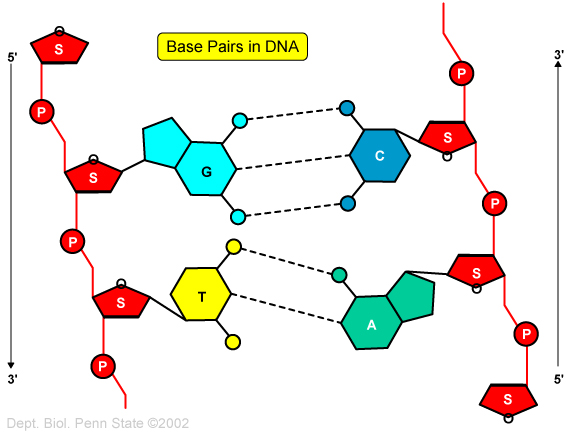
In DNA, Adenine bonds with ______________.
a)
Guanine
b)
Thymine
c)
Cytosine
d)
Adenine
17.
Guanine bonds with ______________.
a)
Adenine
b)
Guanine
c)
Cytosine
d)
Thymine
18.
Name this structure
a)
double helix
b)
nucelotide
c)
twisted ladder
d)
hydrogen bond
19.
Nitrogenous bases are joined by which type of bond?
a)
polar bonds
b)
ionic bonds
c)
covalent bonds
d)
hydrogen bonds
20.

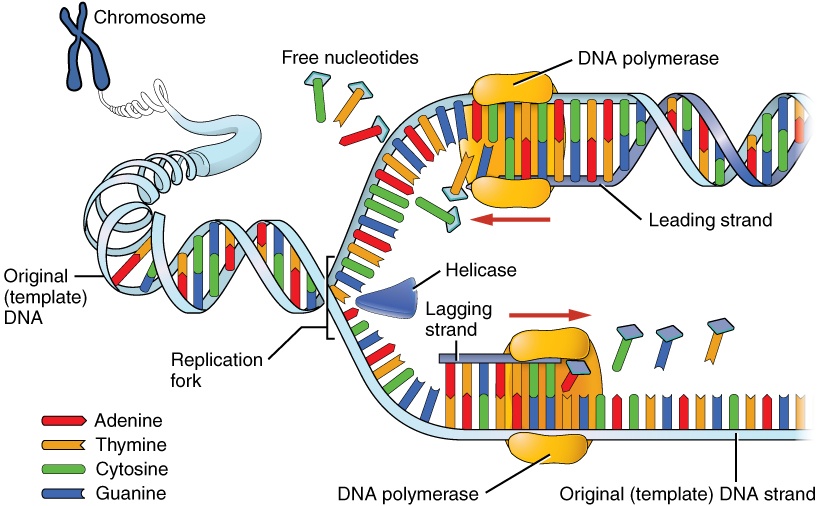
Arrange these steps of DNA replication

a)

3, 2, 1, 4

b)

2, 1, 4, 3

c)

2, 3, 1, 4

d)

3, 4, 1, 2

21.
A process in which DNA has the unique ability to make an exact copy of itself.
a)
Replication
b)
Translation
c)
Transcription
22.
In what phase of the cell cycle does DNA replication take place?
a)
G1
b)
S
c)
G2
d)
M
23.
What is the complement to the DNA strand below:
5'-ATGCCAT-3'
a)
5'-TACGGTA-3'
b)
3'-TACGGTA-5'
c)
3'-ATGGCAT-5'
d)
5'-ATGGCAT-3'
24.
Where does transcription take place?
a)
nucleus
b)
cytoplasm
c)
ribosome
25.
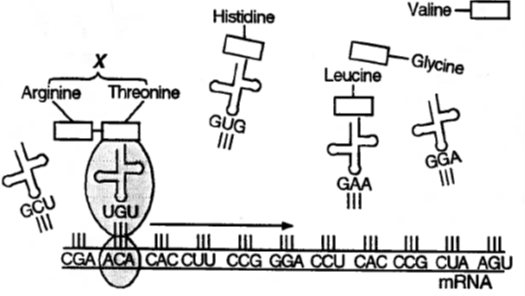
What is occurring in this picture?
a)
Translation
b)
Replication
c)
Translocation
d)
Transcription
26.

What is the correct order to make a protein?

a)

Protein, DNA, RNA

b)

RNA, DNA, Protein

c)

DNA, RNA, Protein

d)

Protein, RNA, DNA

27.
Choose the nucleotide sequence of the RNA strand that would be complementary to the following strand: 
GTAGTCA
a)
UATUAGA
b)
ACGACTG
c)
CAUCAGU
d)
CATCAGT
28.
The process to go from mRNA to a protein is called ____
a)
transcription
b)
rRNA
c)
replication
d)
translation
29.
What process is going on in this photo? 
a)
Transcription 
b)
Translation 
c)
Replication 
d)
All the above 
30.
What is the three base sequence of mRNA that codes for a single amino acid?
a)
Anticodon
b)
Codon
c)
Protein
31.
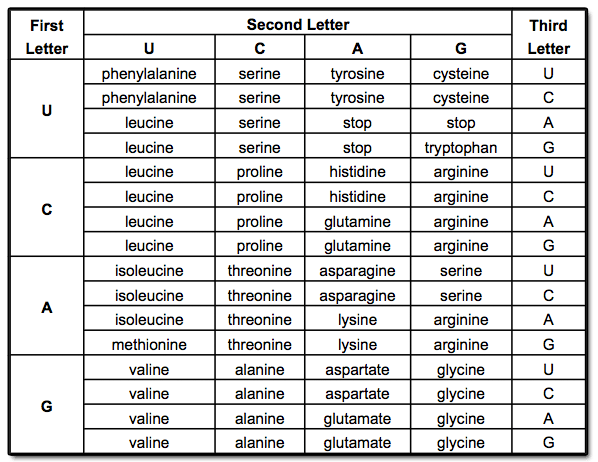
What is the correct amino acid sequence for the mRNA code AUGCCAGUAUGA
a)
Met-Pro-Ala-Val
b)
Met-Pro-Val
c)
Tyr-Gly-His
d)
Tyr-Gly-Arg-His
32.

Protein folding: the entire polypeptide forms a three-dimensional structure

a)

Primary

b)

Secondary

c)

Tertiary

d)

Quaternary

33.

Protein folding: two or more polypeptides attached together and work as one unit

a)

Primary

b)

Secondary

c)

Tertiary

d)

Quaternary

34.
When a protein unfolds, it is
a)
Denatured
b)
Building
c)
Adding amino acids
d)
Making food
35.
Which letter corresponds to the primary protein structure?
a)
A
b)
B
c)
C
d)
D
36.
What is a phenotype?
a)
The expression of a trait; physical appearance.
b)
refers to the genetic makeup of an individual
c)
An organism that has the same genes for a trait (ex. TT or tt)
d)
the passing of traits from parent to offspring
37.
An allele whose trait only shows up when no dominant allele is present.
a)
hidden allele
b)
dominant allele
c)
recessive allele
d)
present allele
38.

Two heterozygous (Tt) tall pea plants are crossed. Which describes their offspring?

a)

50% tall and 50% short

b)

75% tall and 25% short

c)

100% short

39.
A human usually has _____ total chromosomes.
a)
6
b)
22
c)
4
d)
46
40.

This type of inheritance pattern is a BLENDING of both traits.

a)

incomplete dominance

b)

codominance

c)

complete dominance

d)

recessive pattern

41.
Colorblindness is a recessive, X chromosome sex-link disorder. Cross the parents to figure out which percentage of their offspring will be colorblind.
a)
25%
b)
0%
c)
75%
d)
50%
42.

This type of inheritance pattern shows BOTH parental phenotypes in possible offspring

a)

complete dominance

b)

incomplete dominance

c)

codominance

d)

dominant pattern

43.

What determines sex in humans?

a)

the X and Y chromosome

b)

chromosome 21

c)

codominance

d)

epistasis

44.
In humans, skin tone is caused by 3 genes, each with 2 alleles.  This is an example of
a)
codominance
b)
incomplete dominance
c)
polygenic inheritance
d)
multiple alleles
45.

What gamete possibilities could come from this parent's genotype? (*Hint- FOIL)

a)

AB, AB, aB, aB

b)

Ab, AB, Ab, ab

c)

Ab, Ab, Ab, Ab

d)

AB, aB, ab, aB

46.
What goes in box 3
a)
Aabb
b)
AABB
c)
AAbb
d)
aaBb
47.
What genotype is missing from this Punnett Square?
a)
RrYy
b)
RRYY
c)
rryy
d)
RrYY
48.
Based off this punnett square, what fraction of the offspring will have wrinkled, yellow seeds?
a)
9/16
b)
3/16
c)
1/16
d)
16/16
49.

The diagram represents a segment of a gene on two chromosomes. The change in the gene sequence is an example of

a)

an insertion

b)

a deletion

c)

a substitution

d)

a replication