wayground logo

Free Printable Worksheets

Font size

S
M
L
XL
Worksheets

Unit 5 test review

Total questions: 89

Worksheet time: 1hrs 12mins
Name
Class
Date
1.

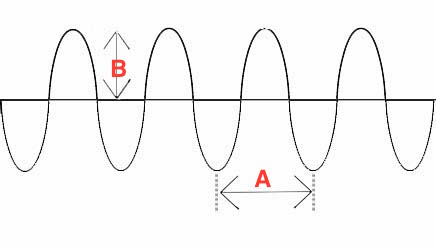
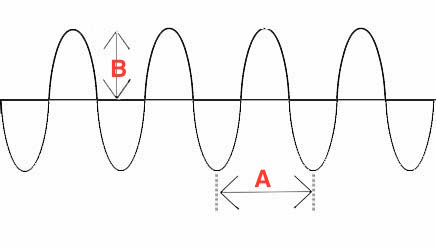
What property of this wave is represented by the letter "A"

a)

amplitude

b)

crest

c)

trough

d)

wavelength

2.
What property of the wave is represented by the letter "B"?
a)
amplitude
b)
crest
c)
trough
d)
wavelength
3.
The highest point on a wave is:
a)
the crest
b)
the trough
c)
the top
d)
the coast 
4.
The number of wavelengths that pass a point each per second is:
a)
frequency
b)
period
c)
longitudinal 
d)
transverse wave 
5.
The type of waves that require medium to pass:
a)
Mechanical Waves
b)
Electromagnetic Waves
6.
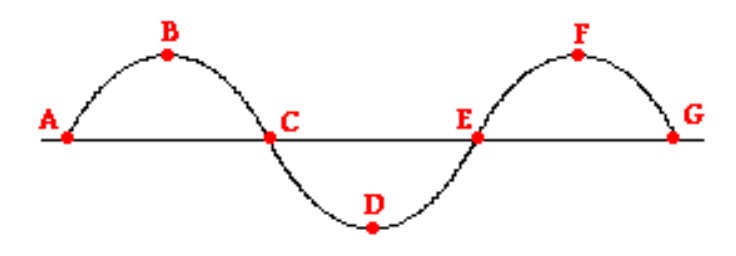
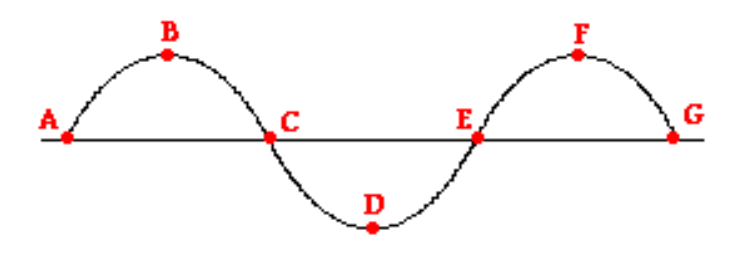
Which vocabulary term is used to identify the distance between points C & G?
a)
Amplitude
b)
Crest
c)
Frequency
d)
Wavelength
7.
When the frequency of a wave increases, what happens to the wavelength?
a)
The wavelength is not directly affected by the frequency of a wave.
b)
The wavelength increases.
c)
The wavelength decreases.
d)
More specific information is needed to form a conclusion about the wavelength.
8.
A mechanical wave cannot travel through...
a)
a vacuum(empty space).
b)
water.
c)
air. 
d)
glass.
9.
Which letter(s) represent the trough of the wave?
a)
A
b)
B & D
c)
D
d)
C & G
10.
Which letter(s) represent the crest of the wave?
a)
A
b)
B & D
c)
B & F
d)
F
11.
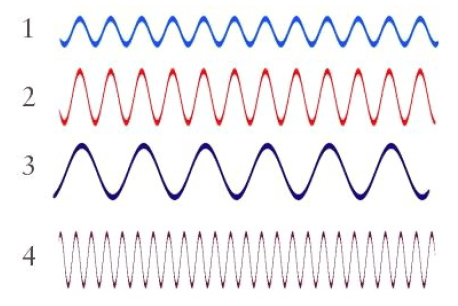
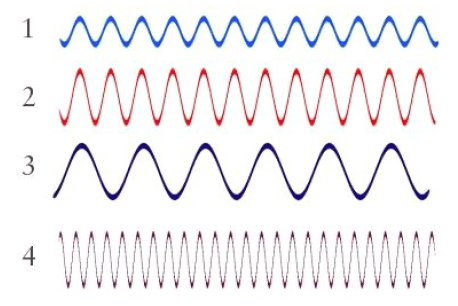
Which wave in the diagram has the greatest frequency?
a)
1
b)
2
c)
3
d)
4
12.
Which wave in the diagram has the greatest wavelength?
a)
1
b)
2
c)
3
d)
4
13.
Which of the following can sound travel through?
a)
solid
b)
liquid
c)
gas
d)
all of the above
14.
crest to crest or trough to trough
a)
crest
b)
trough
c)
amplitude
d)
wavelength
15.
Electromagnetic waves include the following except
a)
radio waves
b)
X-rays
c)
doing the wave at a football game
d)
microwaves
16.
regular disturbances that carry energy through matter or space
a)
crest
b)
energy
c)
wave
d)
trough
17.
which material does sound travel the fastest?
a)
solid 
b)
liquid 
c)
gases
18.
When a wave strikes and object and bounces off. (example echo)
a)
medium
b)
refraction
c)
reflection
d)
interference
19.

The larger the amplitude, the less energy

a)

true

b)

false

20.

When light shines through a prism it creates ________________

a)

visible light

b)

infrared radiation

c)

ultraviolet rays

d)

electromagnetic wave

21.
Material that allows light to pass through allowing you to see "clearly" to the other side
a)
opaque
b)
translucent
c)
transparent
22.
Light is a form of 
a)
energy
b)
radiation
c)
reflection
23.

Compressions are...

a)

associated with transverse waves

b)

associated with longitudinal waves

c)

light waves

d)

visible light

24.

Mechanical waves can be transverse or longitudinal waves

a)

True

b)

False

25.

Which of the following is not a seismic wave

a)

P Waves

b)

S waves

c)

Surface Waves

d)

Electromagnetic Waves

26.
Light travels in a straight line
a)
True
b)
False
27.

High frequency equals

a)

high energy

b)

low energy

c)

no change in energy

d)

none of the above

28.

Earthquakes produce

a)

Electromagnetic waves

b)

Thermal Energy Waves

c)

Seismic Waves

d)

None of the above

29.

The distance between 2 crests or troughs

a)

wavelength

b)

amplitude

c)

frequency

d)

wave speed

30.

The number of waves that pass in a given amount of time.

a)

wavelength

b)

wave speed

c)

amplitude

d)

frequency

31.

Rarefactions are...

a)

were waves are farthest apart

b)

were waves are closest together

c)

associated with transverse waves

d)

found near the crest of a wave

32.

When waves overlap

a)

Interference

b)

Resonance

c)

Reflection

d)

Diffraction

33.
What does refract mean?
a)
To shrink
b)
To bend
c)
To widen
d)
To enlarge
34.

All waves can be reflected

a)

true

b)

false

35.

The bending of waves around a barrier.

a)

refraction

b)

diffraction

c)

resonance

36.

Which seismic waves cause the most damage

a)

P waves

b)

S waves

c)

Surface waves

37.

Light is a type of energy

a)

true

b)

false

38.
A disturbance that travels through a medium as a longitudinal wave
a)
sound
b)
wavelength
c)
pitch
d)
frequency
39.
Bending of waves around an object (such as through a doorway)
a)
sound
b)
diffract
c)
pitch
d)
volume
40.
travels through solids fastest because the molecules are closer together
a)
speed of sound
b)
wavelength
c)
frequency
d)
amplitude
41.
The number of wavelengths that pass a point each second
a)
frequency
b)
wavelength
c)
pitch
d)
amplitude
42.
Material (matter) through which a wave travels
a)
medium
b)
Doppler Effect
c)
sound
d)
pitch
43.
How high or low a sound is; depends on the frequency (greater frequency= higher pitch)
a)
pitch
b)
frequency
c)
sound
d)
medium
44.
When the sound source moves, the frequency changes
ex. police car siren sounding lower pitch after the car passes
a)
pitch
b)
frequency
c)
Doppler Effect
d)
medium
45.
When the sound source moves, the frequency changes
ex. police car siren sounding lower pitch after the car passes
a)
pitch
b)
frequency
c)
Doppler Effect
d)
medium
46.
A wave in which the vibration is in the same direction as that in which the wave is traveling; sound waves
a)
longitudinal wave
b)
ocean wave
c)
transverse wave
d)
mechanical wave
47.
The part of a longitudinal wave where the particles of the medium are close together.
a)
rarefaction
b)
compression
c)
crest
d)
trough
48.
A part in a longitudinal wave where the particles are spread apart
a)
compression
b)
rarefaction
c)
crest
d)
trough
49.
The number of wavelengths that pass a point each second
a)
crest
b)
amplitude
c)
frequency
d)
pitch
50.
A disturbance that transfers energy from one place to another without transferring energy
a)
wave
b)
trough
c)
pitch
d)
sound
51.
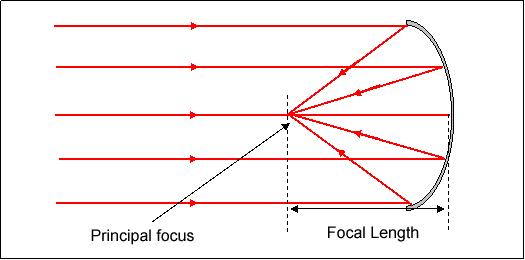
The following is a picture of what type of mirror? 
a)
Convex (diverging) mirror
b)
Concave (converging) mirror
c)
Plane Mirror
d)
Flat Mirror
52.
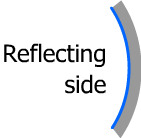
The following is a picture of what type of mirror? 
a)
Convex (diverging) Mirror
b)
Concave (converging) Mirror
c)
Plane Mirror
d)
Flat Mirror
53.
A material that reflects or absorbs all of the light that strikes it is called which of the following? 
a)
Transparent
b)
Translucent
c)
Diffuse
d)
Opaque
54.
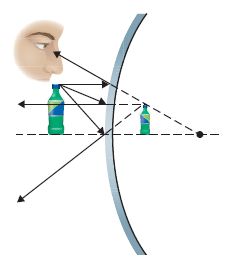
This is an example of a __________ mirror.
a)
Concave
b)
Convex
c)
Plane
d)
Magnifying
55.
Convex mirrors cause light to spread out.
a)
True
b)
False
56.
A mirror with a flat surface is a plane mirror.
a)
true
b)
false
57.
What does The law of reflection state?
a)
the angle the incident ray makes with a line drawn perpendicular to the surface of the mirror.
b)
shows how rays change direction when they strike mirrors and pass through lenses.
c)
The angle of reflection is equal to the angle of incidence.
58.
What kind of mirror is shown here?
a)
plane
b)
concave
c)
convex
d)
diffuse
59.
a mirror with a surface that curves inward like the inside of a bowl
a)
concave mirror
b)
convex mirror
c)
plane mirror
d)
flat mirror
60.
What does it mean to reflect?
a)
bounce off
b)
bend
c)
refract
d)
energy
61.
Which of the mirrors is used as rear view mirror in vehicles?
a)
Concave
b)
Convex
c)
Plane
62.
The following is a picture of what type of mirror? 
a)
Convex Mirror
b)
Concave Mirror
c)
Plane Mirror
d)
Flat Mirror
63.
Which images are opaque?
a)
A & C
b)
A,C,E, & F
c)
D, E, & F
d)
A & E
64.
Smooth surfaces _______ a lot of light.
a)
reflect
b)
bend
c)
absorb
d)
twist
65.
Another name for light bending is ....
a)
Reflaction
b)
Absorbing
c)
Refraction
d)
mirror
66.
The Law of Reflection:
The angle of incidence is _________ the angle of reflection
a)
bigger than
b)
the same as
c)
smaller than
67.
The color you see is the color that is ___.
a)
reflected
b)
absorbed
68.
If light strikes a mirror at a 50⁰ angle, what angle will it come off of the mirror?
a)
50⁰
b)
70⁰
c)
45⁰
d)
30⁰
69.
Which color reflects all light?
a)
White
b)
Black
c)
Orange 
d)
Green
70.
Which color absorbs all light?
a)
White
b)
Black
c)
Orange
d)
Green
71.
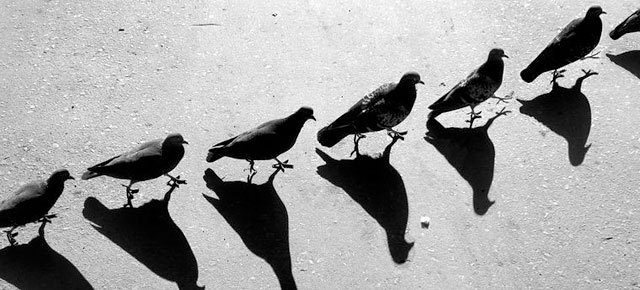
What does light do when it hits an object that it cannot pass through?
a)
It creates a shadow
b)
It passes through anyway
72.
The following is a picture of what type of mirror? 
a)
Convex Mirror
b)
Concave Mirror
c)
Plane Mirror
d)
Flat Mirror
73.
Write 7.113 x 10⁷ in standard form.
a)
71,130,00
b)
7,113,000
c)
0.0000007113
d)
7,113
74.
Write 0.00000707 in scientific notation.
a)
7.07 x 10⁻⁶
b)
7.07 x 10⁶
c)
707 x 108
d)
707 x 10-8
75.
Write 2.08 x 10²  in standard form.
a)
208
b)
0.0208
c)
20,800
d)
0.208
76.
Write 7.8 x 10⁻³  in standard form.
a)
0.0078
b)
7,800
c)
78
d)
0.078
77.
Write 8.73 x 10⁻⁴  in standard form.
a)
0.000873
b)
0.0873
c)
87,300
d)
8,730
78.
Write 6,700 in scientific notation.
a)
6.7 x 10³
b)
6.7 x10⁻³
c)
67 x 102
d)
67 x 10-2
79.
An experiment is performed on plants to see how different liquids affect plant growth. Each plant in the experiment is given a different liquid; water, apple juice, or milk. Each plant has the same amount of soil, sunlight, and listens to the same music. In this investigation, the independent variable is ...
a)
The type of plant
b)
The amount of sunlight
c)
The type of music
d)
The type of liquid
80.
An experiment is performed on plants to see how different liquids affect plant growth. Each plant in the experiment is given a different liquid; water, apple juice, or milk. Each plant has the same amount of soil, sunlight, and listens to the same music. In this investigation, what are the controlled variables?
a)
Type of plant, amount of music, and sunlight
b)
Water, apple juice, milk
c)
Plant growth
81.
An experiment is performed on plants to see how different liquids affect plant growth. Each plant in the experiment is given a different liquid; water, apple juice, or milk. Each plant has the same amount of soil, sunlight, and listens to the same music. In this investigation, what is the dependent variable?
a)
Type of plant
b)
Water, apple juice, milk
c)
Plant growth
82.
A student is planning an experiment to find out how the height from which he drops a ball affects how high the ball bounces. The dependent variable is the _____.
a)
Diameter of the ball
b)
Force acting on the ball
c)
Height that the ball bounces
d)
Height from which the ball is dropped
83.
A student is planning an experiment to find out how the height from which he drops a ball affects how high the ball bounces. What is the control variable?
a)
The ball used
b)
The height the ball bounces
c)
Height of the ball being dropped
84.
Mr. S set up an experiment to see how the mass of a ball affects the distance it rolls off a ramp. What is the dependent variable?
a)
Distance traveled by the ball
b)
Height of the ramp
c)
Mass of the ball
85.
Mr. S set up an experiment to see how the mass of a ball affects the distance it rolls off a ramp. Identify the independent variable.
a)
Distance traveled by the ball
b)
Height of the ramp
c)
Mass of the ball
86.
Mr. S set up an experiment to see how the mass of a ball affects the distance it rolls off a ramp. What is the controlled variable?
a)
Distance traveled by the ball
b)
Height of the ramp
c)
Mass of the ball
87.
Scientific Question:  Does the type of sneaker you wear affect how fast you can run?
What is the independent variable?
a)
type of sneaker
b)
how fast you run
c)
person
88.

A longitudinal wave that is caused by vibrations and travels through a medium:

a)

transverse wave

b)

mechanical wave

c)

sound wave

d)

electromagnetic wave

89.

Sound waves travel the fastest through

a)

rock

b)

seawater

c)

space

d)

atmosphere