wayground logo

Free Printable Worksheets

NEW

Font size

S
M
L
XL
Worksheets

IPC Newton's Law of Universal Gravitation and Circular Motion

Total questions: 75

Worksheet time: 2hrs 34mins

Name
Class
Date
1.
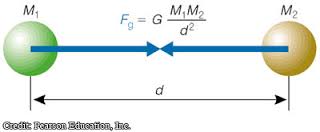
Two asteroids exert a gravitational force, F, on each other. Some time later, the asteroids are now three times as far from each other as before. Which of the following represents the gravitational force at this distance? 
a)
F/3
b)
F/2
c)
F/6
d)
F/9
2.
What states that "every object in the universe attracts every other object"?
a)
Law of Universal Gravitation
b)
Newton's First Law of Motion
c)
My mother
d)
Inertia & gravity
3.
Force of gravity is inversely proportional to
a)
Mass
b)
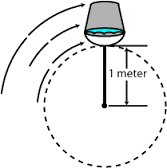
Weight
c)
Distance
d)
Time
4.
If Earth's mass was cut in half, what would happen to your mass?
a)
increase because gravitational force increases
b)
decrease because gravitational force decreases
c)
decrease because gravitational force increases
d)
nothing, mass is not affected by gravitational force
5.

Calculate the gravitational force between two objects when they are 0.750m apart. Each object has a mass of 5.00kg.

a)

2.96x10⁻⁷N

b)

3.00x10⁻⁶N

c)

2.22x10⁻⁹N

d)

2.23x10⁻⁸N

6.
Two objects are attracted to each other with 36 N of gravitational force.
What would the force between them be if the distance between them were doubled?
a)
9
b)
18
c)
72
d)
144
7.
What is the Universal law of gravitation equation? 
a)
G=F ⋅ m⋅m2/r2
b)
F=G ⋅ m⋅m2/(r)2
c)
F=G ⋅ r2/m⋅m2
d)
G=F ⋅ r2/m⋅m2
8.
Two factors effecting the magnitude of the force of gravity between 2 objects are...
a)
mass and distance 
b)
mass and matter
c)
distance and weight 
d)
weight and mass
9.
Gravity attracts all objects towards one another.
a)
False
b)
True
c)
It depends
10.

What is the gravitational force between two identical 50,000 kg asteroids whose centers of mass are separated by 1000 m?

a)

2500 N

b)

3.3 x 10⁻¹² N

c)

1.67 x 10⁻⁴ N

d)

1.67 x 10⁻⁷ N

11.

Two spherical objects have masses of 8000 kg and 1500 kg. Their centers are separated by a distance of 1.5 m. Find the gravitational attraction between them

a)

5.4 X 10⁻⁴ N

b)

1.2 X 10⁷ N

c)

3.6 X 10⁻⁴ N

d)

5.33 N

12.
Complete the following statement: The farther away two planets are the _______ the gravitational force between them.
a)
more
b)
same
c)
dosen't matter
d)
less
13.
Gravity is the force objects put on each other because of their ______.
a)
Mass
b)
Friendliness
c)
Acceleration
d)
Speed
14.

Which configuration will result in the greatest gravitational force?

a)

small masses far apart

b)

large masses far apart

c)

small masses close together

d)

large masses close together

15.
The force of gravity acting on an object is the object's ______.
a)
mass
b)
matter
c)
weight 
d)
friction 
16.
As distance between two objects increase the pull of gravity 
a)
Increases
b)
Decreases
c)
Stays the same
17.
If I double the mass of one object, but don't change anything else... WHat happens to the gravitational force between two objects?
a)
Doubles
b)
Quadruples
c)
Cut in Half
d)
4x Smaller
18.
Force of gravity is directly proportional to
a)
Mass
b)
Weight
c)
Distance
d)
Time
19.
Force of gravity is inversely proportional to
a)
Mass
b)
Weight
c)
Distance
d)
Time
20.
Double the mass of an object, what happens to the force of attraction?
a)
4 times stronger gravity force
b)
4 times weaker gravity force
c)
2 times weaker gravity force
d)
2 times stronger gravity force
21.
A moon is located at  1 unit out from the planet it orbits. If that moon was orbiting at 2 units out from the planet, how much would the gravitational force on the moon be compared to its distance at 1 unit?
a)
1/4
b)
1/6
c)
2x as much
d)
4 times as much
22.

Two masses m1 and m2 are separated by a distance R and gravitaional force between them is F. If the distance R is doubled the force will now be _

a)

4F

b)

2F

c)

F/2

d)

8F

e)

F/4

23.

Two masses m1 and m2 are separated by a distance R and gravitaional force between them is F. If the distance R is reduced to R/3 the force will now be _

a)

9F

b)

3F

c)

6F

d)

F/3

e)

F/9

24.

If two objects, each with a mass of 2.0x10² kg, produce a gravitational force between them of 3.7x10‐6 N. What is the distance between them?

a)

1.7 m

b)

0.85 m

c)

0.72 m

d)

0.92 m

25.

Two isolated masses m1 and m2 are separated by a distance r. Which expression gives the gravitational field strength caused by m1 at m2?

a)

G m1m2 / r

b)

G m1 m2 / r2

c)

G m1 / r2

d)

G m2 / r2

26.

What is numerically equal to the gravitational field strength at a point P on the Earth's surface?

a)

the acceleration of free fall at P.

b)

the change in potential energy per unit distance from P.

c)

the force acting on any body placed at P.

d)

the work done in bringing unit mass from infinity to P.

27.

Which statement about a uniform gravitational field is true?

a)

Its magnitude is the same in all directions.

b)

The gravitational potential has the same value at all points within it.

c)

Its direction is opposite to the direction of motion of a test mass released in it.

d)

Its field strength is the same at all points within it.

28.

A 10kg car travels at a constant speed of 20.0 m/s around a horizontal circular track. Which diagram correctly represent the direction of the car's velocity (v) and the direction of the centripetal force (Fc) acting on the car at a particular moment?

a)
b)
c)
d)
29.
The force that is necessary to keep the bucket swinging in a circle is called the:
a)
tangential velocity
b)
centrifugal force
c)
centripetal force
d)
the force of gravity
30.
The velocity is always _____ to the line of a circle. 
a)
outwards
b)
towards the center
c)
tangent
d)
faster
31.
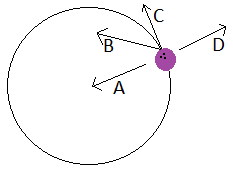
Which of the following vectors depicts the tangential speed of the blowing ball?
a)
A
b)
B
c)
C
d)
D
32.
What relationship exists between the radius of a circle and the centripetal acceleration?
a)
direct
b)
inverse
c)
exponential
d)
inverse squared
33.
What is the relationship between centripetal force and the mass of an object?
a)
direct
b)
inverse
c)
exponential
d)
inverse squared
34.
What is the difference between rotation and revolution?
a)
Rotation is around another object while revolution is around its own axis.
b)
Rotation is on its own axis while revolution is around another object.
c)
They are the same
d)
Rotation is faster
35.
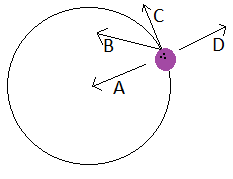
Which arrow represents the acceleration of the ball?
a)
A
b)
B
c)
C
d)
D
36.
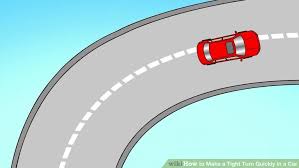
What are the forces that causes centripetal acceleration when a car goes around a banked curve?
a)
Friction & Normal
b)
Gravity & Friction
c)
Normal & Gravity
d)
Tension & Gravity
37.
The time taken for one complete circuit is called the... 
a)
Period
b)
Frequency 
c)
Angular velocity
38.

Who found the Gravitational Constant

a)

Newton

b)

Galileo

c)

Einstein

d)

Cavendish

39.
A horse gallops around a circular arena.  The centripetal force on the horse is ___.
a)
directed outward
b)
tension
c)
directed toward the center of the arena
d)
9.8 N
40.
Calculate the amount of centripetal force it takes for a softball pitcher to rotate a ball with a velocity of 3 m/s if the ball weighs 0.12 kg and her arm is 0.65 meters long.
a)
.38
b)
1.23
c)
.55
d)
1.66 N
41.
A car traveling at 15 m/s on a flat surface turns in a circle with a radius of 25 m.  What is the centripetal acceleration of the car?
a)
2.4 x 10⁻² m/s2
b)
0.60 m/s2
c)
9.0 m/s2
d)
zero
42.
Which of the following terms means "center seeking"?
a)
centrifugal
b)
centrifuge
c)
centripetal
d)
centenarian
43.
What is the relationship between centripetal force and the mass of an object?
a)
direct
b)
inverse
c)
exponential
d)
inverse squared
44.
This is typically just the momentum of a revolving object, but is mistaken for a force:
a)
centripetal force
b)
centripetal acceleration
c)
centrifugal force
d)
gravity
45.
What is the speed of a car traveling around a circle of 20 m radius once every 4.2 seconds?
a)
9.5 m/s
b)
30 m/s
c)
4.8 m/s
d)
125 m/s
46.
The farther away a planet is from the sun, the _______ it takes it to orbit the sun once. 
a)
longer
b)
shorter
47.

What is the tangential velocity if the centripetal force is 150 N when a 3 kg toy plane flies in a 2 m radius circle?

a)

10 m/s

b)

100 m/s

c)

225 m/s

d)

15 m/s

48.
Calculate the velocity of an object moved around a circle with a radius of 1.65 m and an acceleration of 3.5 m/s2.
a)
2.4 m/s
b)
3.6 m/s
c)
3.9 m/s
d)
4.2 m/s
49.
Planets orbit the Sun in a shape called a(n)
a)
circle
b)
ellipse
c)
focus
d)
perihelion
50.
An ellipse is drawn around two points called
a)
aphelion
b)
perihelion
c)
foci
d)
axis
51.
When a planet orbits the Sun, one of the foci of the elliptical orbit is 
a)
the axis
b)
the perihelion
c)
the center
d)
the Sun
52.
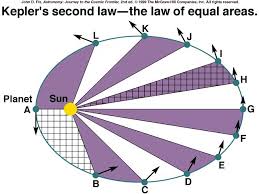
Where is the planet moving faster
a)
Position A to B
b)
Position B to C
c)
Position H to I
d)
Position I to J
53.
What is true about the area between points A, B and the Sun, and the area between points H, I and the Sun?
a)
The area between A, B and the Sun is the largest.
b)
The area between H, I and the Sun is the largest
c)
Both areas are equal in size
d)
There is not enough information to determine the areas
54.
A planet moves __________ when it is farthest from the sun.
a)
faster
b)
slower
55.
Kepler's first law states that the orbits of the planets are oval in shape or 
a)
ellipses
b)
perfect circles
56.
Kepler’s 3rd law states the square of the orbital period is proportional to the cube of the orbital radius. (T2=r3)

If a planet's orbital radius is doubled, what happens to the length of a year on that planet?
a)
It will become twice as long
b)
It will become about 8 times as long
c)
It will become 2.8 times as long
d)
It will remain the same
57.
Mars has a mass of about 6.4 × 10^23 kg, and its moon Phobos has a mass of about 9.6 × 10^15 kg. If the magnitude of the gravitational force between the two bodies is 4.6 × 10^15 N, how far apart are Mars and Phobos?
a)
18.7x10^10 m
b)
8.99x10^11 m
c)
9.4x10^6 m
d)
19.76x10^-10 m
58.
Each planet travels in an elliptical orbit around the sun,and the sun is at one of the focal points is Kepler's___ Law?
a)
1st
b)
2nd
c)
3rd
d)
None of the above
59.
An imaginary line drawn from the sun to any planet sweeps out equal areas in equal time intervals is Kepler's___ Law?
a)
1st
b)
2nd
c)
3rd
d)
None of the above
60.
The square of a planet’s orbital period (T2) is proportional to the cube of the average distance (r3) between the planet and the sun is Kepler's___ Law?
a)
1st
b)
2nd
c)
3rd
d)
None of the above
61.
This torsion apparatus was used to find the Gravitational Constant by whom?
a)
Cavendish
b)
Newton
c)
Kepler
d)
Einstein
62.
The force of gravity does work on a satellite when it is in
a)
circular orbit.
b)
elliptical orbit.
c)
both of these
d)
neither of these
63.
What is centripetal force?
a)
a force that acts on a body moving in a circular path and is directed toward the center around which the body is moving.
b)
The force exerted on Earth by the Sun
c)
The force exerted on the Sun by the Earth
64.
When an object is in circular motion it is constantly changing its velocity.
a)
True
b)
False
65.
When an object is in circular motion what type of acceleration is occurs?
a)
Constant
b)
Directional
c)
Positive
d)
Negative
66.
You swing a bucket of water attached to a string in a circle above your head. What keeps the water in the bucket?
a)
Friction
b)
Centripetal Force
c)
Gravity
d)
Inertia
67.
Inertia is always tangent to the centripetal force.
a)
True
b)
False
68.
The centripetal force of satellites is similar to gravitational force because they are both a net force towards the center of earth.
a)
True
b)
False
69.
Decreasing the radius when making a turn allows you to____?
a)
Increase your friction
b)
Keep a high speed
c)
Change your inertia
d)
Decrease gravitational pull
70.
Predict the magnitude of the gravitational force of 35 N, the distance was cut 1/4?
a)
692 N
b)
135 N
c)
246 N
d)
560 N
71.
what doe heliocentric mean? 
a)
Earth centered
b)
Helium centered
c)
Sun centered
d)
Proof of the Big Bang
72.
Who proved that the Geocentric Model was incorrect, and later proposed that the Sun and the Moon orbit around the Earth, and the other planets orbit around the Sun?
a)
Aristotle
b)
Johannes Kepler
c)
Tycho Brahe
d)
Galileo Galilei
73.
Who used data from Tyco Brahe to develop the Planetary Laws of Motion?
a)
Tycho Brahe
b)
Johannes Kepler
c)
Galileo Galilei
d)
Aristotle
74.
Who Is Nicolaus Copernicus?
a)
Somebody
b)
An Astronomer who created the Geocentric Theory
c)
A Women
d)
An Astronomer who created the Heliocentric Theory
75.
What did Kepler add to Copernicus’ heliocentric theory?  
a)
That Jupiter had four moons
b)
That the planets revolved around the earth 
c)
That the sun was the biggest star
d)
That the planets move in eliptical (oval shaped) orbits around the sun