wayground logo

Free Printable Worksheets

NEW

Font size

S
M
L
XL
Worksheets

Weather & Seasons Pre-Assessment

Total questions: 70

Worksheet time: 58mins

Name
Class
Date
1.

How long does it take the Earth to rotate once on it's axis? What does this rotation cause?

a)

365 days, a year

b)

24 hours, a year

c)

12 hours, day/night

d)

24 hours, day/night

2.
What are the reasons for the season?
a)
Earth's tilt & rotation
b)
Earth's tilt & revolution
c)
Earth's rotation & rovolution
d)
Earth's tilt & resolution
3.
Day & night are caused by the ______________ of earth on its axis
a)
revolution
b)
orbit
c)
rotation
d)
tilt of the axis
4.
The earth orbits around the _________
a)
sun
b)
moon
c)
other planets
d)
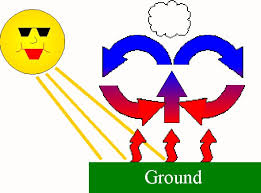
solar system
5.
How long does it take earth to make one revolution around the sun?
a)
12 hours
b)
24 hours 
c)
365 days
d)
30 days
6.
The hemisphere where you live 
a)
equator
b)
southern
c)
northern
d)
eastern
7.

Which season(s) have the same amount of daylight hours?

a)

Spring & Fall

b)

Winter & Summer

c)

None of the seasons have equal daylight hours

d)

All are equal

8.
Which season, or seasons, have the shortest daylight hours?
a)
Summer
b)
Fall
c)
Winter
d)
Spring
9.

In winter, the axis of the earth is pointed away or toward the sun?

a)

pointed towards

b)

pointed away

c)

neither pointed toward or away

10.

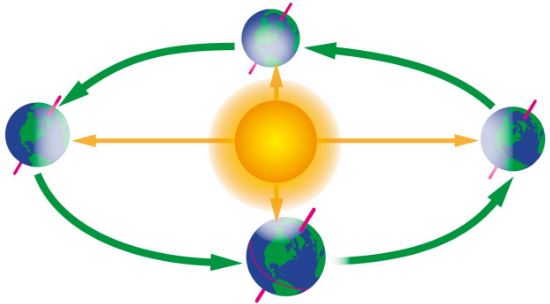
Which season is taking place in the Southern Hemisphere in Position 1?

a)

Winter

b)

Spring

c)

Summer

d)

Fall

11.

Which season is taking place in the Northern Hemisphere in Position 1?

a)

Winter

b)

Spring

c)

Summer

d)

Fall

12.

Which season is taking place in the Northern Hemisphere in Position 3?

a)

Winter

b)

Spring

c)

Summer

d)

Fall

13.

Which season is taking place in the Northern Hemisphere in Position 2?

a)

Winter

b)

Spring

c)

Summer

d)

Fall

14.
Which season is taking place in the Northern Hemisphere in Position 3?
a)
Winter
b)
Spring
c)
Summer
d)
Fall
15.
Which season is taking place in the Northern Hemisphere in Position 4?
a)
Winter
b)
Spring
c)
Summer
d)
Fall
16.
In spring/summer, the axis of the earth is pointed away or toward the sun?
a)
towards
b)
Neither away or toward
c)
away
17.
The Earth's axis is tilted _____ degrees.
a)
23.5
b)
25.3
c)
30.2
d)
24
18.
At position A, which hemisphere would have summer?
a)
Northern hemisphere
b)
Southern hemisphere
19.
What happens when the area in which you live tilts away from the sun?
a)
It is summer.
b)
It is spring.
c)
It is winter.
d)
It is fall.
20.
What do June 21 and December 21 have in common?
a)
equinox dates
b)
the moon is full
c)
solstice dates
d)
the cold fronts blow in
21.
What is the longest day of the year?
a)
winter solstice
b)
summer solstice
c)
fall equinox
d)
spring equinox
22.
Why is the Equator warmest?
a)
Because it is closest to the sun.
b)
Because it receives the most direct sunlight
c)
Because no clouds form here.
d)
Because it is far from the sun
23.
What causes the seasons to change?
a)
The warming and cooling of Earth's core.
b)
The distance from the sun.
c)
Earth's tilt in relation to the sun.
d)
Earth's rotation on its axis.
24.
What season is it in the Southern Hemisphere when it is fall in the Northern Hemisphere?
a)
winter
b)
spring
c)
summer
d)
fall
25.
Why does the area around the equator stay the same temperature all year?
a)
The equator rotates slower than the poles.
b)
The equator remains the same distance from the sun.
c)
The equator always receives direct sunlight.
d)
The equator has 18 hour days.
26.
What would seasons be like if Earth's axis were straight up and down?
a)
Seasons would be the same.
b)
Seasons would be more extreme.
c)
There would be no seasons.
27.
Which seasons have an equal amount of daylight and darkness?
a)
Spring and Fall
b)
Winter and Summer
c)
Winter and Spring
d)
Summer and Fall
28.
The Northern Hemisphere gets __________ sunlight in the winter, which leads to _________ temperatures.
a)
less direct, hotter
b)
less direct, colder
c)
more direct, hotter
d)
more direct, colder
29.
One rotation of Earth is equal to
a)
a day.
b)
a year.
30.
If its ____ in the Northern hemisphere, then its summer in the Southern hemisphere. 
a)
spring
b)
summer
c)
fall
d)
winter
31.
The Earth's _______ is an imaginary line that goes from the North Pole to the South Pole.
a)
vernal equinox
b)
axis
c)
solar eclipse
d)
solar flare
32.
What causes there to be longer number of hours of light during the summer
a)
Earth tilt's away from the sun in summer
b)
Earth's revolves slower in summer
c)
Earth tilts toward the sun in summer
d)
Earth is closer to the sun
33.
Why is it warmer in the summer?
a)
Closer to the sun
b)
More direct light from Earth's tilt
c)
Stronger light from the sun
d)
Earth spins slower
34.
What is Earth's annual motion around the sun called?
a)
Rotation
b)
Revolution
35.
Which location is receiving the greatest solar angle?
a)
A
b)
B
c)
C
d)
D
36.
Which location will receive the least amount of daylight hours?
a)
A & B
b)
A
c)
B
d)
C
37.
Which location has the least intense solar radiation?
a)
A
b)
B
c)
C
d)
A & C
38.
The higher the latitude, the
a)
Higher the temperature
b)
Lower the temperature
c)
More direct sunlight
d)
Higher the solar angle
39.
What is the source of radiant energy that hits Earth?
a)
Earth's Atmosphere
b)
The Moon
c)
Mars
d)
Sun
40.
Why does Earth have different seasons? 
a)
because of the distance between Earth and the sun 
b)
because of the speed of Earth as it rotates on its axis 
c)
because of the amount of light blocked by the moon on its axis 
d)
because of the tilt of Earth on its axis as it moves around the sun 
41.
As the Earth travels around the sun, this tilt causes different areas of the Earth’s surface to get different amounts of daylight at different times of the year. The angle of the Sun’s rays to the surface also causes areas to have more or less of the Sun’s energy. This causes the ________.
a)
months
b)
day and night
c)
seasons
d)
years
42.
Located at the leading edge of a temperature drop off. Bring heavy thunderstorms, rain, and hail. Cool, fair weather is likely to follow.  
a)
Warm Front
b)
Cold Front
c)
Occluded Front
d)
Stationary Front 
43.
Located at the leading edge of a warm air mass. Brings gentle rain or light snow, followed by warmer, milder weather.  
a)
Warm Front
b)
Cold Front 
c)
Occluded Front 
d)
Stationary Front 
44.
This is the symbol for a... 
a)
Cold Front
b)
Warm Front
c)
Stationary Front
d)
Occluded Front 
45.
This is the symbol for a... 
a)
Occluded Front
b)
Stationary Front
c)
Warm Front
d)
Cold Front 
46.
This is the symbol for a... 
a)
Stationary Front
b)
Occluded Front
c)
Cold Front
d)
Warm Front
47.
Identify the type of front that is shown in the image.
a)
Occluded Front
b)
Cold Front
c)
Stationary Front
d)
Warm Front
48.
Identify the type of front that is shown in the image.
a)
Occluded Front
b)
Cold Front
c)
Stationary Front
d)
Warm Front
49.
Identify the type of front that is shown in the image.
a)
Occluded Front 
b)
Cold Front
c)
Stationary Front
d)
Warm Front
50.
Which weather tool measures air pressure?
a)
thermometer
b)
barometer
c)
anemometer
d)
psychrometer
51.
What kind of weather is usually associated with a low pressure system?
a)
Sunny weather
b)
Precipitation (rain, snow, etc.)
52.
What kind of weather is usually associated with a high pressure system?
a)
Sunny weather
b)
Precipitation (rain, snow, etc.)
53.
In what direction do winds always blow?
a)
From areas of high pressure to areas of low pressure
b)
From areas of low pressure to areas of high pressure
54.
Warm air rises and the cool air sinks demonstrates this type of heat transfer. 
a)
conduction
b)
convection
c)
radiation
d)
Insolation 
55.
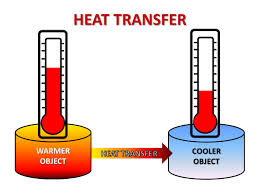
Heat transfers from an area of ____temperature to an area of ___ temperature.
a)
high to low
b)
low to high
c)
high to high
d)
It can travel high to low and low to high. 
56.
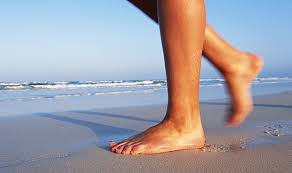
Walking on the warm sand sand with your bare feet demonstrates this type of heat transfer. 
a)
conduction
b)
convection
c)
radiation
57.
Warm air is __________ dense than cold air and rises creating convection currents.
a)
more
b)
less
58.
Johnny accidentally grabbed the handle of the hot pot.
a)
conduction
b)
convection
c)
radiation
59.
What is the weather conditions in an area over a long period of time?
a)
climate
b)
temperature
c)
elevation
d)
precipitation
60.
Changes from minute-to-minute, hour-to-hour, day-to-day
a)
Climate
b)
Weather
61.
What is climate?
a)
 What's going on with the atmosphere at any particular time
b)
The type of weather that occurs during a particular season
c)
An area's pattern of weather over a long period of time
d)
How much sunshine an area gets 
62.
A front is
a)
where warm air is cooling at earth's surface
b)
a line where hot and cold air are separating
c)
a line where two different air masses meet
d)
where cold air is rising and forming rain clouds
63.
Hot air (RISES / FALLS) __________.
a)
RISES
b)
FALLS
64.
Cold air (RISES/ FALLS)  _________.
a)
RISES
b)
FALLS
65.
What type of storm front is this? 
a)
warm front
b)
cold front
c)
stationary front
d)
occluded front
66.
Which type of severe event is most likely to occur when a cold front moves in behind warm, moist air?
a)
Blizzard
b)
Hurricane
c)
Tornado
d)
Drought
67.
A front is
a)
where warm air is cooling at earth's surface
b)
a line where hot and cold air are separating
c)
a line where two different air masses meet
d)
where cold air is rising and forming rain clouds
68.

What is lift? (As it relates to weather)

a)

Warm air moving under cold air and pushing it upThis is a wrong answer Cold and warm air lifting up

b)

Cold and warm air lifting up

c)

Cold air moving under warm air and the warm air rising

d)

Lifting heavy weights

69.

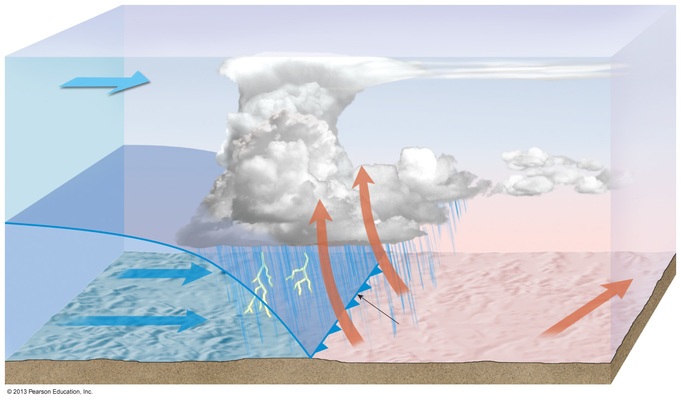
What is the density of the warm air mass pictured above?

a)

more dense than the cold air mass

b)

less dense than the cold air mass

c)

same density because temperature doesn't affect density of air
70.

What is the density of the cold air mass in comparison to the warm air mass in the picture?

a)

It is more dense than the warm air mass

b)

It is less dense than the cold air mass

c)

Both air masses have the same density