
 Worksheets
3.5 IB Restriction Endonucleases
Total questions: 20
Worksheet time: 42mins

If the target sequence or restriction site is 5'GCTTCG3', what is the complementary sequence read in the 3'-5' direction?
CGAAGC
GCTTCG
CGUUCG
GCUUCG

What is a restriction enzyme?
An enzyme that cuts DNA
An enzyme that add to the DNA strand
An enzyme that builds proteins
An enzyme that breaks down lipids

A special protein that targets a specific base sequence and cuts DNA into smaller fragments.
PCR
DNA Polymerase
Helicase
Restriction Enzyme

What is the term given to symmetrical ends of DNA after being cut by a restriction enzyme?
Blunt Ends
Sticky Ends
Ligated Ends
Restrictive Ends

This biomolecule originates from bacterial DNA and has the ability to cut DNA....
Helicase
Ligase
Restriction Enzyme
DNA Polymerase

DNA cutting "scissors" are more correctly referred to as....
Bacteriophages
Restriction Enzymes
DNA Enzymes
Plasmids

The unpaired nucleotides produced by the action of restriction enzymes are referred to as.....
sticky end.
base sequence.
single strands.
restriction fragments.
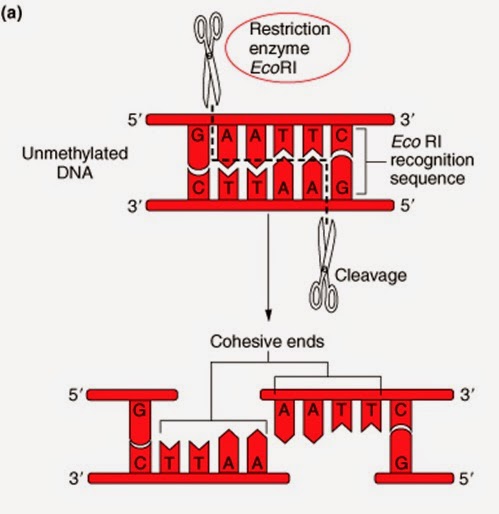
The recognition sites for restriction enzymes are usually...
alliterations
pallindromes
acronyms
analogies

Restriction Enzymes are isolated from....
proteins
bacteria
viruses
bacteriophages

Restriction Enzymes were primarily used as....
defense by protozoa against antibiotics
tools by viruses to cleave bacterial genome
defense by bacteria against bacteriophages viruses
tools to cleave DNA during replication

What is a palindrome?
A sticky end resulting from a restriction enzyme
A blunt end resulting from a restriction enzyme
A sequence that reads the same forwards and backwards
A sequence that is complementary to the other

Which restriction enzymes from above make blunt cuts? (2)
Alul
HaeIII
BamHI
HindIII
EcoRI
Which restriction enzymes from above make sticky cuts? (3)
Il
HaeIII
BamHI
HindIII
EcoRI

How many fragments resulted from the cut above?
1
2
3
4

How many base pairs (bp's) make up each fragment?
11
14
7
22
28

Another name for "recognition site" is...
nucleotide
restriction Site
primer
construction site
What kind of cuts were made in the scenario above?
Blunt
Sticky
No cuts were made
Palindrome

Restriction enzymes need the right temperature in order to work . . .
to recreate the conditions found in the particular bacteria at which the enzyme was sourced
so they can cut the DNA
to recreate the conditions found in the human body cell
they can work at any temperature as they are sourced from extremophiles

Another name for a restriction enzyme is...
an endonuclease
an extremophile
Taq polymerase
a pallindromic ligase

What is a plasmid?
Chloroplast DNA
Mitochondrial DNA
A bacterial chromosome
Small circle of DNA that can transfer genes to or from a prokaryote

