Wayground logo

Free Printable Worksheets

Font size

S
M
L
XL
Worksheets

Gases-Conceptual

Total questions: 50

Worksheet time: 2hrs 25mins

Name
Class
Date
1.

Two basic properties of the gas phase are

a)

a definite shape and a definite volume

b)

a definite shape but no definite volume

c)

no definite shape but a definite volume

d)

no definite shape and no definite volume

2.
If you increase the pressure of a constant volume of gas, what will happen to the temperature?
a)
Increase
b)
Decrease
c)
Stay the same
d)
It will Blow Up
3.
What will happen to the volume of a gas under constant temperature if the pressure increases?
a)
Increase
b)
Decrease
c)
Nothing
d)
Explosion!
4.
How are pressure and volume related?
a)
Directly
b)
Indirectly
c)
They aren't related
5.
You have a gas that has a pressure of 2 ATM and a volume of 10L.  What would be the new volume if the pressure was changed to 1 ATM?
a)
5 L
b)
20 L
c)
It would stay at 10L
d)
1 L
6.
Which of the following would increase the pressure on a system?
a)
Increase the Temperature
b)
Pump in more gas
c)
Decrease the volume
d)
All of these
7.

What is the hissing sound you hear when you open a can of soda? Is that liquid or gas?

a)

Gas

b)

Solid

c)

Liquid

d)

None of these choices

8.

Is gasoline a liquid or a solid?

a)

Neither, gasoline is a solid.

b)

Gas because of the fumes.

c)

Liquid because it flows.

d)

Gasoline is magma

9.

What happens to solids as temperatures rise?

a)

Solids will melt.

b)

Solids will turn to gas.

c)

Solids will stay the same.

d)

Solids will become steam

10.

What percentage of the atmosphere is nitrogen?

a)

100%

b)

78%

c)

21%

d)

1%

11.

What percentage of the atmosphere is oxygen?

a)

100%

b)

78%

c)

21%

d)

1%

12.
At a constant temperature, the volume decreases.  What happens to the pressure?
a)
increases
b)
decreases
c)
stays the same
13.

Matter that has a definite volume and a definite shape is a

a)

solid

b)

liquid

c)

gas

d)

plasma

14.

Particles are fixed, but vibrate in place in a

a)

solid

b)

liquid

c)

gas

d)

plasma

15.

Matter with no definite volume and no definite shape is a

a)

solid

b)

liquid

c)

gas

16.

Matter that has a definite volume but no definite shape is a

a)

solid

b)

liquid

c)

gas

d)

plasma

17.

Matter in which the particles are free to move in all directions until they have spread evenly throughou their container is a

a)

solid

b)

liquid

c)

gas

d)

plasma

18.

As a sample of matter is heated, its particles

a)

stop moving

b)

move more slowly

c)

move more quickly

d)

are unaffected

19.
The relationship between temperature and volume is a:
a)
direct relationship
b)
inverse relationship
c)
scattered relationship
d)
long distance relationship
20.
A hot air balloon uses heat to inflate the balloon. What two variables does this relate?
a)
Pressure and Volume
b)
Volume and Temperature
c)
Temperature and Pressure
d)
Pressure, Temperature and Volume 
21.
Ears pop on an airplane because the decrease in pressure ____________ the volume of air inside your ears?
a)
increases
b)
decreases
22.
A submarine dives deep into the ocean where the pressure of the water increases dramatically. What happens to the pressure inside the submarine?
a)
Pressure increases
b)
Pressure decreases
c)
Pressure stays the same
d)
Impossible to tell
23.
What is the variable for this number 9.10 atm
a)
P
b)
T
c)
n
d)
V
24.

There is no temperature lower than

a)

273 K

b)

0 °C

c)

0 K

d)

0 °F

25.

All molecular motion stops at a temperature of

a)

0 K

b)

273 °C

c)

0 °C

d)

0 °F

26.

Compressing a gas at constant amount and temperature makes the pressure _______.

a)

increase

b)

decrease

c)

stay the same

d)

need more information

27.

If a balloon is cooled with constant amount and pressure, what will happen to the volume?

a)

volume will increase

b)

volume will decrease

c)

volume will not change

d)

need more information

28.

Gases have...

a)

A definite shape and volume

b)

A definite shape but no definite volume

c)

No definite shape but a definite volume

d)

No definite shape nor volume

29.
In order to solve gas law calculations, temperature must be measured in:
a)
Fahrenheit
b)
Celsius
c)
Kelvin
d)
It doesn't matter 
30.

At a constant temperature and amount, the pressure of a gas increases. What happens to the volume?

a)

increases

b)

decreases

c)

stays the same

d)

need more information

31.

What is the formula for Boyle's Law?

a)

P1V1=P2V2

b)

P1V1/P2V2

c)

P1V2=P2V1

d)

P1/V1=P2/V2

32.
When Pressure increases then the Volume must...
a)
Increase
b)
decrease
33.
When Volume increases then Pressure must...
a)
Increase
b)
Decrease
34.
A gas occupies 4.98 L at 2.6 atm of pressure. What volume does it occupy at 1.8 atm pressure?
a)
12.9 L
b)
0.72 L
c)
7.2 L
d)
3.44 L
35.
A gas at a volume of 4 liters is at a pressure of 2 atm. The volume is changed to 16 Liters, what must the new pressure be?
a)
2 atm
b)
12 atm
c)
10 atm
d)
0.5 atm
36.
What type of relationship to pressure and volume have?
a)
direct
b)
inverse
c)
no relationship
d)
I don't know
37.
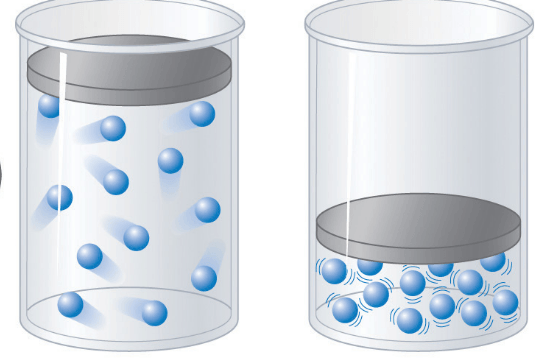
Which container will have a lower pressure?
a)
left
b)
right
c)
they both have the same pressure
d)
I don't know
38.
The relationship of which two variables are compared in Boyle's Law?
a)
pressure & volume
b)
volume & temperature
c)
temperature & pressure
d)
volume & moles (amount of gas)
39.

IF we are using Boyles' law and our Pressure goes UP, what must our volume do?

a)

Go UP

b)

Go DOWN

c)

Stay the same

d)

Wrong law.

40.

Which best explains why increasing the pressure on a gas decreases the volume of the gas sample?

a)

Increasing the pressure causes the gas particles to hit the container walls more often.

b)

Increasing the pressure on a gas sample moves the gas particles closer together.

c)

Increasing the pressure on a gas sample causes the kinetic energy to increase.

41.

Which of these is a unit of temp? PICK Three

a)

Kelvin (K)

b)

cm3

c)

F

d)

atm

e)

Celcius (C)

42.
What is the new volume of the gas if the pressure on 350 L of oxygen at 720 mm Hg is decreased to 600 mm Hg?
a)
420 L
b)
29.16 L
c)
4200.0 L
d)
291.6 L
43.
The following graph shows ____ relationship. 
a)
Direct
b)
Inverse
44.
Boyle's law :  The pressure and volume of a gas show a _____ relationship. 
a)
Inverse 
b)
Direct 
45.
This graph is an example of two variables that are:
a)
directly proportional
b)
inversely proportional
c)
Straight line
d)
No relation
46.
The volume of a gas at 25ο C is 3.8 L.  What will be the volume of that gas at 57 ο C if the pressure is held constant?
a)
8.66 L
b)
4.21 L
c)
6.34 L
d)
3.46 L
47.
A sample of oxygen gas in a closed system has a volume of 200 milliliters at 600 K. If the pressure is held constant and the temperature is lowered to 300 K, the new volume of the gas will be -
a)
400 milliliters.
b)
300 milliliters.
c)
100 milliliters.
d)
200 milliliters.
48.
The volume of a sample of a gas at 273 oC is 200 liters. If the volume is decreased to 100 liters at constant pressure, what will be the new temperature of the gas?
a)
0 K
b)
546 K
c)
273 K
d)
100 K
49.
If 200 mL of a gas at 27°C is cooled to -33°C at a constant pressure, the volume will be
a)
250 mL
b)
204 mL
c)
196 mL
d)
160 mL
50.

Which measurement can be identified by the unit K (Kelvin)?

a)

Temperature

b)

Volume

c)

Pressure

d)

Mass