wayground logo

Free Printable Worksheets

NEW

Font size

S
M
L
XL
Worksheets

Unit 3 Study Guide

Total questions: 57

Worksheet time: 20mins

Name
Class
Date
1.
The natural chemical or physical processes that breaks down rock on Earth's surface.
a)
weathering
b)
erosion
c)
deposition
d)
jackhammering
2.
The process by which water, ice, wind or gravity moves weathered rock and soil from one place to another.
a)
weathering
b)
erosion
c)
deposition
d)
dumptruck
3.
What is liquid rock called within the Earth's surface?
a)
core
b)
lava
c)
magma
d)
volcanic ash
4.
Rock underground suddenly breaks along a fault causing tectonic movement, causing what natural hazard? 
a)
Volcanic Eruption 
b)
Cyclone
c)
Earthquake
d)
Hurricane
5.

What is this?

a)

Asia

b)

Europe

c)

Pangea

d)

Africa

6.

Continental drift is when pieces of Pangea moved apart.

a)

True

b)

False

7.

None of the plates on Earth move.

a)

True

b)

False

8.

This is an example of

a)

convergent

b)

divergent

c)

transform

9.

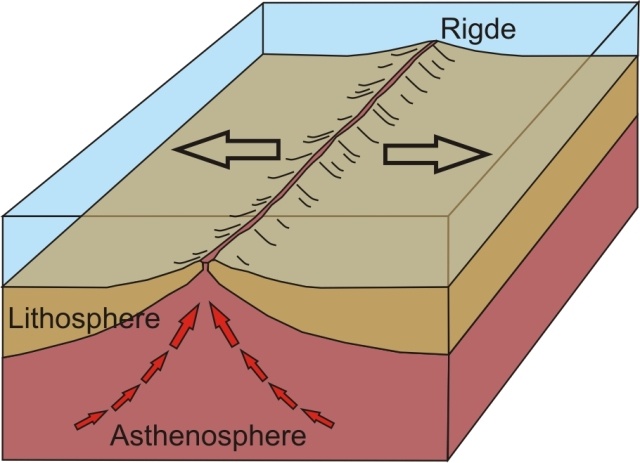
This is an example of

a)

seafloor

b)

Convergent plate

c)

Divergent plate

10.

Mountains are formed when two plates collide

a)

true

b)

False

11.

What is the name of the molten rock rising into the crack from the Earth's mantle?

a)

magma

b)

lava

c)

fossils

d)

fish

12.

______________________ is called when two continental plates under the sea move apart,and a crack forms between them.

a)

continental drift

b)

convergent plates

c)

transform plates

d)

sea floor spreading

13.

Where are fossils found?

a)

Metamorphic

b)

Sedimentary

c)

Underground

d)

Igneous

14.
Plates move towards each other at
a)
divergent plate boundaries
b)
convergent plate boundaries
c)
transform fault boundaries
d)
all of the above
15.
Which ocean is surrounded by the "Ring of Fire"?
a)
Atlantic
b)
Pacific
c)
Indian
d)
Antartic
16.
The outside layer of the earth is called ______________________.
a)
core
b)
crust
c)
mantle
d)
outer core
17.
The Earth's crust is made up of several __________ that are like puzzle pieces. 
a)
puzzle pieces
b)
crust parts
c)
saucers
d)
tectonic plates
18.

Layer of Earth consisting of crust and rigid upper mantle.

a)

Sedimentary

b)

Divergent

c)

Lithosphere

d)

Mesosphere

19.

Circular heat motion in the Earth's middle layer, driving the rock cycle and plate tectonics.

a)

Foliation

b)

Completion

c)

Volcanic Island Arc

d)

Mantle Convection

20.
Earth's plates are....
a)
Constantly moving and changing the face of the Earth
b)
Never moved
c)
Move seldom and very fast
d)
move when they feel like it
21.
What geologic feature/event would you most likely to find at a divergent boundary between two pieces of continental crust?
a)
Mid-Ocean Ridge
b)
Mountain
c)
Rift Valley
d)
Island Arc
22.
What geologic feature/event would you most likely to find at a convergent boundary between two pieces of continental crust?
a)
Volcano
b)
Mountain
c)
Rift
d)
Island Arc
23.
A deep crack in the Earth's crust is called a _______________.
a)
canyon
b)
trench
c)
fault
d)
plate
24.
Earthquakes typically occur _________________.
a)
In the middle of tectonic plates
b)
only in California
c)
only in the middle of the ocean
d)
along plate boundaries
25.
At which type of plate boundary does seafloor spreading occur?
a)
Tranform
b)
Convergent
c)
Divergent
d)
Subductive Zone
26.
The primary force responsible for plate tectonics is ___________ in the mantle.
a)
Conduction
b)
Convection
c)
Radiation
27.
New crust forms at
a)
divergent plate boundaries
b)
convergent plate boundaries
c)
transform fault boundaries
d)
all of the above
28.
Why was the hypothesis of Continental Drift rejected?
a)
there was no known mechanism to explain how the continents move 
b)
the occurrence of earthquakes and volcanoes could not be explained
c)
the fit of North America and Europe was not a very good one
d)
no one really liked Wegener because he was a crazy little man
29.
All of the following were known to Alfred Wegener as support for his Hypothesis of Continental Drift EXCEPT
a)
fossils found on different continents
b)
fit of the continents
c)
rock type similarities
d)
weather patterns in Greenland
30.
Where on the ocean floor is there ongoing volcanic activity
a)
ocean ridges
b)
deep sea trenches
c)
continental shelves
d)
abyssal plains
31.
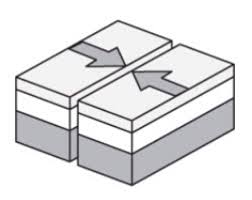
What kind of plate boundary is shown here?
a)
divergent
b)
convergent
c)
transform
d)
subducting
32.
What kind of plate boundary is shown here?
a)
divergent
b)
convergent
c)
transform
d)
submergent
33.
What kind of plate boundary is shown here?
a)
divergent
b)
convergent
c)
transform
d)
strike slip
34.
What geologic feature/event you be most likely to find at a transform boundary?
a)
Earthquakes
b)
Volcanoes
c)
Mountains
d)
Rift Valleys
35.
What geologic feature/event would you most likely to find at a divergent boundary between two pieces of oceanic crust?
a)
Rift Valley
b)
Mid-Ocean Ridge
c)
Island Arc
d)
Flat land
36.
What geologic feature/event would you most likely to find at a divergent boundary between two pieces of continental crust?
a)
Mid-Ocean Ridge
b)
Mountain
c)
Rift Valley
d)
Island Arc
37.
A subduction zone is formed...
a)
when one tectonic plate sinks below another
b)
at every type of convergent plate boundary
c)
at every type of divergent plate boundary
d)
at transform boundaries
38.
Name the boundary
a)
convergent boundary
b)
divergent boundary
c)
transform boundary
d)
sergent boundary
39.
Name the boundary
a)
convergent boundary
b)
divergent boundary
c)
transform boundary
d)
sergent boundary
40.
In which type of boundary do the plates move away from each other?
a)
convergent
b)
normal
c)
divergent
d)
transform
41.
Plates slide past one another at ____________ boundaries.
a)
divergent
b)
convergent
c)
transform
d)
submergent
42.
Plates move towards one another at ______________ boundaries.
a)
divergent
b)
convergent
c)
transform
d)
detergent
43.
Volcanoes typically form _______________.
a)
along plate boundaries
b)
only under water
c)
only in hawaii
d)
where it is usually hot
44.
What is the term for a heavier, denser plate sliding under a less dense plate?
a)
plate boundary
b)
submersion
c)
accretion
d)
subduction
45.
Whenever a subduction zone is formed a ______ is formed.
a)
Mountain
b)
Island Arc
c)
Rift
d)
Volcano
46.
Which of the following is NOT an example of a fossil?
a)
a petrified dinosaur bone
b)
a footprint captured in mud
c)
a seashell found on the beach
d)
an insect stuck in amber
47.
Why don't we know what many ancient plants looked like? 
a)
They had too many soft parts.
b)
They were all eaten by dinosaurs.
c)
There weren't ancient plants.
d)
They had too many hard parts.
48.
Produced when sediments fill in a cavity made when an object decayed 
a)
cast
b)
mold
c)
original remains
49.
Cavity in a rock made when an organism decayed
a)
cast
b)
mold 
c)
original remains
50.
Principle that states in a sequence of undisturbed rocks, the oldest rocks are on the bottom and the rocks become progressively younger toward the top 
a)
superposition 
b)
uniformitarianism
c)
half-life
51.
Method by which a geologist can calculate the absolute age of the rock by knowing the half-life of an isotope 
a)
radiometric dating
b)
relative dating
c)
absolute dating
52.
Fossil of thin layer of carbon atoms and molecules 
a)
original remains 
b)
carbon film
c)
trace fossil
53.
Method by which order of events or age of rocks is determined by examining the position of rocks in a layer 
a)
relative dating
b)
absolute dating
c)
radiometric dating
54.
Fossils of species that existed for  short periods and were widespread 
a)
trace fossils 
b)
index fossils 
c)
original remains 
55.
Correctly sequence the layers of rocks oldest to youngest 
a)
A,B,C,D
b)
D,C,B,A
56.

Correctly sequence the layers of rocks oldest to youngest

a)

C, D, E, A, B

b)

C, E, D, A, B

c)

C, E, D, B, A

57.
Correctly sequence the layers of rocks oldest to youngest 
a)
A,D, C, B, E
b)
E, B,C D, A
c)
B,E,C, D, A