wayground logo

Free Printable Worksheets

NEW

Font size

S
M
L
XL
Worksheets

Benchmark Review Quiz

Total questions: 50

Worksheet time: 53mins

Name
Class
Date
1.
How many worms were 7.25 cm long?
a)
3 worms
b)
4 worms
c)
5 worms
d)
6 worms
2.
This variable in an experiment is the one being deliberately changed by the scientist. 
a)
dependent variable
b)
independent variable
c)
data
d)
control group
3.
In a controlled experiment, how many variables can be worked with at a time? 
a)
one
b)
none
c)
two or more
d)
how ever many makes sense.
4.
Mr. S. sets up an experiment to see how the mass of a ball affects the distance it rolls off a ramp.  Identify the dependent variable.
a)
height of the ramp
b)
 distance traveled by the ball
c)
mass of the ball
d)
weight of the ball
5.
What is the formula for density?
a)
density = mass x volume
b)
density = mass / volume
c)
density = mass + volume
d)
density = mass - volume
6.
If an object has a density of 3.6 g/mL and you put it into water, will it sink or float?  
a)
sink
b)
float
7.
Frank has a paper clip. It has a mass of 9g and a volume of 3cm3. What is its density?
a)
3 g/cm3
b)
1/3 g/cm3
c)
27 g/cm3
d)
39 g/cm3
8.
What is the volume of Object X?
a)
10.0 cm3
b)
15.0 cm3
c)
20.0 cm3
d)
25.0 cm3
9.
The color of a mineral in powder form is called?
a)
hardness
b)
specific gravity
c)
luster
d)
streak
10.
Which mineral group contains the most minerals?
a)
Halides
b)
Oxides
c)
Sulfates
d)
Silicates
11.
How do you test the hardness of a mineral? 
a)
Throw it against a wall
b)
Step on it
c)
Scratch Test
d)
Kick it until it breaks
12.
A naturally formed, inorganic solid with a crystalline structure 
a)
density
b)
streak
c)
mineral
d)
non silicate mineral
13.
What are the two types of luster? 
a)
Metallic and Metallic
b)
Nonmetallic and Shiny
c)
Metallic and Nonmetallic
d)
Shiny and Dull
14.
Using this scale, which mineral can scratch fluorite?
a)
Talc 
b)
Gypsum 
c)
Apatite 
d)
Calcite 
15.

What are the particles of weathered rock called?

a)

Sediments

b)

Fossils

c)

Rocks

d)

Minerals

16.

This is the type of rock that forms when earth processes change the texture and heat and pressure are applied.

a)

Igneous rock

b)

Sedimentary rock

c)

Metamorphic rock

d)

Rock Cycle

17.

These are traces or remains of a once-living thing sometimes found in sedimentary rocks.

a)

Rocks

b)

Sediments

c)

Fossils

d)

Minerals

18.

This is the type of rock that forms from magma or lava hardening.

a)

Igneous rock

b)

Sedimentary rock

c)

Metamorphic rock

d)

Rock Cycle

19.

Which missing rock type is the arrow pointing at?

a)

Igneous

b)

Sedimentary

c)

Metamorphic

20.

What must happen to a metamorphic rock before it becomes a sedimentary rock rock?

a)

It must be broken down into sediment

b)

It must be melted into magma

c)

Its minerals must dissolve in water

d)

It must be exposed to high temperature and pressure

21.
What are the 3 main fossil fuels?
a)
Coal, Oil, and Gasoline
b)
Coal, Oil, and Natural Gas
c)
Electricity, Gasoline, Petroleum
d)
Coal, Oil, Non-renewable Resources
22.
Geothermal energy is energy from 
a)
the sun
b)
heat from deep in the earth
c)
wind
d)
inexhaustable
23.
Energy made from moving water or falling water is
a)
geothermal energy
b)
solar energy
c)
electrical energy
d)
hydroelectrical energy
24.
This Picture Represents Which Type of Alternative Energy?
a)
Wind
b)
Solar
c)
Biofuels
d)
Geothermal
25.
Which of the following letter is at approximately 60 degrees S, 40 degrees W? 
a)
A
b)
D
c)
E
d)
H
26.
Which letter would you find at 15oS, 60oW?
a)
A
b)
C
c)
L
d)
H
27.
If contour lines are close together, then the slope is
a)
gentle
b)
steep
c)
flat
d)
going up and down
28.
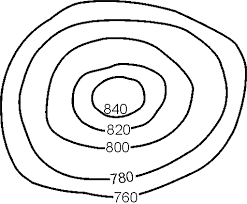
Determine the contour interval:
a)
5 m
b)
10 m
c)
15 m
d)
20 m
29.
The natural chemical or physical processes that breaks down rock on Earth's surface.
a)
weathering
b)
erosion
c)
deposition
d)
jackhammering
30.
The process by which water, ice, wind or gravity moves weathered rock and soil from one place to another.
a)
weathering
b)
erosion
c)
deposition
d)
dumptruck
31.
This type of weathering occurs when rock is physically broken down into smaller pieces of rock.
a)
mechanical weathering
b)
chemical weathering
c)
erosion weathering
d)
deposition
32.
These rocks were broken apart from the continuous freeze/thaw of water in the cracks of the rocks. This is an example of:
a)
ice wedging
b)
acid rain
c)
permeability
d)
abrasion
33.
Weeds growing into the cracks in a sidewalk and the sidewalk begins to crumble is an example of:
a)
mechanical weathering
b)
chemical weathering
34.
Potholes forming in the road after a cold winter is an example of:
a)
mechanical weathering
b)
chemical weathering
35.
A metal statue slowly turning green after years of being outside is an example of:
a)
mechanical weathering
b)
chemical weathering
36.

water that flows off the land when it can no longer be absorbed by soil

a)

rainsplash

b)

runoff

c)

transport

d)

badland

37.
A loop like bend in the course of a river.
a)
meander
b)
oxbow lake
c)
alluvial fan
d)
delta
38.
A landform made of sediment that is deposited where a river flows into an ocean or lake.
a)
delta
b)
alluvial fan
c)
flood plain
d)
oxbow lake
39.

What is the correct order (starting from the surface) of Earth’s layers?

a)

crust, outer core, inner core, mantle

b)

mantle, outer core, inner core, crust

c)

crust, mantle, outer core, inner core

d)

outer core, inner core, crust, mantle

40.

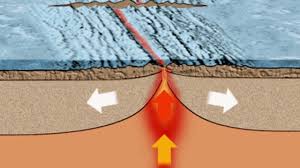
In sea-floor spreading, molten material rises from the mantle and erupts

a)

along the edges of all the continents.

b)

along mid-ocean ridges.

c)

in deep-ocean trenches.

d)

at the north and south poles.

41.

The process by which the ocean floor sinks beneath a deep-ocean trench and back into the mantle is known as _______

a)

convection.

b)

continental drift.

c)

subduction.

d)

conduction.

42.

Most geologists think that the movement of Earth’s plates is caused by _______

a)

convection.

b)

continental drift.

c)

subduction.

d)

conduction.

43.

A place where two plates slip past each other, moving in opposite directions, is known as a _______

a)

transform boundary

b)

divergent boundary.

c)

convergent boundary.

d)

rift valley.

44.

The place where two plates come together is known as a _______

a)

transform boundary.

b)

divergent boundary.

c)

convergent boundary.

d)

rift valley.

45.
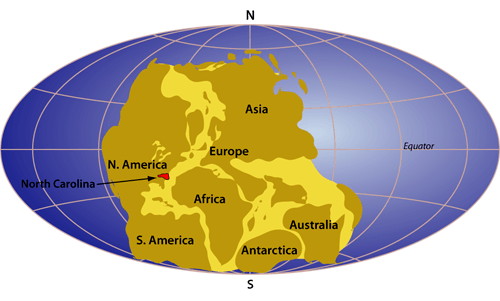
What is this a picture of?
a)
plate tectonics
b)
continental drift
c)
pangea
d)
glacier scaring
46.
What evidence did Wegener use in his theory?
a)
Continents and fossils fitting together/matching-up like puzzle pieces 
b)
glacier scars and evidence from temperature
c)
mountain ranges and coal deposits line up across continents
d)
all of the above
47.
What is a fault?
a)
A crack in a plate.
b)
Where two plates move toward each other.
48.
Most earthquakes happen along the _________________. 
a)
coast
b)
faults
c)
desert
d)
directions
49.
This famous transform fault is located in the western United States creates significant earthquake activity for California
a)
Sierra Nevada Seismic Zone
b)
Denali Fault
c)
San Fransisco 
d)
San Andreas
50.
How many variables should be tested at a time?
a)
Three
b)
Zero
c)
Two
d)
One