

wayground logo

Free Printable Worksheets

Font size

S
M
L
XL
Worksheets

Benchmark 3 Review PART2 2019

Total questions: 73

Worksheet time: 47mins

Name
Class
Date
1.
How did the plague affect the Feudal economy of Europe?
a)
Feudalism remained unchanged
b)
Feudalism was made stronger
c)
Labor shortages ended feudalism, serfs and peasants demand higher pay
d)
Feudalism ended because all peasants died
2.
Crusaders brought many new and interesting goods back with them from the Middle East. This served to ___________ trade in western Europe.
a)
increase
b)
decrease
c)
maintain
d)
eliminate 
3.

How did life change for surviving peasants and serfs after the plague?

a)

They all moved from towns to the country.

b)

They began to demand pay for their labor.

c)

They rioted and took over the manors.

d)

They worked longer hours.

4.

Which of the following best describes how the plague was spread from one person to another?

a)

through the air

b)

through the bites of fleas

c)

through contact with an infected person

d)

all of the above

5.

Where did the Bubonic Plague originate?

a)

Northern Europe

b)

South Africa

c)

Central Asia

d)

Middle East

6.

During the Black Death period, how did the plague arrive in Italy?

a)

on trade ships

b)

on the Silk Road

c)

on the trans-Saharan gold trade

d)

on camels

7.

The plague was carried (spread) by which of the following? (all that apply)

a)

rats/animals

b)

humans

c)

fleas

d)

rain water

8.

What did the most people believe the Black Death was caused by?

a)

dogs and cats

b)

biological warfare

c)

God as a punishment

d)

food mites

9.
The wealthy family of Florence that controlled the city-state and was a patron of Renaissance artists was the _________ family.
a)
Da Vinci
b)
Medici
c)
Petrach
d)
Orsini
10.
The Renaissance first began in the city-state of
a)
Florence
b)
Rome
c)
Venice
d)
Milan
11.
Which describes why the Renaissance began in Italy?
a)
Its' city-states were wealthy due to trade and banking and often competed with each other
b)
It was located near the ruins of ancient Greece
c)
The Renaissance did NOT begin in Italy.
d)
It was economically depressed and had a need for a change.
12.
Gutenberg's accomplishment that led to the spread of the Humanist movement throughout Europe was
a)
wood block printing
b)
his poem, "The Divine Comedy"
c)
"The Prince"
d)
the printing press with movable type
13.
The writer of "The Prince," who wrote that leaders should do whatever it takes to keep power and protect their city, even lie and kill was
a)
Brunelleschi
b)
Dante
c)
Machiavelli
d)
Shakespeare
14.
Leonardo DaVinci's most famous contributions to Renaissance art were
a)
The "Last Supper" and the ceiling of the Sistine Chapel 
b)
The "Pieta" and "David"
c)
"David" and the ceiling of the Sistine Chapel
d)
The "Mona Lisa" and the "Last Supper"
15.
Which was NOT a characteristic of humanism?
a)
an emphasis on the individual and society
b)
gaining knowledge through reason and not just religious faith
c)
an emphasis on the Catholic Church
d)
It was based on Greek and Roman ideas
16.

Copernicus, Kepler, Galileo and Newton were known for contributing what to the Renaissance?

a)

books printed in local vernaculars

b)

new trade routes and goods

c)

new concepts on religion

d)

new concepts on the universe

17.

What helped to increase the amount of vernacular literature during the Renaissance?

(Check ALL that apply)

a)

publication of Greek and Roman mythology
b)

realism in art

c)

invention of the printing press

d)

humanist belief

18.

What are acts by the Catholic Church to reduce punishments after death or forgive one's sins?

a)

Reformation

b)

Indulgence

c)

Excommunicate

d)

Patrons

19.

A person who gives money to support artistic works.

a)

Patrons

b)

Indulgence

c)

Humanism

d)

Vernacular

20.

What major contributiuon did Machiavelli make to the Renaissance?

a)

He wrote the book called The Prince

b)

He painted the ceiling of the Sistine Chapel in Rome

c)

He invented the movable type printing press

d)

He painted the Mona Lisa

21.

Which two fields of science, from the list below, did humanist thought most influence during the Renaissance?

a)

human anatomy

b)

molecular biology

c)

chemistry

d)

astronomy

22.

What explains the vast improvement in health care and disease treatment during the Renaissance?

a)

Focus on humanism started new areas of study, like anatomy.

b)

The doctors stuck to their traditional ideas of medical care.

c)

The cure of many diseases came to Europe from Central Asia.

d)

The plague doctors all died of the Black Death.

23.

Which was a major result of the Protestant Reformation?

a)

The Crusades were organized and fought in the Holy Land.

b)

Religious teachings were no longer allowed in universities.

c)

New Christian churches were created and gained followers.

d)

The power of the Pope was strengthened.

24.

What was a criticism of the Catholic Church during the Protestant Reformation?

a)

It sponsored explorations to the Middle East.

b)

It allowed the Bible to be distributed to the people.

c)

It was corrupt and focused on wealth.

d)

It refused to sell indulgences to peasants.

25.

What was the "Peace of Augsburg?"

a)

It allowed peace between multiple religious groups.

b)

It allowed people to decide which religion they wanted to follow.

c)

It brought peace between Henry VIII and Charles V.

d)

It allowed Germanic kingdoms to determine their religious affiliations.

26.

What are the major reforms enacted by Pope Paul III's Council of Trent? (Check ALL that apply)

a)

creation of seminaries to train priests

b)

allowed women to become nuns

c)

allowed Germanic kingdoms to choose their religion

d)

creation of the Jesuits who lead missionary efforts

27.

What did Martin Luther teach?

a)

The church was corrupt.

b)

Anyone could have a direct relationship with God.

c)

God knew who would be saved before they were born

d)

People needed priests to help them communicate with God.

28.

Who is considered to be the most important multi-talented "Renaissance Man?"

a)

Niccolo Machiavelli

b)

Michelangelo

c)

Leonardo da Vinci

d)

Johannes Gutenberg

29.

Who is considered to be the most important multi-talented "Renaissance Man?"

a)

Niccolo Machiavelli

b)

Michelangelo

c)

Leonardo da Vinci

d)

Johannes Gutenberg

30.

What helped to increase the amount of vernacular literature during the Renaissance? (Check ALL that apply)

a)

humanist belief

b)

invention of the printing press

c)

realism in art

d)

publication of Greek and Roman mythology
31.
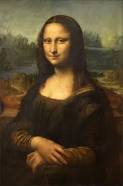
Who painted the Mona Lisa?
a)
Michelangelo
b)
Boticceli
c)
Leonardo da Vinci
d)
Donatello
32.
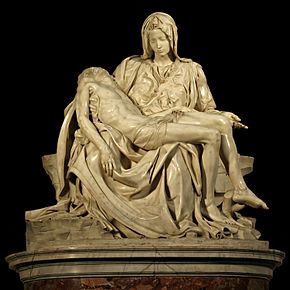
Who is the creator of this sculpture? 
a)
Michelango
b)
Raphael
c)
Leonardo da Vinci
d)
Donatello
33.
Humanism...
a)
emphasized the Bible
b)
leads to happier lives
c)
encourages people to learn Latin and Greek
d)
focuses on the potential of humans to achieve 
34.

Architectural evidence of Greek and Roman influence on buildings created during the Renaissance is seen where?

(Check ALL that apply)

a)

Duomo

b)

St. Peter's Basilica

c)

Coliseum

d)

Shinto shrines

35.

How did Gutenberg's printing press impact Europe?

a)

It decreased literacy throughout the continent

b)

It decreased the production of navigational maps

c)

It allowed more people to train and join the priesthood

d)

It allowed literature to mass produced

36.

-spread ideas quickly throughout Europe

-literacy rates increased in many areas

-people were able to read The Bible in their vernacular


What technological advancement is being described above?

a)

New navigational tools introduced

b)

Invention of the telescope

c)

Invention of the printing press

d)

Diffusion of Romance languages

37.
How did life change for peasants after the Black Death? 
a)
there was an increase in Christianity 
b)
there was in increase in feudalism
c)
Peasants charged high rates for the same jobs. Most left the lord’s manor. Peasants were no longer working for the lord. 
d)
there was an increase in the population
38.
Martin Luther, John Calvin, and Henry VIII were all
a)
Impressionist painters
b)
High ranking officials of the Catholic Church
c)
Leaders of the Protestant reformation
d)
Divine right monarchs
39.
He painted the mural on the ceiling of the Sistine Chapel.
a)
Leonardo da Vinci
b)
Michaelangelo
c)
Raphael
d)
Donatello
40.
How did the Crusades contribute to the Renaissance in Europe?
a)
Crusaders destroyed the libraries of Muslim scholars.
b)
Crusaders rebelled against the Roman Catholic Church.
c)
Crusaders developed an interest in painting and sculpture
d)
Crusaders brought back learning from the East.
41.
Which geographic factor contributed most to Italy’s economic success?
a)
its forests
b)
its climate
c)
its location
d)
its mountains
42.
Painting technique that emphasized 3D, depth, shading, and detail:
a)
fresco
b)
2 dimensional
c)
perspective
d)
water color
43.
Humanism focuses on  
a)
the abilities of humans 
b)
the achievements of humans
c)
the study of the humanities (art, history, and literature) 
d)
all of these are correct
44.
This painting by da Vinci shows the artistic concept that creates distance or depth.
a)
chiaroscuro
b)
sufmato
c)
perspective
d)
2D
45.

What major contributiuon did Machiavelli make to the Renaissance?

a)

He wrote the book called The Prince

b)

He painted the ceiling of the Sistine Chapel in Rome

c)

He invented the movable type printing press

d)

He painted the Mona Lisa

46.

Which statement describes a characteristic of the Renaissance in Europe?

a)

Rebirth of Greek and Roman culture and ideas

b)

The social structure became very rigid

c)

Humanism decreased in importance.

d)

The political structure was disorganized

47.

Architectural evidence of Greek and Roman influence on buildings created during the Renaissance is seen where? (Check ALL that apply)

a)

Duomo

b)

St. Peter's Basilica

c)

Coliseum

d)

Shinto shrines

48.

Which Renaissance artist is responsible for the above sculpture?

a)

Michelangelo

b)

Niccolo Machiavelli

c)

Sandro Botticelli

d)

Leonardo da Vinci

49.
Who authored the book "The Prince", where he declared "It is better to be feared than to be loved, if  you cannot be both"?
a)
Kepler
b)
Medici
c)
Machiavelli
d)
da Vinci
50.
All of the following city-states were important duing the Italian Renaissance EXCETP?
a)
Florence
b)
Milan
c)
Venice
d)
Rome
51.
Why did people support Martin Luther?
a)
They too were unhappy with the Church.
b)
They wanted to read the Bible in German
c)
. Luther gave out indulgences.
d)
Luther was a popular priest in Wittenberg.
52.
Why did Medieval Christians fear excommunication?
a)
Those cast out from their church had to leave their villages.
b)
Cut off from the church could not go to heaven.
c)
Those cast out from their church could not get work.
d)
Those cast out from their church could not rent property.
53.
Martin Luther's attempt to reform the Roman Catholic Church, due to corrupt practices, was initiated by what action?
a)
 invention of printing press
b)
forming the Council of Trent
c)
posting 95 Theses on church door
d)
start of the Thirty Years' War
54.

What is Humanism?

a)

A device used to call someone.

b)

A person that calls and tries to sell you something over the phone.

c)

A medical device.

d)

The belief in the potential for humanity to be good .

55.
What were the key ideas of the Renaissance?
a)
Black & Yellow
b)
Humanism & Reality
c)
Humanism & Realism
d)
Religion & Protestantism
56.

What impact did Gutenberg's printing press have on European society?

a)

It led to increased literacy rates throughout Europe

b)

It created more pollution as a byproduct

c)

It led to a decrease in literacy rates among nobles in Europe

d)

It led to increased literacy rates in the Ottoman Empire.

57.
The revival of Greek and Roman culture, the economic growth of Italian city-states in the 1400s and the development of humanism were aspects of the
a)
Age of Revolutions
b)
Protestant Reformation
c)
Spread of Islam
d)
European Renaissance
58.
What was a major characteristic of the Renaissance?
a)
Conformity
b)
Mysticism
c)
Humanism
d)
Obedience
59.
In Europe, a major characteristic of humanism was
a)
A belief in the supremacy of the state in relation to individual rights
b)
A rejection of ancient civilizations and their cultures
c)
An emphasis on social control and obedience to national rulers
d)
An appreciation for the basic worth of individual achievements
60.
Who painted the “Mona Lisa” & “Last Supper”?  
a)
Michelangelo
b)
Johannes Gutenberg
c)
John Calvin 
d)
 Leonardo da Vinci
61.
How did Marin Luther's ideas about interpreting the Bible differ from Catholics' ideas?
a)
Luther thought people could interpret for themselves, Catholics thought only priests should interpret
b)
Catholics thought people could interpret for themselves, Luther thought only church clergy could interpret.
c)
Catholics thought only Jews or Muslims could interpret.
d)
There was not a difference in their views.
62.
How did the Roman Catholic Church initially react to the Protestant Reformation?
a)
Welcomed Luther and Calvin's suggestions
b)
Tried to end the movement with political and religious pressure
c)
Held a revival to entice members not to leave the church
d)
Told Luther he would not be accepted into Heaven for telling lies about the church
63.
How did the Roman Catholic Church respond to the Reformation after the corrupt practices were exposed in an effort to keep their church members?
a)
Tried to reform itself through the effort known as the Counter Reformation 
b)
Rid Eurpoe of all non-Christians through the Spanish Inquisition
c)
Pope Paul III began the Hundred Years War
d)
The Council of Trent adopted all reforms written by Luther
64.

What are Michelangelo's famous works of art? (Check ALL that apply)

a)

The Pieta

b)

The Sistine Chapel

c)

Birth of Venus

d)

David

65.

Who are considered to be the influential people of the Reformation and Counter Reformation? (Check ALL that apply)

a)

Luther

b)

Calvin

c)

Gutenberg

d)

Kepler

66.

Who are considered to be the influential people of the Renaissance? (Check all that apply)

a)

Michelangelo

b)

Leonardo da Vinci

c)

Botticelli

d)

Luther

67.

Which events resulted in bloodshed between Catholics and Protestants?(Check All that Apply)

a)

The Thirty Years War

b)

actions of "Bloody Mary"

c)

Reconquista

d)

Spanish Inquisition

68.

Which beliefs of the Catholic Church did Martin Luther challenge? (Check ALL that apply)

a)

excommunication

b)

hierarchy of the church

c)

selling of indulgences

d)

people reading the Bible for themselves

69.

How did society differ from the Middle Ages to the Renaissance?

a)

the church was no longer important

b)

emphasis on art and education increased

c)

the spread of economic activity declined

d)

artwork no longer contained religious themes

70.
Which classical civilizations were rediscovered during the Renaissance?
a)
Egypet and India
b)
China and Japan
c)
Sumer and Phoenicia
d)
Greece and Rome
71.

Which of the following is a reason Luther disapproved of the actions of the Roman Catholic Church?

a)

He disagreed with the sale of indulgences.

b)

He blamed the church for not curing people who had the plague.

c)

He thought that the church should continue financing the Crusades.

d)

He believed that the kings should have more power to appoint clergy.

72.

Which of the following areas supported Catholicism?

a)

Netherlands and Denmark

b)

England and Sweden

c)

France and Spain

d)

Norway and Northern Germanic kingdoms

73.

What was a major goal of the Counter Reformation?

a)

To reinstate the influence of the Roman Catholic Church

b)

To reduce the authority of absolute monarchs.

c)

To encourage new ideas in science and philosophy.

d)

To make a compromise with the European Protestants.
