Wayground logo

Free Printable Worksheets

Font size

S
M
L
XL
Worksheets

7.3 Review

Total questions: 67

Worksheet time: 1hrs 2mins

Name
Class
Date
1.

How many valence electrons should Lithium have in its Lewis dot model?

a)

1

b)

2

c)

3

d)

4

2.

How many valence electrons should Oxygen have in its Lewis dot model?

a)

5

b)

6

c)

7

d)

8

3.

This could be the dot diagram of

a)

Mg

b)

Cl

c)

C

d)

O

4.

What is the goal of the Lewis Dot Structure?

a)

To determine the electron position.

b)

To show the element's valence electrons & bonding capabilities.

c)

To find the atomic mass of an element.

d)

To search for the number of electrons in an individual atom.

5.

How many valence electrons should Magnesium have in its Lewis dot model?

a)

1

b)

2

c)

3

d)

4

6.

This is a correct dot diagram for carbon (C)

a)

true

b)

false

7.

This is a correct dot diagram for neon (Ne)

a)

true

b)

false

8.

Which of these is incorrect?

a)
b)
9.
What's a valence electron?
a)
electrons in the second energy level
b)
electrons in the outermost energy level
c)
the atomic number
d)
electrons in the first level
10.
What is the name of this element?
a)
Helium
b)
Hydrogen
c)
Argon
d)
Silver
11.

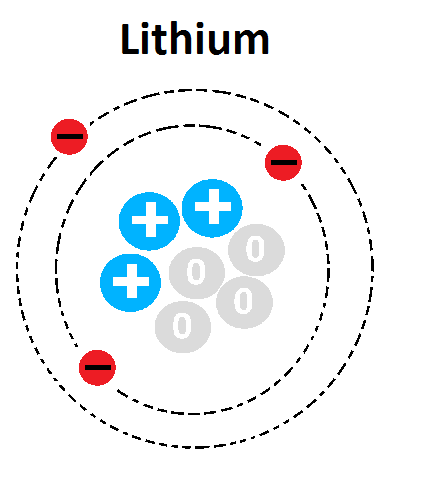
What element is represented in this Bohr Model?

a)

Carbon

b)

Hydrogen

c)

Aluminum

d)

Lithium

12.
What is the name of this element?
a)
Lithium
b)
Boron
c)
Carbon
d)
Neon
13.
What is the name of this element?
a)
Beryllium
b)
Boron
c)
Barium
d)
Bromine
14.
What is the mass number of this atom?
a)
1
b)
3
c)
4
d)
7
15.
What is the atomic number of this atom?
a)
2
b)
4
c)
6
d)
none of the above
16.
Identify this atom.
a)
Lithium
b)
Boron
c)
Carbon
d)
Neon
17.
How many valence electrons?
a)
2
b)
3
c)
5
d)
10
18.
What's a valence electron?
a)
electrons in the second energy level
b)
electrons in the outermost energy level
c)
the atomic number
d)
electrons in the first level
19.

On the periodic table, Groups are

a)

Horizontal rows

b)

Vertical columns

20.

On the periodic table, Periods are

a)

Horizontal rows

b)

Vertical columns

21.

The innermost energy level has a maximum of how many electrons?

a)

1

b)

2

c)

6

d)

8

22.

How many valence electrons?

a)

2

b)

3

c)

4

d)

5

23.

What is this element?

a)

Beryllium (atomic #4)

b)

Boron (atomic #5)

c)

Carbon (atomic #6)

d)

Nitrogen (atomic #7)

24.

How many valence electrons?

a)

2

b)

3

c)

4

d)

5

25.

How many electrons can the 3rd energy level hold?

a)

1

b)

8

c)

16

d)

2

26.
How many electrons does Si contain? (click to see image)
a)
14
b)
28
c)
2
d)
None of these
27.
How many electrons does potassium K contain? (click to see image)
a)
19
b)
39
c)
20
d)
40
28.
Iron is a good conductor, malleable and magnetic. What type of element is Iron? 
a)
Metal
b)
Nonmetal
c)
Metalloid
29.
Which of these is a property of metals?
a)
It's malleable
b)
It can't conduct electricity
c)
They are used in food
d)
It's very brittle
30.
The table shows the properties of three classifications of elements. What are the best headings for columns A, B, and C?
a)
(A) Metals, (B) Non-metals, and (C) Metalloids
b)
(A) Non-metals, (B) Metalloids, and (C) Metals
c)
(A) Metals, (B) Metalloids, and (C) Non-metals
d)
(A) Non-metals, (B) Metals, and (C) Metalloids
31.
What physical properties are used to classify elements as metals, non-metals, or metalloids?
a)
Color, smell, physical state
b)
Reactivity, streak, hardness
c)
Ability to burn, mass, density
d)
Luster, conductivity, malleability
32.
When an object changes shape when struck by a hammer.
a)
luster
b)
malleable
c)
brittleness
d)
ductile
33.
Describe what luster means
a)
How an object reflects light
b)
How soft an object is
c)
If an object floats
d)
If an object can be dug out of the earth.
34.

I am shiny and a good conductor of heat

a)

Metal

b)

Metalloid

c)

Non Metal

35.

I am an insulator and have a dull luster.

a)

Metal

b)

Metalloid

c)

Non Metal

36.

I am malleable, but do not have a shiny luster.

a)

Metal

b)

Metalloid

c)

Non Metal

37.
Non-metals are good conductors of heat and electricity. 
a)
TRUE
b)
FALSE
38.

ductile means...

a)

can be made into wire

b)

can be bent or hammered

c)

can light up a light bulb

d)

it's shiny

39.

Which is true about a compound?

a)

two or more elements

b)

Elements that are combined to make something new

c)

Elements that are chemically combined

d)

All answer chioices are correct

40.

Which of the following is an element?

a)

Cl

b)

CO

c)

NaCl

d)

H2O

41.
Which of the following is a compound?
a)
Fe
b)
CO
c)
C
d)
Cl
42.

How well a substance can be hammered into sheets.

a)

Malleability

b)

Conductivity

c)

Luster

d)

Magnetic

43.

How well a substance allows heat or electricity to flow through it.

a)

Malleablility

b)

Conductivity

c)

Luster

d)

Ductile

44.

A substance that does NOT allow heat or electricity to flow through it.

a)

Insulator

b)

Conductor

c)

Semiconductor

d)

Magnetic

45.
A chemical property that shows that one type of matter is able to react with another type of matter.
a)
combustibility
b)
flammability
c)
acidity
d)
reactivity
46.

Chemical reactivity and bonding is dependent on....

a)

the protons

b)

the neutrons

c)

valence electrons

d)

the mass

47.
Which element is found in group 1 period 2
a)
Lithium
b)
Magnesium
c)
Beryllium
d)
Potassium
48.
Which element is found in group 16 period 3?
a)
Sulfur (S)
b)
Selenium (Se)
c)
Chlorine (Cl)
d)
Carbon (C)
49.
Which element is found  in group 17 period 3?
a)
Chlorine
b)
Flourine
c)
Oxygen
d)
Phosphorous
50.
Which element is found in period 3 group 2?
a)
Sodium (Na)
b)
Magnesium (Mg)
c)
Yttrium (Y)
d)
Boron (B)
51.
Which element is found in group 13 period 6?
a)
Titanium (Ti)
b)
Thallium (Tl)
c)
Lead (Pb)
d)
Mercury (Hg)
52.
Which element is found in group 18 period 4?
a)
Neon (Ne)
b)
Chlorine (Cl)
c)
Krypton (Kr)
d)
Xenon (Xe)
53.
Which element is found in group 2 period 7?
a)
Radium (Ra) 
b)
Radon (Rn)
c)
Stontium (Sr)
d)
Lutetium (Lu)
54.
Which element is found in group 18 period 1?
a)
Neon (Ne)
b)
Helium (He)
c)
Chlorine (Cl)
d)
Krypton (Kr)
55.
Which element is found in group 2 period 4?
a)
Strontium (Sr)
b)
Barium (Ba)
c)
Calcium (Ca)
d)
Beryllium (Be)
56.
Look at the periodic table that is provided. Where would metals be located? 
a)
to the left of the table 
b)
to the right of the table 
c)
in the zigzag line 
57.
Look at the periodic table that is provided. Where would nonmetals be located? 
a)
to the left of the table 
b)
to the right of the table 
c)
in the zigzag line 
58.

How many valence electrons do Alkali metals have? (group 1)

a)

1

b)

5

c)

3

d)

2

59.

How many valence electrons do Group 13 elements have?

a)

2

b)

7

c)

3

d)

4

60.

How many valence electrons do Noble Gases have? (group 18)

a)

7

b)

1

c)

3

d)

8

61.

How many valence electrons do elements in the Oxygen family have? (group 16)

a)

5

b)

6

c)

7

d)

8

62.

How many valence electrons do Halogens have? (group 17)

a)

7

b)

6

c)

8

d)

4

63.

How many valence electrons do Group 14 elements have?

a)

2

b)

3

c)

4

d)

1

64.
_______ are the ROWS on the periodic table.
a)
Families
b)
Groups
c)
Periods
d)
Elements
65.
________ are the COLUMNS on the periodic table and are organized by similar properties.
a)
Classifications
b)
Groups
c)
Periods
d)
Elements
66.
What is the number of protons that the element in this image contain?
a)
14
b)
7
c)
15
d)
18
67.
Why is water NOT on the periodic table?
a)
It is naturally occurring
b)
It is a compound, not an element
c)
It exists as a solid, a liquid, and a gas
d)
Its chemical formula doesn't fit