wayground logo

Free Printable Worksheets

NEW

Font size

S
M
L
XL
Worksheets

Natural Selection/Adaptations/Survival

Total questions: 50

Worksheet time: 39mins
Name
Class
Date
1.
A giraffe's long neck - used to reach leaves high in trees - is an example of a 
a)
instinct
b)
learned behavior
c)
behavioral adaptation
d)
physical adaptation
2.
A trait that helps a living thing survive.
a)
instinct
b)
mimicry
c)
camouflage
d)
adaptation
3.
Animals that have something they DO  to live. This includes things like hibernation, migration etc.
a)
warning coloration
b)
camouflage
c)
behavioral adaptation
d)
mimicry
4.
Which of the following is NOT a behavioral adaptation?
a)
Making a nest in the crevices of buildings
b)
Hunting at night
c)
Collecting food from trash cans
d)
Having large eyes that can see well in the dark
5.
What word describes the process of having the advantageous traits that helps an organism survive  and reproduce?
a)
natural selection
b)
adaptation
c)
mutation
d)
genetic engineering
6.
Which organisms are most likely to survive?
a)
the best adapted
b)
the fastest
c)
the strongest
d)
the most domesticated (tamed)
7.
Any inherited trait that gives an organism an advantage in its environment is called ___.
a)
a mutation
b)
an adaptation
c)
evolution
d)
natural selection
8.
Which of the following means "genetic change over time"
a)
natural selection
b)
speciation
c)
evolution
d)
fitness
9.
The differences among a species, like different bird beaks, are called
a)
genes.
b)
variations.
c)
traits.
d)
theories.
10.
Why are advantageous traits more likely to be passed onto offspring?
a)
Because they are more likely to survive and reproduce.
b)
Because they come from dominant alleles.
c)
Because they come from recessive alleles.
d)
Because the trait is an acquired phenotype.
11.
When every organism of a given species has died
a)
Natural Selection
b)
Homeostasis
c)
Extinction
d)
Selective Breeding
12.
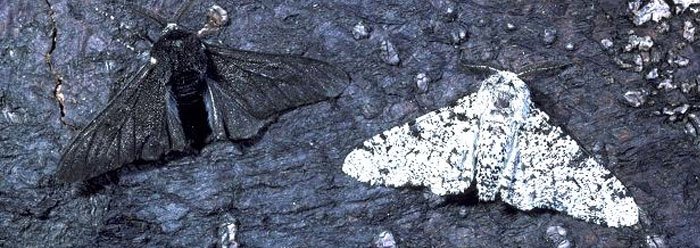
The trees these moths used to live on were white, but have been covered in soot from coal factories. Which moth will be more successful in this environment?
a)
Dark moth
b)
Light moth
c)
Both will be equally successful
d)
Neither will be successful
13.
Since the 1800s humans have stopped burning coal, and the trees have returned to their original color. Which moth will be more successful in this environment?
a)
Dark moth
b)
Light moth
c)
Both will be equally successful
d)
Neither will be successful
14.
Where do adaptations come from?
a)
The individual organism decides to adapt
b)
Mutations that give an organism an advantage in its environment
15.
These moths are all the same species. The differences between their wings is an example of ________________
a)
Natural Selection
b)
Variation
c)
Homeostasis
d)
Extinction
16.
Selective breeding is where ___________ decides which traits should be passed on
a)
Nature
b)
 A human
c)
Mr. Holt
d)
The illuminati
17.
Natural selection is where ___________ decides which traits should be passed on
a)
Nature
b)
A human
c)
Mr. Holt
d)
The illuminati
18.

The more genetic variation a population has,

the more likely it is for some individuals to

a)

evolve

b)

migrate

c)

survive

d)

mutate

19.
What was the name of the scientist who had the theory of evolution?
a)
Lamarck
b)
Einstein
c)
Washington
d)
Darwin
20.
What is the advantage of having different shaped beaks?
a)
To look different from other species.
b)
To be able to eat different types of food.
c)
To fly faster.
d)
To confuse scientists. 
21.
Which of the following is a term for a group of similar organisms that can reproduce fertile offspring?
a)
individual
b)
population
c)
species
d)
fossil
22.
Evolution means...
a)
Change over time in a population.
b)
That everything is the same.
c)
That organisms never change.
d)
Negative traits are acquired in populations.
23.
Survival of the Fittest and the theory of evolution are attributed what scientist?
a)
Charles Darwin
b)
Albert Einstein
c)
Jean Baptiste de Lamark
d)
Isaac Newton
24.
What is it called when better adapted organisms survive to pass traits along to their offspring.
a)
Evolution
b)
Natural Selection
c)
Extinction
d)
Artifical Selection
25.
"Survival of the Fittest" describes which theory
a)
a) natural selection
b)
b) gravity
c)
c) heredity
d)
d) string theory
26.
Modern whales developed their traits through natural selection.  What occurs during the process of natural selection?
a)
Organisms choose mates from other species to create new species
b)
Breeders selectively cross organisms with desired traits
c)
Only the fittest organisms can survive and reproduce
d)
Organisms remain exactly the same over time.
27.
Why did the population of peppered moths in England change from light to dark after the Industrial Revolution?
a)
Light moths were easy to see against sooty trees and were eaten
b)
Light moths were killed by soot
c)
The birds that ate the dark moths were killed by soot
d)
Dark moths were produced by industrial processes
28.
The purpose of selective breeding is to 
a)
Get bigger animals
b)
get smaller animals
c)
create animals with desirable traits
d)
create animals with bad traits
29.
A farmer has bred his pineapple plants from the sweetest pineapples from his last harvest to get even sweeter pineapple plants. What is this an example of?
a)
Selective breeding
b)
Natural selection
c)
Extinction
d)
Mutagenesis
30.
Which term refers to a farmer choosing the best corn from this year to plant next year?
a)
natural selection
b)
selective breeding
c)
genetic engineering
d)
genetic transformation
31.

What is one of the processes involved in selective breeding?

a)

allowing organisms to reproduce without interference

b)

choosing individuals with desirable characteristics to be parents of the next generation

32.
Organisms within a population have genetic differences in their traits called.
a)
Genotypes
b)
Variation
c)
Natural Selection
d)
Heterozygous
33.

Charles Darwin is credited with the theory which states that organisms with favorable traits survive in greater numbers than organisms with non-favorable traits. What is the name of this theory?

a)

the theory of natural selection

b)

the theory of selective breeding

c)

the theory of acquired traits

d)

the theory of plate tectonics

34.

The figure below shows four different species of finches found on the Galapagos Islands. Each of these finches evolved from a common ancestor through natural selection. Which of these finches is best suited to pick small insects off a cactus?

a)
b)
c)
d)
35.

A bison has teeth that ate adapted for grazing or eating grasses. Suppose a disease were to kill off all the grasses in a region where the bison live. What would likely happen to the bison?

a)

They would adapt to eating a different kind of plant.

b)

They would evolve into a new species

c)

They would eventually die from lack of food

d)

They would not be affected.

36.
Which of the following is an example of a physical trait , or structural adaptation?
a)
a long neck of a giraffe
b)
building a nest
c)
regulation of body functions
d)
production of a toxic substance
37.
Most adaptations that help an organism survive are passed on from parent to child as ___traits?
a)
adaptable
b)
physical
c)
more
d)
inherited
38.

Which of the following would be an adaptation for survival in a desert?

a)

an animal being active during the middle of the day

b)

a bird having dark feathers that absorb sunlight as heat

c)

a plant having a thick stem to store water

d)

a plant having large leaves to gather sunglight

39.
A plant growing in response to the sunlight. 
a)
Gravitropism 
b)
Phototropism
c)
Thigmotropism
d)
Hydrotropism
40.
When the plant responds to touch
a)
Phototropism
b)
Thigmotropism
c)
Gravitropism
d)
Hydrotropism
41.

Which factor will most likely increase the survival chances of an organism living in an environment that is undeergoing rapid changes?

a)

having a long life span

b)

producing identical offspring

c)

offspring having a diverse gene pool

d)

encountering strong competition

42.

Darwin proposed that evolution occured by a mechanism know as?

a)

Genetic Drift

b)

Artificial Selection

c)

Natural Selection

d)

Gene Flow

43.
What is another name for natural selection?
a)
survival of the smartest
b)
survival of the fastest
c)
survival of the biggest
d)
survival of the fittest
44.

Genetic drift is a process that causes---

a)

The genetic makeup of an entire population to disappear

b)

The genetic makeup of an entire population to be altered by chance

c)

Organisms to better adapt to their environment

d)

Organisms to have the same DNA as their parents

45.

This random change in allele frequency has caused the small population to change. This is an example of

a)

artificial selection

b)

reproductive isolation

c)

genetic drift

d)

mutations

46.
Tigers living in warm climates have thinner coats of fur than tigers living in cool climates. This is a result of
a)
general diversity 
b)
species diversity
c)
ecosystem diversity
d)
genetic diversity
47.
The difference in beak shape and size of the Galapagos Island finches was because...........
a)
birds immigrating from different locations
b)
introduction of non-native bird species to the island
c)
variation within the species which allowed them to adapt to different food sources
d)
cross-breeding of finches with other bird species
48.
A group of birds become separated from its original population. Over a period of time, the new population of birds adapted to its new environment. If this new population returned to the environment it originated from, which of the following would most likely determine its ability to survive as a species?
a)
its beak size
b)
its ability to fly
c)
its common ancestry
d)
its ability to reproduce
49.
Process by which individuals that are better suited to their environment survive and reproduce most successfully; also called natural selection.
a)
Survival of the Fittest
b)
Extinction
c)
Derived trait
d)
Artificial Selection
50.

When is April Fool's Day?

a)

April 1, 2018

b)

April 1,2019

c)

Easter

d)

Every Day