wayground logo

Free Printable Worksheets

NEW

Font size

S
M
L
XL
Worksheets

Evolution

Total questions: 50

Worksheet time: 50mins

Name
Class
Date
1.

What did Charles Darwin observe in finch populations of the Galapagos Islands off the coast of South America?

a)

different species on different islands

b)

all species on one of the islands

c)

identical species on all the islands

d)

the same species as North America

2.
Mutations are important because they bring about
a)
death of the organism in which they develop
b)
genetic variation needed for a population to evolve
c)
benefits for the individual, not for the population
d)
Hardey-Weinberg equilibrium within a population
3.
The Physical remains of a plant or animal preserved in rock or Earth's crust. 
a)
Adapt
b)
Fossil
4.
Charles Darwin came up with this theory 
a)
Natural Selection
b)
Mutation
5.
To adjust to a changing environment
a)
Mutation
b)
Adapt
6.
Most of the species found in fossil form are _______________. 
a)
Alive
b)
Extinct
7.
Darwin wrote that organisms with traits that are best suited to the environment will ________________
a)
increase in number
b)
become extinct
8.
The gradual change in species over time is...
a)
Evolution
b)
Nucleotide 
c)
Adaptation
d)
Natural Selection
9.
What is another name for natural selection?
a)
survival of the smartest
b)
survival of the fastest
c)
survival of the biggest
d)
survival of the fittest
10.
Structures with the same parts have different functions; suggests that organisms share a common ancestry
a)
vestigial structures
b)
homologous structures
c)
adaptive radiation
d)
fossil
11.
The cause of artificial selection is…
a)
The environment
b)
Humans
c)
Mutation
d)
Gene Flow
12.
Where the better adapted organisms survive to pass traits along to offspring.
a)
Evolution
b)
Natural Selection
c)
Extinction
d)
Artifical Selection
13.
When an organism is completely wiped out of existence, we call it?
a)
extinction
b)
adaptation
c)
evolution
d)
inbreeding
14.
What are the evidences for Evolution?
a)
Fossil Records
b)
Embryology
c)
Similar body structure
d)
All the above
15.
Which organisms are most likely to survive?
a)
the best adapted
b)
the fastest
c)
the strongest
d)
the most domesticated (tamed)
16.
Two organisms that are closely related would have
a)
very similar DNA sequence
b)
exactly the same DNA sequences
c)
no proteins in common
d)
completely different DNA sequence
17.
Which of the following is NOT an example of natural selection? 
a)
People selectively breeding hamsters.
b)
Insect populations developing resistance to certain pesticides.
c)
Bacteria becoming resistant to antibiotics.
d)
Male birds of certain species developing colorful feathers to attract female mates.
18.
What characteristic did Darwin observe about the finches on the Galapagos Islands?
a)
Their feathers 
b)
Genotypes 
c)
Their beaks
d)
Their body sizes
19.

Who is credited as the founder of evolution?

a)

Albert Einstein

b)

Charles Darwin

c)

Charles Barkley

d)

Isaac Newton

20.

Another word for adapt is ____________.

a)

change

b)

create

c)

destroy

21.
Genetic differences between organisms of the same species
a)
Variation
b)
Adaptation
c)
Behavior
d)
Environment
22.
What is the advantage of having different shaped beaks?
a)
To look different from other species.
b)
To be able to eat the food readily available in the environment.
c)
To protect itself against predators.
d)
To protect itself against prey.
23.
The struggle for existence against other members of an organisms species is
a)
Competition
b)
Natural Selection
c)
gene flow
d)
genetic drift
24.
Remains of ancient organisms are called
a)
Extinctions
b)
Fossils
c)
Mutations
d)
Variations
25.
Which of the following is NOT a factor that affects the process of natural selection?
a)
Overpopulation
b)
Fossils
c)
Competition
d)
Variations
26.
A well-tested concept that explains a wide range of observations is called a(an):
a)
hypothesis
b)
experiment
c)
cause and effect
d)
scientific theory
27.
A group of similar organisms that can mate with each other and produce fertile offspring is called a species.  
a)
True  
b)
False
28.

Which one of these is an example of overproduction?

a)

Monkeys

b)

Whales

c)

Rhinos

d)

Sea turtles

29.

Competition is...

a)

when more offspring are born than what can survive.

b)

a difference in organisms among the same species.

c)

when food and other resources are limited.

d)

when negative or un-helpful traits disappear over time.

30.

Variation is...

a)

when more offspring born than what can survive.

b)

a difference in organisms from the same species.

c)

when food and other resources are limited.

31.

Overproduction is...

a)

when more offspring are produced than the environment can support.

b)

a difference in organisms from the same species

c)

when food and other resources are scarce.
32.
What is the study of organisms at the early stages of development?
a)
DNA studies
b)
embryology 
c)
extinction
d)
fossil record
33.
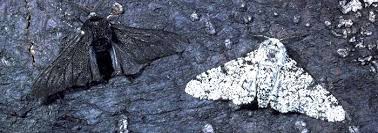
Predict which moth would increase in population
a)
light 
b)
dark
34.
Darwin wrote that organisms with traits that are best suited to the environment will ________________
a)
increase in number
b)
become extinct
35.
The white feathers of a snowy owl allow it to blend in with its environment during the winter months (snow). This is an example of ________________
a)
Species
b)
Environmental Change
c)
Adaptation
d)
Variation
36.

The fact that both these mammals incubate their immature offspring in a pouch provides evidence that they-

a)

Belong to the same species

b)

Must range great distances to eat

c)

Have very similar skeletal structures

d)

Are descended from a common ancestor

37.

Oldest rocks and ancestors would be deeper in the ground

a)

Speciation

b)

Homologies

c)

Recessive Traits

d)

Fossil Record

38.

According to evolutionary theory, all living things have a common

a)

Purpose

b)

Function

c)

Ancestor

d)

Phone Number

39.

According to evolutionary theory, similar DNA would mean a common

a)

Ancestor

b)

Environment

c)

Interest

d)

Residency

40.
Which of these does NOT provide evidence that evolution occured?
a)
the fossil record
b)
the physical differences between species
c)
similar structures between species
d)
where an organism lives
41.

A species is __________ if no more members of that species are still alive.

a)

evolved

b)

extinct

c)

selected

d)

varied

42.

The theory that evolution occurs slowly but steadily is called ________________.

a)

selection

b)

scientific theory

c)

gradualism

43.
What is the study of organisms at the early stages of development?
a)
DNA studies
b)
embryology 
c)
extinction
d)
fossil record
44.
What is this an example of?
a)
vestigial structures
b)
embryology
c)
homologous structures
d)
fossil record
45.
Which species’ DNA is most similar to the DNA of the toothed whale? 
a)
Hippopotamus 
b)
Baleen Whale
c)
Grazing Mammals
d)
Camels
46.
The study of the early stages of development that is one evidence of evolution is:
a)
Homologous Structures
b)
Embryology
c)
Vestigial Organs
47.
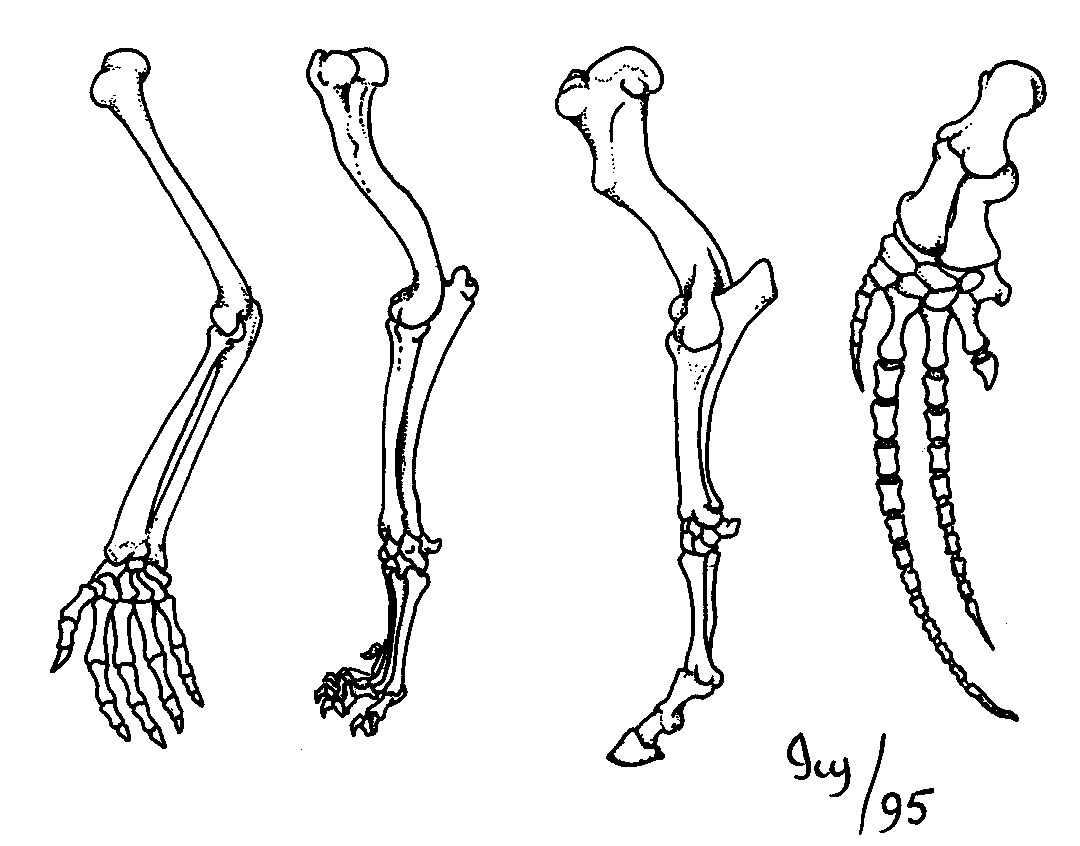
The similarities of the bones in the diagram provide evidence that---
a)
The organisms shown lived in the same natural envionrment
b)
The organisms shown may have developed from a common ancestor
c)
The organisms shown have the same genetic diseases
d)
All vertebrate species have identical forelimbs
48.

_____________________are features present in modern organisms which are no longer in use.

a)

DNA

b)

Vestigial structures

c)

Fossils

d)

Homologous structures

49.

_________________ show clear changes in an organism over time, the environment organisms lived in, the time period the organism lived in, and where the organism lived.

a)

DNA

b)

Vestigial structures

c)

Fossils

d)

Homologous structures

50.

When vertebrates are in the early stages of development (an embryo) they all possess....

a)

gill slits and tails

b)

backbone and hands

c)

hands and feet

d)

tongue and mouth