wayground logo

Free Printable Worksheets

NEW

Font size

S
M
L
XL
Worksheets

PDT 4 final bio

Total questions: 40

Worksheet time: 29mins

Name
Class
Date
1.

The enzyme responsible for Carbon Fixation in C3 Photosynthesis is

a)

Rubisco

b)

PEP Carboxylase

c)

Cytokinase

d)

Pyruvate dehydrogenase

2.
The loss of H2O through stomata is referred to as:
a)
Transpiration
b)
Respiration
c)
Evaporation
d)
Photorespiration
3.
In CAM Photosynthesis CO2 is stored as:
a)
Malate
b)
RuBP
c)
Pyruvate
d)
G3P
4.

The main problem encountered by C3 plants in hot conditions is:

a)

transpiration

b)

photorespiration

c)

dehydration

d)

translocation

5.

Cyclic photophosphorylation differs from non-cyclic photophosphorylation in that ___________ is not made from the process

a)

ATP

b)

PGAL

c)

NADH

d)

NADPH

6.

Which of the following plants fixes carbon dioxide at night?

a)

Sugarcane

b)

Cactus

c)

Oryza sativa

d)

Hibiscus rosa-sinensis

7.

How many carbon dioxide molecule must be added to RuBP to make a single molecule of glucose?

a)

3

b)

4

c)

5

d)

6

8.

Photorespiration lowers the efficiency of photosynthesis by preventing the formation of

a)

Carbon dioxide molecules

b)

3-phosphoglycerate molecules

c)

ATP molecules

d)

Ribulose bisphosphate molecules

9.

Most of the carbon dioxide produced by the body tissue is transported to the lungs in the form of …

a)

Carbonic acid.

b)

Blood plasma.

c)

Bicarbonate ion.

d)

Carbaminohaemoglobin.

10.

In the chloride shift, ________________ move into the erythrocyte to replace the ______________ that move out.

a)

Chloride ions; carbon dioxide molecules.

b)

Carbon dioxide molecules; chloride ions.

c)

Bicarbonate ions; chloride ions.

d)

Chloride ions; bicarbonate ions.

11.

The Bohr shift occurs when …

a)

Increased partial pressure of oxygen.

b)

Decreased partial pressure of oxygen.

c)

Increased partial pressure of carbon dioxide.

d)

Decreased partial pressure of carbon dioxide.

12.

Which of the following is the chemoreceptor detects changes of pH in cerebrospinal fluid?

a)

Aortic bodies

b)

medulla oblongata

c)

Carotid bodies

d)

external intercostal muscle

13.
A flap of tissue that prevents blood from flowing backward
a)
Aorta
b)
Atrium
c)
Septum
d)
Valve
14.
An electrocardiogram measures what?
a)
The amount of pressure exerted on blood vessels.
b)
The electrical activity of the heart.
c)
How many times the heart contracts over time.
d)
The body's temperature caused by friction of blood in vessel.
15.
Normal blood pressure is...
a)
120/80 mmHg
b)
80/120 mmHg
c)
140/90 mmHg
d)
80/140 mmHg
16.

The 'Lub' sound of the heart is the....

a)

Atrioventricular valves closing

b)

Semilunar Valves closing

c)

Blood flowing through the pulmonary artery and Aorta

17.

The opening of semilunar valves is due to

a)

increased ventricular pressure

b)

decrease ventricular pressure

c)

increased aortic pressure

d)

increase in artrial volume

18.

In the diagram below, which part of the tracing represents the contraction of the atria?

a)

P

b)

T

c)

R

d)

S

19.

What shows the time a signal is delayed at the AV nodes?

a)

PR segment

b)

ST segment

c)

PR interval

d)

QRS complex

20.

Structure of phloem consists all below, except?

a)

Sieve tube element

b)

Tracheids

c)

Companion cell

d)

Sieve plate

21.

What is the best words to describe sugar source and sugar sink

a)

Both are plants organ and act as storage

b)

Sugar sink can be either roots, fruit or mature leaves and sugar source is shoots

c)

Sugar source act as site for sugar production and sugar sink will store sugar

d)

Companion tube carry food from a sugar source to a sugar sink

22.

Process in which food substances are moved to the rest of plant by phloem is known as

a)

transpiration

b)

respiration

c)

photosynthesis

d)

translocation

23.
What force between adjacent water molecules helps transpiration?
a)
Cohesion
b)
Adhesion
24.

Movement of water across the endodermis cell can occur through the

I: apoplast pathway

II: vacuolar pathway

III: symplast pathway

a)

III only

b)

II and III

c)

I and II

d)

I, II and III

25.
High pressure in Bowman's capsule is caused by a _________ afferent arteriole and a __________ efferent arteriole
a)
large, small
b)
small, large
c)
nutrient rich, nutrient poor
d)
nutrient poor, nutrient rich
26.
Identify Letter D
a)
Adrenal Gland
b)
Renal Artery
c)
Renal Vein
d)
Renal Pelvis
27.
Which cells are the target of the ADH hormone?
a)
medulla cells
b)
pancreatic cells
c)
collecting duct cells
d)
limb cells
28.

when you drink caffeinated drink.....

a)

ADH is less produced

b)

ADH is more produced

29.

Which cells activate helper T-cells by antigen presentation?

a)

B-cells

b)

Bacteria

c)

Macrophages

d)

Plasma cells

30.
Which of the following is NOT part of the first line of defense?
a)
skin
b)
B cells
c)
sweat
d)
lysozyme
31.
Which type of immunity is found in plants, invertebrates, and vertebrates?
a)
innate (nonspecific)
b)
adaptive (specific)
32.
Which antibody is produced during the primary immune response?
a)
IgA
b)
IgG
c)
IgM
d)
IgE
33.
Which cells kill cancer cells and infected cells?
a)
cytotoxic T cells
b)
B cells
c)
mast cells
d)
eosinophils
34.
What cell type does HIV target?
a)
cytotoxic T cells
b)
helper T cells
c)
B cells
d)
neutrophils
35.
Where do T cells mature?
a)
bone marrow
b)
thymus
c)
brain
d)
thyroid
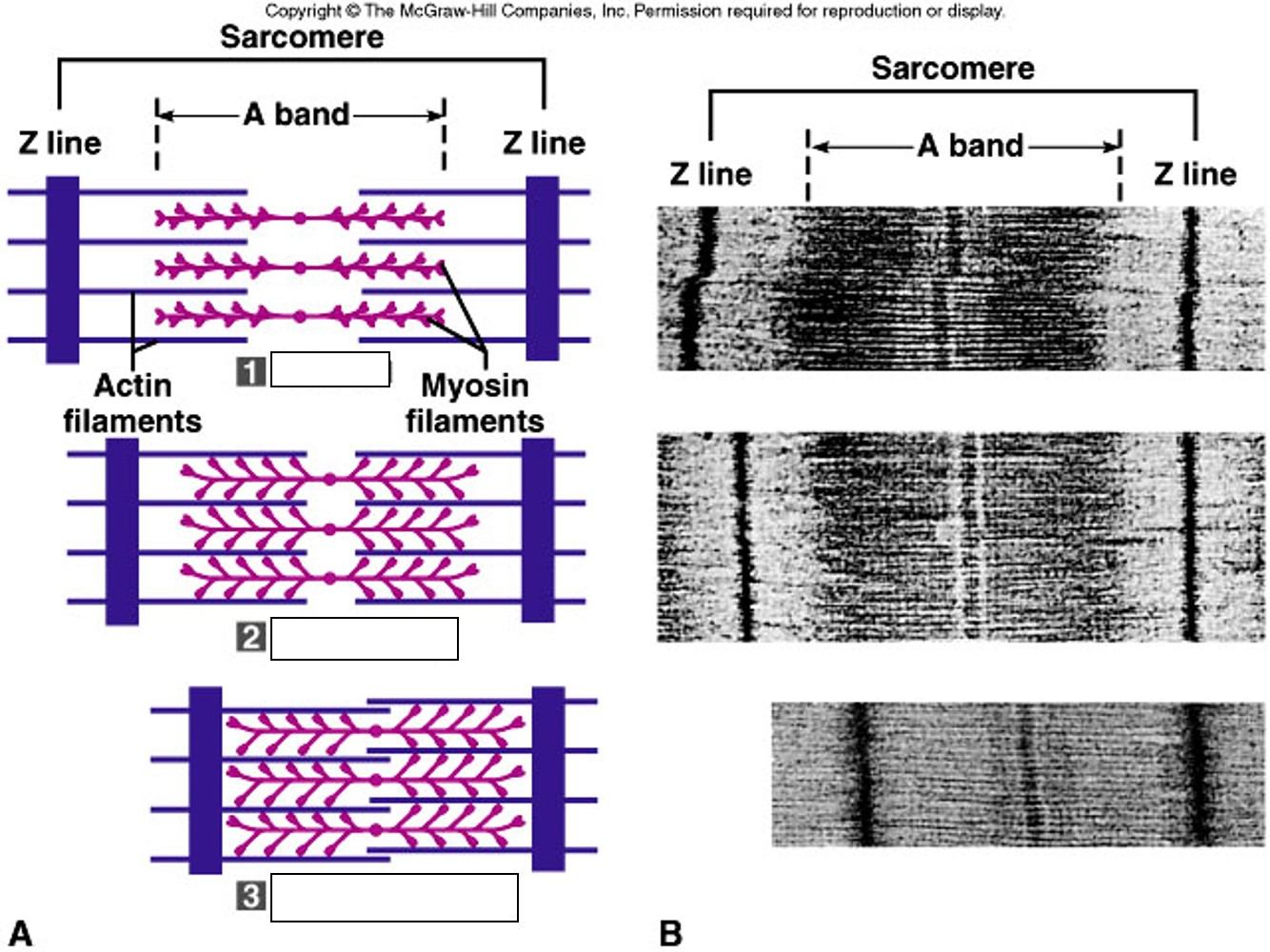
36.
What zone/band of the sarcomere is represented by yellow.
a)
I Zone/Band
b)
A Zone/Band
c)
H Zone/Band
d)
M Zone/Band
37.
What state is the sarcomere in #1
a)
Relaxed
b)
Contracting
c)
Fully Contracted
d)
None of the above
38.
When a membrane potential reaches +30mV, ________ channels open, ________ occurs, and ________ channels close.
a)
Sodium, depolarization, potassium
b)
Potassium, depoloarization, sodium
c)
sodium, repolarization, potassium
d)
postassium, repolarization, sodium
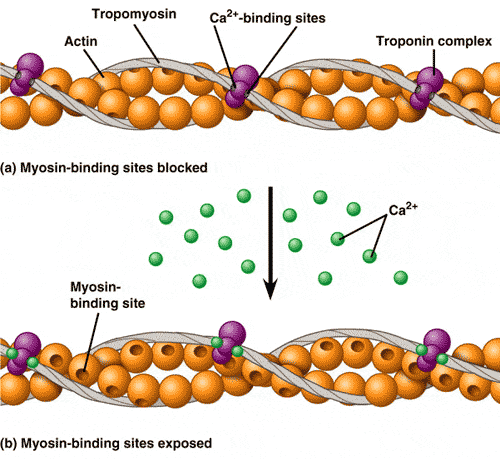
39.
Calcium:
a)
causes ATP binding to actin
b)
increases the action potential along the sarcolemma
c)
binds to proteins on myosin
d)
triggers the binding of myosin to actin
40.
The ripening of fruit and the dropping of leaves and fruit are principally controlled by 
a)
auxins. 
b)
cytokinins.
c)
ethylene. 
d)
carbon dioxide concentration (in air).