wayground logo

Free Printable Worksheets

NEW

Font size

S
M
L
XL
Worksheets

Unit 7: Weather and Climate

Total questions: 75

Worksheet time: 45mins

Name
Class
Date
1.
What weather instrument is this?
a)
Radar
b)
weather satellite
c)
barometer
d)
anemometer
2.
A severe storm which involves a funnel cloud forming over land is:
a)
hurricane
b)
tornado
c)
thunderstorm
d)
blizzard
3.
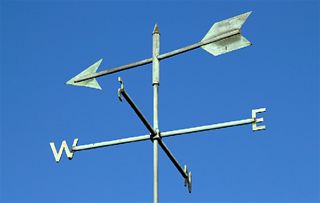
From which direction is the wind blowing in this picture?
a)
north
b)
east
c)
south
d)
west
4.
What weather instrument is this and what does it measure?
a)
thermometer-temperature
b)
rain gauge-rain fall
c)
barometer-air pressure
d)
hygrometer-humidity
5.
What weather instrument is this and what does it measure?
a)
wind vane- wind direction
b)
thermometer-temperature
c)
rain gauge-rain fall
d)
anemometer-wind speed
6.
This weather instrument is a...
a)
thermometer
b)
anemometer
c)
rain gauge
d)
barometer
7.
What weather instrument is this?
a)
radar
b)
weather satellite
c)
compass
d)
anemometer
8.
A person that studies, reports and forecast weather conditions is a
a)
radiologist
b)
geologist
c)
astronomer
d)
meteorologist
9.
What are the yearly conditions of temperature, precipitation and humidity?
a)
weather
b)
climate
10.

As you move towards the poles, what happens to temperature?

a)

temperature becomes hotter

b)

temperature becomes colder

11.
Which climate zone gets the least amount of direct sunlight and is the coldest?
a)
tropical
b)
temperate
c)
polar
12.
Which climate zone gets the most amount of direct sunlight and rainfall and is the warmest?
a)
tropical
b)
temperate
c)
polar
13.
Which climate zone has moderate temperatures and rainfall year round?
a)
tropical
b)
temperate
c)
polar
14.

As altitude increases, what happens to temperature?

a)

temperature gets hotter

b)

temperature gets colder

15.
What are the imaginary lines that determine weather patterns and run parallel to the equator?
a)
latitude
b)
longitude
16.
What are the imaginary lines that determine weather patterns and run parallel to the equator?
a)
latitude
b)
longitude
17.
True or False?  Warm and cold ocean currents affect the land nearby.
a)
false
b)
true
18.
Which factor does not affect climate?
a)
longitude
b)
distance from large bodies of water
c)
latitude
d)
altitude
19.
When air pressure is high, what type of weather do we experience?
a)
sunny and clear
b)
rainy and cloudy
20.
When air pressure is low, what type of weather do we experience?
a)
sunny and clear
b)
rainy and cloudy
21.
What are the daily conditions of temperature, humidity and precipitation?
a)
weather
b)
climate
22.
A severe storm that involves strong winds and forms over warm water is:
a)
tornado
b)
thunderstorm
c)
hurricane
d)
blizzard
23.
This severe weather involves lightning, rain, and forms from a cumulonimbus cloud.
a)
thunderstorm
b)
tornado
c)
hurricane
d)
blizzard
24.
Humidity is the...
a)
Amount of Water Vapor in the Air
b)
Amount of Wind in the Air
c)
Amount of Precipitation in the Air
d)
Amount of Pressure in the Air
25.
________________ are made of water vapor that condenses in the troposphere.
a)
dew
b)
clouds
c)
evaporation
d)
transpiration
26.
__________ a two-thermometer instrument slung around a rod or pole that is also referred to as a wet dry bulb used to measure relative humidity.
a)
thermometer
b)
barometer
c)
sling psychrometer
d)
anemometer
27.
Warm air near the Earth’s surface rises and then cools and drops, this creates a _________________ in the atmosphere.
a)
run-off
b)
Greenhouse Effect
c)
convection current
d)
water cylce
28.
Because the earth is spinning on its axis, the global winds appear to curve. This is known as the __________ ________.
a)
Coriolis Effect
b)
Greenhouse Effect
c)
Climate Effect
d)
Atmosphere Effect
29.
Where does a hurricane form?
a)
Over a cold body of water
b)
Over a warm body of water
c)
Over cold land
d)
Over warm land
30.
What kind of weather is usually associated with a low pressure system?
a)
Sunny weather
b)
Precipitation (rain, snow, etc.)
31.
What kind of weather is usually associated with a high pressure system?
a)
Sunny weather
b)
Precipitation (rain, snow, etc.)
32.
What layer does weather occur in?
a)
mesosphere
b)
troposphere
c)
thermosphere
d)
stratosphere
33.
What measures temperature?
a)
barometer
b)
anemometer
c)
thermometer
d)
psychrometer
34.
What type of cloud looks like cotton and is in the lower altitudes?
a)
Cumulus
b)
Stratus
c)
Cirrus
35.
a)
nimbostratus cloud
b)
cumulonimbus cloud
c)
cirrocumulus cloud
d)
altostratus cloud
36.
what type of cloud is shown?
a)
cumulus
b)
cirrus
c)
stratus
37.
what type of cloud is shown?
a)
cumulus
b)
cirrus
c)
stratus
38.
At which humidity is it more likely to rain?
a)
50%
b)
20%
c)
77%
d)
99%
39.
What type of map is shown?
a)
satelite
b)
radar
c)
isobar
d)
isotherm
40.
What type of map is shown?
a)
satellite
b)
radar
c)
isobar
d)
isotherm
41.
What weather factor does a wind vane measure?
a)
Air Pressure
b)
Air Temperature
c)
Wind Speed
d)
Wind Direction
42.

What causes global convection currents

a)

Forests

b)

greenhouse gases

c)

more land forms

d)

uneven heating of the Earth's surface

43.

Where do warm ocean currents come from

a)

the poles

b)

near the land

c)

the equator

d)

middle of the oceans

44.

What city will experience decreasing temperatures in the next day?

a)

Denver

b)

El Paso

c)

Memphis

d)

Los Angeles

45.

What city is most likely going to see temperatures rise?

a)

San Jose

b)

El Paso

c)

Jacksonville

d)

Chicago

46.

Where do cold ocean currents come from?

a)

cold ocean currents come from the southern hemisphere

b)

cold ocean currents come from the equator

c)

cold ocean currents come from the poles

d)

cold ocean currents come from the beach

47.

What does this symbol represent?

a)

Cold Front

b)

Warm Front

c)

Stationary Front

d)

Occluded Front

48.

What does this symbol represent?

a)

Cold Front

b)

Warm Front

c)

Stationary Front

d)

Occluded Front

49.

What does this symbol represent?

a)

Cold Front

b)

Warm Front

c)

Stationary Front

d)

Occluded Front

50.

What does this symbol represent?

a)

Cold Front

b)

Warm Front

c)

Stationary Front

d)

Occluded Front

51.

hurricanes are

a)

extreme low pressures

b)

extreme high pressures

c)

small rain storms

d)

formed over land

52.

Low Pressures are associated with what type of weather

a)

fair weather

b)

cold weather

c)

warm weather

d)

rainy weather

53.

Warm Fronts bring

a)

rain followed by cool dry air

b)

hurricanes

c)

rain followed by hot humid air

d)

fair weather

54.

cold Fronts bring

a)

rain followed by cool dry air

b)

hurricanes

c)

rain followed by hot humid air

d)

fair weather

55.

Which of the following does NOT affect the weather?

a)

The temperature of the air

b)

The speed of the wind

c)

The types of clouds in the sky

d)

The phase of the moon

56.

This storm covers a narrow path, yet it is extremely destructive. It often forms over flat land. What storm is described?

a)

Flood

b)

Hurricane

c)

Tornado

d)

Thunderstorm

57.

Which fluffy, white clouds with flat bottoms are usually present during fair weather?

a)

Cumulonimbus

b)

Cumulus

c)

Cirrus

d)

Stratus

58.

What kind of cloud most resembles a feather in the sky?

a)

Cumulonimbus

b)

Cumulus

c)

Cirrus

d)

Stratus

59.

A barometer measures air pressure and tells whether the pressure is rising or falling. What weather can be expected when the air pressure is rising?

a)

Sunny and dry conditions are coming

b)

Stormy and wet conditions are coming

c)

A hurricane is coming

d)

A tornado may happen

60.
Which of the following is a part of weather?
a)
temperature
b)
wind direction
c)
precipitation
d)
all of the above
61.
What type of storm front is this? 
a)
warm front
b)
cold front
c)
stationary front
d)
occluded front
62.
A front is
a)
where warm air is cooling at earth's surface
b)
a line where hot and cold air are separating
c)
a line where two different air masses meet
d)
where cold air is rising and forming rain clouds
63.
_____________ air is more dense and tends to sink
a)
cold
b)
warm
c)
moist
d)
dry
64.
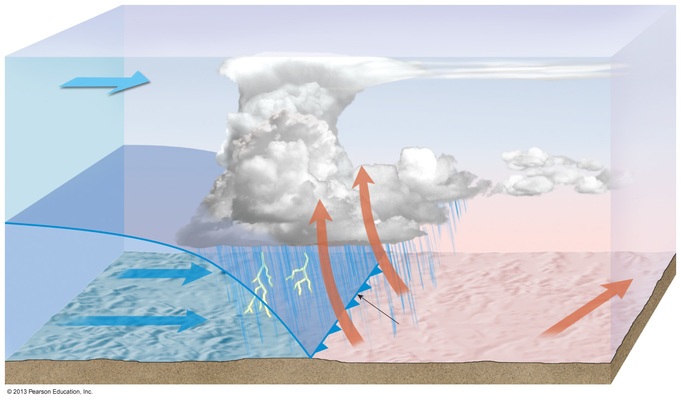
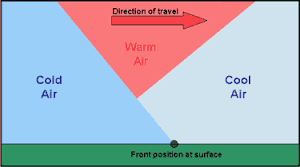
Which type of front is pictured?
a)
Cold front
b)
Warm front
c)
Occluded front
d)
Stationary front
65.
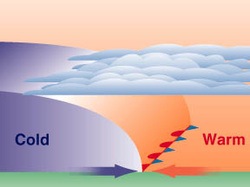
Which type of front is pictured?
a)
Cold front
b)
Warm front
c)
Occluded front
d)
Stationary front
66.
What symbol is this?
a)
warm front
b)
cold front
c)
stationary front
d)
occluded front
67.
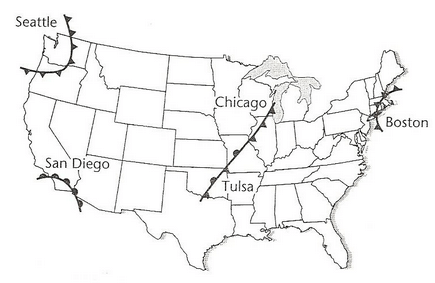
Which type of front is near Seattle?
a)
cold front
b)
warm front
c)
occluded front
d)
stationary front
68.
Which front is located near San Diego?
a)
cold front
b)
warm front
c)
occluded front
d)
stationary front
69.
Which type of front is located near Boston?
a)
warm front
b)
cold front
c)
stationary front
d)
occluded front
70.
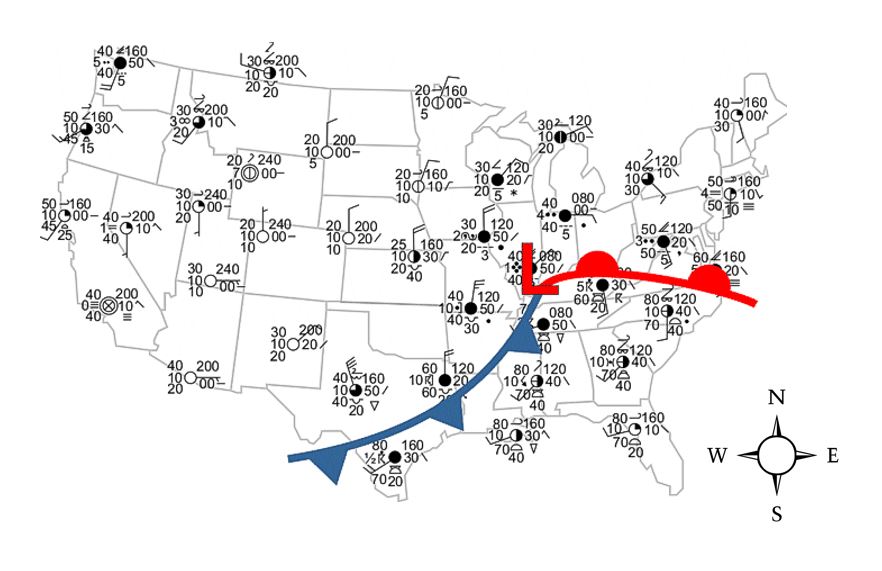
What direction is the warm front moving on the map? 
a)
North
b)
South
c)
East
d)
West
71.
What direction is the cold front moving on the map? 
a)
Southwest
b)
Northwest
c)
Southeast
d)
Northeast
72.
Which front leads to steady rain for several days?
a)
warm front
b)
cold front
c)
stationary front
d)
occluded front
73.

Which one shows a warm front?

a)
b)
c)
d)
74.
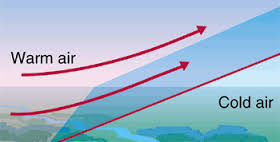
Which type of front is pictured?
a)
Cold front
b)
Warm front
c)
Occluded front
d)
Stationary front
75.
What is the source of energy that heats the atmosphere and creates air movement?
a)
clouds
b)
the moon
c)
tides
d)
the sun