
 Worksheets
1st Semester Review BMS 6th Grade
Total questions: 70
Worksheet time: 1hrs 6mins
Question: Determine the independent variable.
Question: Determine the dependent variable.
Question: Determine the control group.

Which law is this?


__________________ is a measure of the average kinetic energy of the particles in an object
Temperature
Heat
Absolute zero
Cold
___________ is the transfer of thermal energy from a warmer object to a cooler object.
Temperature
Energy
Heat
Cold
__________________ is a type of heat transfer that occurs only in fluids, such as water and air.
Convection
Radiation
Conduction
Heat
__________________ is the transfer of energy by electromagnetic waves.
Convection
Radiation
Conduction
Heat
________________ transfers heat from one particle of matter to another within an object or between two objects.
Convection
Radiation
Conduction
Heat
A material that conducts heat well is called a __________________.
conductor
convection
radiation
insulator
______________ are materials that do not conduct heat well.
Convections
Conductors
Insulators
Properties
The amount of energy required to raise the temperature of 1 kg of a material by 1 kelvin is called its _______________________.
specific heat
energy change
specific change
temperature change
The expanding of matter when it is heated is known as _____________ expansion.
heat
specific
thermal
cold
Warm air rises because it is
Less dense than cool air
More dense than cool air
The same density as cool air
Heavier than cool air
What is thermal energy?
the total kinetic energy in an object
a measure o the average kinetic energy of the molecules in an object or substance
The energy that is transferred between two objects that are different temperatures.
Heat is...
the total kinetic energy in an object. Depends on mass and temperature.
A measure of the average kinetic energy of the molecules in an object or substance.
The energy that is transferred between two objects that are different temperatures.
Which of the following best represents what happens when you're inside a room, holding a cold glass of lemonade?
The lemonade makes your hand cold, the air warms the lemonade.
Your hand warms the lemonade, the coldness of the lemonade cools your hand, the air warms the lemonade
Your hand transfers heat to the lemonade, the water vapors cool on the outside of the glass, the air warms the lemonade
Which of the following statements is true? (only one)
a large ice sculpture has more thermal energy than a boiling pan of water just removed from the stove.
a large ice sculpture has less thermal energy than a boiling pan of water just removed from the stove.
Thermal energy only exists in objects that have high kinetic energy and high temperatures.
A lizard sits on a hot rock to get warm. What type of thermal energy transfer is occurring?
conduction
convection
radiation
kinetic
A hot potato at 80 ºC is placed in a bowl of soup at 40 ºC. The surrounding room is at
20 ºC. Which correctly describes the directions of thermal energy transfer?
potato to soup, and soup to room
room to soup, and soup to potato
room to soup, and room to potato
soup to potato, and potato to room
A hot iron is turned off and cools down to room temperature. the iron cools because...
the iron does not hold heat very well
the room transfers cold energy to the iron
heat energy is transferred from the warm iron to the cooler room
the thermal energy is destroyed during an interaction with the room
A liquid thermometer works because liquid ____ when warmed.
expands
contracts
solidifies
condenses
This is the horizontal movement of ocean water that occurs at or near the ocean's surface.
Ocean Current
Surface Current
Deep Current
Convection Current
This is a stream-like movement of ocean water far beneath the surface of the ocean.
Ocean Current
Surface Current
Convection Current
Deep Current
Which of the following does not affect surface currents?
Continental Deflections
The Coriolis Effect
Global Winds
Marine Life
Continents affect surface currents by:
Dropping Pieces of Rock into the Ocean
The Coriolis Effect
Making the Water Warmer
Continental Deflection
What affects the density of water?
Salinity and Temperature
Temperature and Air Pressure
Salinity and Air Pressure
Only Temperature
True or False: The sun is the major source of energy that powers surface currents.
True
False
Which does not affect surface currents/
wind
density
Coriolis Effect
Continental Deflection
What is the curving of Earth's motion due to?
wind
Corlios Effect
density
temperature
What 2 factors affect deep ocean currents?
salinity and wind
wind and temperature
temperature and salinity
Coriolis Effect and wind
What is the name of the surface current on the east coast of the US?
California
Canaries
Gulf Stream
North Atlantic Drift

Wind is created when air moves from a ________________________ pressure area.
high to low
high to high
low to high
low to low
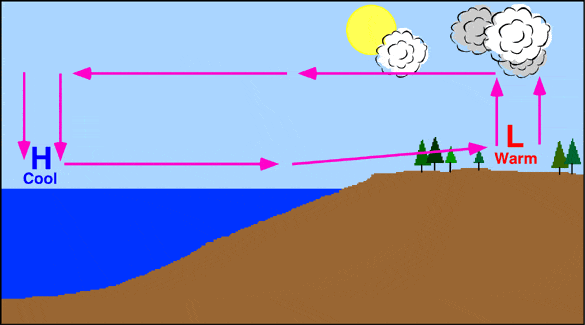
How do warm water currents affect the coastal areas along which they flow?
They create unusually warm climates for the latitude.
They create less rainfall along the coast.
They create unusually cool climates for the latitude.
They make the coastal climate cooler than the inland climate.
The envelope of gases surrounding the Earth is known as the atmosphere. Which of the following statements
accurately describes the atmosphere?
The atmosphere is composed of masses of air particles that are constantly moving.
The atmosphere is composed of several layers that increase in density as altitude increases.
The atmosphere is composed of masses of particles that move very little, if at all.
The atmosphere is composed entirely of nitrogen and oxygen, which react to form ozone.
Warm, less dense air at the equator
Rises and flows toward the poles
Cools and creates an area of low pressure
Cools and creates an area of high pressure
Cools and then flow toward the poles.
Which condition will most likely lead to the formation of winds on Earth?
Uneven heating of the earth's surface
The shifting of tectonic plates
Geothermal activty
The rotation of the Earth on its axis
Unlike local winds, global winds generally
Blow from specific directions over long distances
Are unpredictable
Are not influences by heating of the Earth's surface
Change directions from day to day
The transfer of thermal energy by convection is a very important process in the temperature distribution on the surface of the Earth. The term sea breeze describes a thermally produced wind blowing from an ocean surface onto adjoining land.
Water has a higher specific heat than land. Therefore, the temperature of water does not rise as much as landmass.
Land has a higher specific heat than water. Therefore, the temperature of water does not rise as much as landmass.
Land has a higher specific heat than water. Therefore, the temperature of landmass does not rise as much as water.
Water has a higher specific heat than land. Therefore, the temperature of landmass does not rise as much as water.
Which of these would be the best way to measure the effect that removing many trees in the area would have on the hydrologic cycle?
Measure and compare the amounts of precipitation and surface water runoff in the area before and after the trees are removed.
Survey the people living in the area to determine if they use more water before or after the trees are removed.
Measure and compare the speed and direction of wind in the area before and after the trees are removed.
Evaluate the growth of new plants in the area before and after the trees are removed.
Warm water rises at the equator and cold air sinks at the poles creating
convection currents
hurricanes
tornadoes
The Coriolis Effect
Which statement correctly describes one way ocean currents affect a region?
Warm ocean currents keep coastal air temperatures warm, creating moderate climate conditions in coastal regions.
Deep ocean currents move water from polar seas toward the equator, creating drafts of cold air that blow over polar regions.
Cold ocean currents along the equator increase evaporation rates, creating circular winds that produce tropical storms.
Deep ocean currents push into estuaries, creating sand deposits that form barrier islands.

