
 Worksheets
Semester Exam Review
Total questions: 70
Worksheet time: 1hrs 10mins
Which resources are nonrenewable?
biomass
hydropower
hydroelectric
geothermal
coal
oil
petroleum
natural gas
Coal
Oil
Wind
Solar
Nuclear
Solar
Biomass
Coal

At what point would an object have the most gravitational potential energy?
A
B
C
D

At which point will the skater have the least potential energy?
A
B
C

1. How could we increase the gravitational potential energy at Point E in the object above?
Increase the elevation
Decrease the elevation
Conduction is heat transfer through...
Solids
Liquids
Gases
Outer Space
Convection is heat transfer through...
Solids
Liquids
Gases
Fluids
Radiation is heat transfer through...
Solid
Liquids
Gases
Outer Space
Name the energy transformations when using gasoline to power a car.
chemical ---> mechanical
mechanical --->sound
kinetic ---> potential
chemical ---> gravitational

Which of these correctly describes the gravitational potential energy and the kinetic motion energy of the bicycle rider?
When the rider is at the top of the hill, her potential energy is the greatest and kinetic energy is the least
As the rider moves up the hill, her kinetic energy increases, and her potential energy decreases.
When the rider goes down the hill, her potential energy increases, and her kinetic energy decreases.
As the rider rides down to the bottom of the hill, her kinetic and her potential energy decrease.
When a light bulb is turned on, energy changes from one form to another. Which of the following BEST describes this change?
Sound energy to light energy
Nuclear energy to light energy
Electrical energy to light energy
Magnetic energy to light energy
A room temperature spoon is placed in a cup of hot tea. Which statement best describes the thermal energy transfer in this situation?
Thermal energy will flow from the tea to spoon
Thermal energy will flow from the spoon to tea
There will be no change in temperature and no thermal energy flow
The tea at the top of the cup will transfer to the bottom of the cup.
Wind is becoming more common as a source of energy. Wind farms require large open spaces for the wind turbines. A negative consequence of this technology is wind turbines
Are an inexpensive source of energy
Cause little pollution to the environment
May hurt the flying animals in the area
Are a renewable source of energy
Energy stored in the bonds between hydrogen and oxygen atoms in hydrogen peroxide is called…
Nuclear
Chemical
Hydroelectric
Geothermal
According to the Law of Conservation of Energy, energy is never
Released without heat
Resting
Transformed into another form of energy
Created or destroyed

Which of the following best describes the energy transformation taking place in the diagram pictured below? (In order from left to right)
chemical – thermal – mechanical – electrical – light and heat
mechanical – heat – mechanical – electrical – light and heat
electrical – mechanical –chemical - electrical – light and heat
geothermal – mechanical – heat – mechanical – light and heat
Which describes an object that is experiencing unbalanced forces?
The object is moving right at a constant speed of 8 meters per second.
The object is resting on top of a 30 foot pile of rocks.
The object is moving at a constant speed of 100 m/s northwest
The object resting at the edge of a cliff and is then is pushed off.


|

Acceleration describes how an object’s velocity is changing. Which of the following scenarios provides the best example of an accelerating object?
A car driving at a constant speed
A book sitting on top of a high shelf
A toy train traveling in a circle
A toy boat floating in a bathtub
When a car goes around a corner at 20 mph, why do we say it accelerates?
The car is accelerating because of the velocity is constant
The car accelerates because it's going 20 mph
Cars always accelerate when they are in motion
The car is accelerating because it's changing direction
The geese fly 23 mph to the south when they migrate for the winter.
speed
velocity
acceleration
The Olympian swam 200 meters in 20 seconds.
speed
velocity
acceleration
What is velocity?
the quickness of an object
the location of an object
acceleration
speed in a specific direction
A truck slowing down to stop at a red light is an example of ____.
Speed
Velocity
Acceleration
Direction
A truck moving 20 m/s is an example of ...
Speed
Distance
Velocity
Acceleration
What is the formula for speed?
speed = distance x time
speed=distance / time
speed = time / distance
speed = distance + time

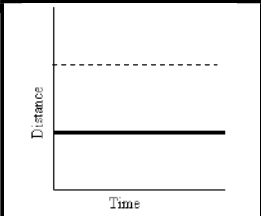
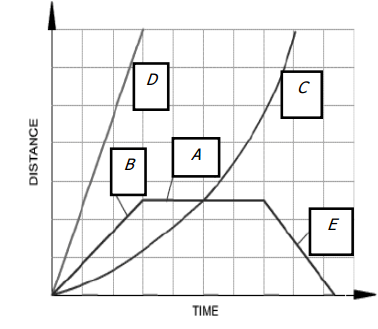
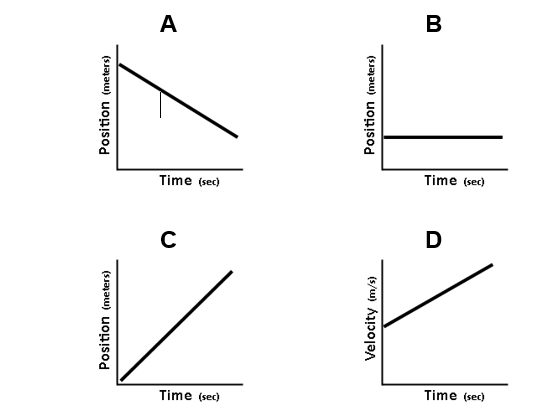
What does the solid line on this graph represent?
Constant speed
Acceleration
Not moving
deceleration
What does the solid line on this graph represent?
Constant speed
Acceleration
At rest
deceleration
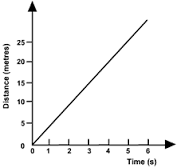
What is the line on this graph showing?
moving away from starting point at a constant speed
moving back towards the starting point at a constant speed
acceleration (getting faster)
deceleration (getting slower)
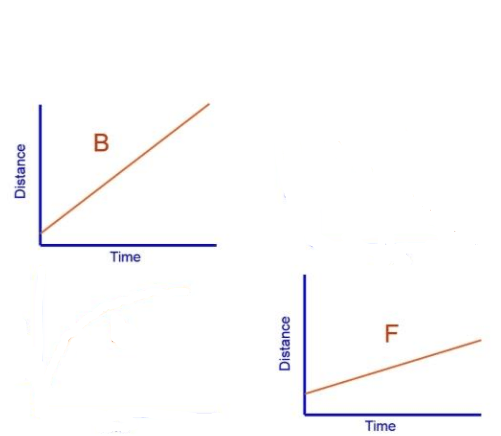


What happened during A to B point?
not moving
increasing speed at a constant rate
moving at a constant speed
acceleration
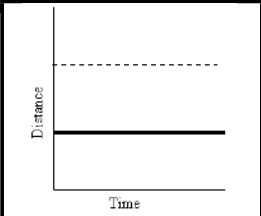
What does this graph represent?
Constant speed
Acceleration
Not moving


Which is newtons 3rd law
for every thing there is reaction
for every reaction there is a unusual action
For every reaction there is an equal and opposite reaction
for every reaction there is an good action
Which is newtons first law states
An object at rest will remain at rest unless a force is applied
An object is moving
An object has stopped
An moving object will keep going when a force is applied to it
Which is newtons 2nd law
Acceleration is a change in speed
Acceleration is a change in action
Acceleration is a change in name
Acceleration is a change in velocity
Newton's third law states that any action will have a(n) _______ and ______ reaction
equal and same
equal and opposite
equal and equal to
The tendency of objects to resist a change in motion is called:
Friction
Inertia
Gravity
Velocity


What is the net force?
40 N left
400 N right
0 N Balanced
40 N right
The mass of a wagon is 40 kg. The wagon accelerates at 8 m/s2 . What is the force?
38.25 Kg
320N
5N
3.825Kg



