
 Worksheets
Physical Science-Waves/Sound
Total questions: 48
Worksheet time: 28mins
A wave will travel only as long as it has ____ to carry.
material
medium
energy
matter
When you squeeze together the coils of a spring and release it, you are creating a ___ wave
longitudinal
transverse
compressional
none of the above
Which of the following is a combination of a transverse and compressional wave?
surface
electromagnetic
sound
microwave
Waves in which the particles of matter move in the same direction (parallel) to the motion of the wave are:
compressional
transverse
x rays
light waves
Waves in which the particles of matter move perpendicular to the motion of the wave are:
transverse
longitudinal
seismic waves
compressional waves
The energy a wave carries is measured by its
wavelength
amplitude
frequency
speed
If the frequency of a particular wave doubles, what happens to the wavelength?
it will also double
it is cut in half
it will remain unchanged
it will triple in length
According to the law of reflection, as the angle of incidence increases, the angle of reflection:
will increase
will decrease
will remain unchanged
When two waves encounter each other, ___ always occurs
interference
reflection
refraction
diffusion
Which of these creates constructive interference?
when crest meets crest
when trough meets trough
when trough meets crest
Constructive interference results in
a smaller wave
a wave of the same size
a wave of larger size
When two waves meet, the areas where they cancel each other out is experiencing
postive interference
constructive interference
destructive interference
When a wave passes from a more dense medium to a less dense medium its speed will
decrease
remain the same
increase
When a piano key is struck and a nearby glass begins to vibrate at the same frequency this is called
interference
refraction
reflection
resonance
Sound waves are ___ waves.
transverse
compressional
seismic
The way your brain interprets amplitude of a sound wave is as:
pitch
loudness
The way your brain interprets frequency of a sound wave is as:
pitch
loudness
Hertz is the unit of wave
frequency
intensity
amplitude
wavelength
For the Doppler effect to occur
the sound source must be moving
the sound receiver must be moving
either the sound source or the sound receiver must be moving
neither the sound source nor the sound receiver must be moving
A sound with distinctive pitch and a specific pattern is called
noise
pitch
intensity
music
Middle C on a piano and on a flute sound different. This is described as sound
pitch
intensity
amplitude
quality
Reverberation of sound waves is caused by wave
reflections
refractions
diffractions
diffusions
Bats use ___ to locate prey and navigate.
echolocation
radar
infrasonic sound
A system of using the reflections of underwater sound waves to locate or map items under water is called
radar
sonar
ultrasound imaging
echolocation
A repeating disturbance or vibration of matter is called a:
wave
force
medium
energy
The angle formed between a wave and the normal of the barrier it strikes is called the angle of
reflection
incidence
refraction
diffusion
The angle between a wave bouncing off a barrier and the normal of that barrier is called the angle of:
reflection
refraction
diffraction
incidience
An imaginary line drawn perpendicular to a barrier or surface is called the:
angle
diffraction
normal
refract
When a wave passes into a material that speeds it up, the wave will bend ___ the normal.
away from
toward
parallel
When a wave moves into a material that slows it down, the wave will bend ___ the normal.
toward
away from
parallel
When a wave must change direction or bend to go around a barrier or through an opening this is called
refraction
reflection
reverberation
diffraction
The unit used to measure sound intensity or loudness is called the
hertz
pascal
decibel
When waves of equal frequency and wavelength constantly interfere with one another a ____ wave results.
refraction
diffraction
standing
sitting
The study of sound and producing and controlling good listening experiences is called:
acoustics
sonar
radar
reverberation
Waves travel through a medium faster as you
increase the temperature
decrease the temperature
Which of the following waves can travel through empty space?
mechanical
sound
electromagnetic
seismic
Which of the following is mismatched?
high point of a wave--crest
low point of a wave--trough
distance between identical points on two successive waves--amplitude
number of waves that pass a given point in a given time--frequency
When sound waves of similar frequencies interfere with one another they create alternating sounds of loudness and softness called:
beats
pulses
rarefactions
compressions
In a standing wave, the areas where waves interfere and cancel each other out are called
nodes
antinodes
compressions
rarefactions
Which of the following is NOT true?
high pitched sounds have higher frequency
low pitched sounds have lower frequency
loud sounds have longer wavelengths
soft sounds have lower amplitudes
Sound travels best in
solids
liquids
gases
plasma
The prolonged production of sound even after the source of the sound waves stops is called:
reflection
refraction
reverberation
replay
Identify the parts of a standing wave.
Label the following points
Amplitude
Wavelength
Crest
Trough
Match the type of wave with its corresponding picture.
Transverse Wave
Longitudinal Wave
Label the parts of this compressional wave.

Which statements are true?
Red wave has the longest wavelength
Green wave has the highest frequency
Violet wave would have the highest pitch
Blue wave carries the greatest amount of energy
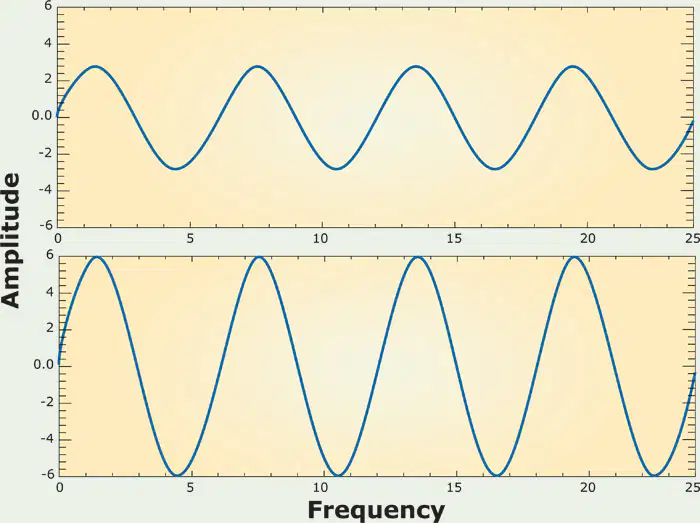
Which of these statements is true?
Both waves have the same pitch.
The top wave sounds softer than the bottom wave.
The bottom wave has more energy than the top wave.
Both waves have the same intensity,

