
 Worksheets
Waves review
Total questions: 40
Worksheet time: 58mins
Name
Class
Date
1.
What happens to frequency when the energy increases?
a)
it increases
b)
it decreases
c)
it stays the same
2.

What part of the wave is shown at letter A?
a)
crest
b)
trough
c)
wavelength
d)
frequency
3.

Which part of the wave is shown at letter B?
a)
crest
b)
trough
c)
wavelength resting point
4.

Which part of the wave is shown at letter C?
a)
crest
b)
wavelength
c)
resting point
d)
amplitude
5.

Which part of the wave is shown at letter D?
a)
trough
b)
resting point
c)
wavelength
d)
frequency
6.

Which part of the wave is shown at letter E?
a)
trough
b)
crest
c)
resting point
d)
amplitude
7.
What does a wave carry?
a)
boats
b)
matter
c)
energy
d)
water
8.

What is the frequency of this wave?
a)
3 Hertz
b)
4 Hertz
c)
5 Hertz
d)
6 Hertz
9.
When wavelength increases, what happens to the frequency?
a)
it increases
b)
it decreases
c)
it stays the same
10.
What is the speed of a wave that has a wavelength of 2 and a frequency of 2.5?
a)
2.5 m/s
b)
5 m/s
c)
4.5 m/s
d)
6 m/s
11.

Which wave has a longer wavelength?
a)
wave C
b)
wave D
12.

Which wave has a greater frequency?
a)
wave B
b)
wave C
13.

Which wave has the most energy?
a)
top wave
b)
bottom wave
14.
The type of waves that require medium to pass:
a)
Mechanical Waves
b)
Electromagnetic Waves
15.
What types of waves carry energy at a right angle or perpendicular to the direction of the energy flow?
a)
Longitudinal waves
b)
Transverse waves
c)
Sound waves
d)
P-waves
16.
What do waves carry from place to place?
a)
Energy, but not matter or particles
b)
Energy and matter or particles
c)
Matter or particles but not energy
d)
Neither energy nor matter or particles
17.
What are the parts of a longitudinal wave?
a)
Compressions and rarefactions
b)
Crests and troughs
c)
Compressions and crests
d)
Rarefactions and troughs
18.

Which wave is pictured?
a)
Transverse
b)
Longitudinal
c)
Both
d)
Neither
19.
Sound is an example of which type of wave?
a)
Transverse
b)
Longitudinal
c)
Both
d)
Neither
20.
How would you describe the movement of a transverse wave?
a)
Up and down
b)
Back and forth
c)
In zigzags
d)
Linear
21.
Which wave travels parallel in relation to a medium?
a)
Transverse
b)
Longitudinal
c)
Both
d)
Neither
22.
Sound needs a medium to travel through. What is a medium?
a)
solid, liquid, gas
b)
open space
c)
waves
d)
nothing
23.
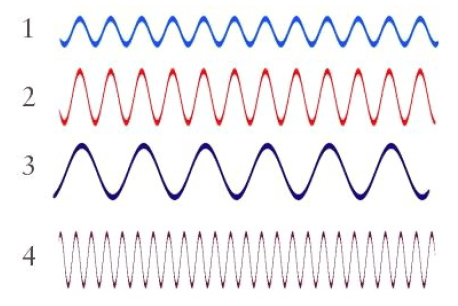
Which wave in the diagram has the greatest frequency?
a)
1
b)
2
c)
3
d)
4
24.

Which word is used to identify the distance between points C & G?
a)
Amplitude
b)
Crest
c)
Frequency
d)
Wavelength
25.

What kind of wave is pictured below?
a)
compressional wave
b)
transverse wave
c)
sound wave
d)
mechanical wave
26.

How would a person measure the wavelength on this sound wave?
a)
dense to less dense
b)
trough to crest
c)
compression to compression
d)
beginning of illustration to the end
27.

You can't hear sounds in outer space because there is no
a)
medium
b)
light
c)
energy
d)
heat
28.

All waves carry ________ as they travel from one place to another.
a)
matter
b)
space
c)
energy
d)
water
29.
Which travels faster, light or sound?
a)
light
b)
sound
30.
What is the top of a wave?
a)
trough
b)
crest
31.
What is the distance between crests or troughs?
a)
amplitude
b)
wavelength
32.
What is the height of a wave?
a)
amplitude
b)
wavelength
33.
When you yell under water, what is the medium that sound travels through?
a)
air
b)
water
34.
What type of wave move a slinky back and forth?
a)
longitudinal
b)
transverse
35.
Which is a Transverse Wave?
a)
b)
36.
Mechanical Waves can not move through water.
a)
True
b)
False
37.
The measure of energy in a wave.
a)
Wavelength
b)
Frequency
c)
Amplitude
d)
Vibration
38.
The frequency of a wave is measured in __________________.
a)
inches
b)
hertz
c)
periods
d)
eras
39.
In longitudinal waves, the parts where the coils are spread apart are called what?
a)
rarefactions
b)
compressions
c)
mechanicals
d)
longitudes
40.
In a longitudinal wave, the parts where the coils are close together are called what?
a)
longitudes
b)
rarefactions
c)
compressions
d)
contractions
100 %

