wayground logo

Free Printable Worksheets

NEW

Font size

S
M
L
XL
Worksheets

Electricity and Magnetism Review

Total questions: 45

Worksheet time: 1hrs 2mins

Name
Class
Date
1.
Magnets have a north and a south ___________
a)
shape
b)
color
c)
pole
d)
region
2.
The strongest part of a magnet is...
a)
the bars.
b)
the force field.
c)
the poles. 
d)
the middle.
3.
A conductor is a
a)
material that does not allow electrons to flow easily.
b)
material that allows electrons to flow easily.
c)
device the detects an electric charge.
d)
device the changes voltage.
4.
This is an example of a ______ circuit
a)
Series
b)
Parallel
c)
Open
d)
Dihexihedral
5.
This is an example of a _______ circuit
a)
open
b)
series
c)
parallel
d)
square
6.
What type of circuit is this?
a)
Parallel Circuit
b)
Series Circuit 
c)
Open Circuit 
d)
Transverse Circuit
7.
This is the circuit symbol for ...
a)
an AC current source
b)
a DC current source
c)
a battery
d)
a single cell
8.
this is the symbol for a _____?
a)
switch
b)
light 
c)
battery
d)
wires
9.
The two ends of a bar magnet are its _____________ _____________.
a)
parallel circuits
b)
magnetic poles
c)
series circuits
10.
A device that uses chemical energy to make electricity
a)
Conductor
b)
Battery
c)
Motor
d)
Generator 
11.

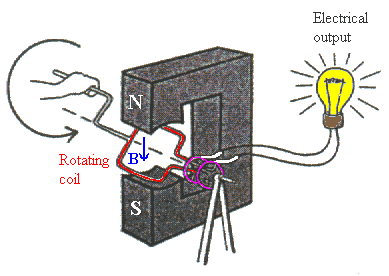
What two forces are required for generators and electric motors to work?

a)

magnetism and thermal

b)

electricity and thermal

c)

electricity and magnetism

d)

magnetism and radiant

12.
What is the transfer of electricity in a generator?
a)
Mechanical to Electrical 
b)
Physical to Potential 
c)
Electrical to Mechanical
d)
Yogurt to Light
13.

What would happen if you broke a bar magnet into 8 pieces?

a)

You would have 8 half magnets

b)

You would have 4 complete magnets

c)

You would have 8 complete magnets

d)

They wouldn't be magnets anymore

14.
The flow of electricity in a circuit-
a)
current
b)
flow
c)
circuit
15.
____________ stops the flow of electricity.
a)
A conductor
b)
An insulator
c)
A magnet
16.
In a _________ circuit, if one bulb goes out then the entire circuit doesn't work.
a)
Series
b)
Parallel
17.
What is the unit for resistance?
a)
Volts
b)
Amperes
c)
Ohms
18.
If the battery produced 12.6 Volts and what would be the current flow be for a 6 Ohm resistor
a)
2.1 Amps
b)
2.4 Amps
c)
1.71 Amps
d)
15 Amps
19.
What resistance is needed to cause a 20A current flow because of a 100V battery?
a)
0.2Ώ
b)
2000Ώ
c)
120Ώ
d)
20.

What voltage is needed to cause a 50A current flow through a 10Ω resistor?

a)

15V

b)

500V

c)

500 kV

d)

0.2V

21.
What will happen when these magnets are brought close together?
a)
They will attract each other.
b)
They will repel each other.
c)
Both magnets will turn to the left
d)
Both magnets will turn to the right
22.
Iron, Nickel and cobalt are all __________________ materials
a)
Shiny
b)
poles
c)
magnetic
d)
cold
23.
A magnet will attract scissors if the scissors contain: 
a)
copper
b)
aluminum
c)
gold
d)
nickel
24.
A device that uses a free-moving magnetic needle to show direction is a:
a)
Ruler
b)
magnet
c)
compass
d)
magnetic field
25.
The space around a magnet where the force of a magnet can attract best is called__________
a)
magnetism
b)
bar magnet
c)
horseshoe magnet
d)
magnetic field
26.
How is a permanent magnet DIFFERENT from a temporary magnet?
a)
A permanent magnet attracts materials made of iron.
b)
A permanent magnet has poles.
c)
A permanent magnet has a magnetic field.
d)
A permanent magnet keeps its magnetism for a long time.
27.
True or False: All metals stick to magnets.
a)
True
b)
False
28.
Which of the following is true of a bar magnet?
a)
Its magnetic field is strongest near its center.
b)
It is surrounded by a magnetic field.
c)
The north pole is stronger than the south pole.
d)
The south pole is stronger than the north pole.
29.

Which of the following is an insulator?

a)

an eraser

b)

a wire

c)

a penny

d)

a metal spoon

30.

This picture shows a circuit that is

a)

closed

b)

open

c)

an insulator

d)

static electricity

31.

What kind of electricity is natural (example: lightning)?

a)

current electricity

b)

static electricity

c)

power source

d)

insulator

32.

If the light bulb turns ON in a circuit, that means the circuit is


a)

open

b)

closed

33.

Items that have opposite charges do what?

a)

attract

b)

repel

c)

nothing changes

34.
A particle that carries a negative electric charge is called a(n) ______.
a)
neutron
b)
atom
c)
proton
d)
electron
35.
According to this law, the current in a circuit equals the voltage difference divided by the resistance. 
a)
Law of Conservation of Energy 
b)
Ohm's Law 
c)
Law of Conservation of Charges
d)
Newton's First Law 
36.
What is current measured in?
a)
Ω (Ohms)
b)
V (Volts)
c)
A (Amps)
d)
W (Watts)
37.
What is resistance measured in?
a)
Ω (Ohms)
b)
V (Volts)
c)
A (Amps)
d)
W (Watts)
38.
What is Resistance?
a)
The flow of electrons
b)
Electric potential difference
c)
A battery
d)
The ability to reduce the flow of electrons
39.
If the Voltage is increased and the resistance stays the same, Current will
a)
Increase
b)
Decrease
c)
Stay the same
d)
X
40.
The positive particles of an atom are 
a)
electrons 
b)
positrons 
c)
neutrons 
d)
protons 
41.
all matter is made of what 
a)
energy 
b)
atoms 
c)
electrons 
d)
compounds 
42.
the central region of an atom where its neutrons and protons are is its 
a)
nucleus 
b)
electron cloud
c)
core 
d)
center 
43.
Particles in an atom that are neutral and have no charge are 
a)
negatrons 
b)
electrons 
c)
neutrons 
d)
protons 
44.
True or False? Neutrons have a negative charge
a)
True
b)
False
45.
A particle that moves around the nucleus is a(n)...
a)
Proton
b)
Neutron
c)
Electron
d)
Quark