Wayground logo

Free Printable Worksheets

Font size

S
M
L
XL
Worksheets

Symbiosis/ Environmental changes

Total questions: 18

Worksheet time: 13mins

Name
Class
Date
1.
A squirrel hides his acorns from the chipmunks for the winter.
a)
commensalism
b)
parasitism
c)
competition
d)
mutualism
2.
The black bear has a tick on it's back
a)
parasitism
b)
mutualism
c)
commensalism
3.

The close relationship between two different species in an ecosystem

a)

Biosphere

b)

Ecology

c)

Symbiosis

d)

Environment

4.

The specific surroundings where an organism lives and functions. It can also be called a habitat, niche or territory. The term can be used to describe all or parts of the biosphere

a)

Mutualsim

b)

Symbiosis

c)

Environment

d)

Symbiosis

5.

Organisms "fight" for limited resources such as food, water or mates. It can be between organisms from different species or between organisms of the same species.

a)

Predator-Prey

b)

Mutualism

c)

Competition

d)

Parasitism

6.

A relationship where one organism (predator)

eats another organism (prey),

usually of a different species.

a)

Parasitism

b)

Mutualism

c)

Commensalism

d)

Predation

7.

What are the living and nonliving things in an environment or area?

a)

predator

b)

producer

c)

ecosystem

d)

abiotic factor

8.

An organism that can make its own food

a)

decomposer

b)

producer

c)

consumer

9.

Breaks down and feeds on the remains of other organisms

a)

decomposer

b)

consumer

c)

producer

10.

is a mutation, or genetic change, that gives an organism such as a plant or animal the trait to survive in its environment.

a)

Natural Selection

b)

Physical Trait

c)

Camouflage

d)

Adaptation

11.
The environmental impact of mining includes erosion, loss of biodiversity,contamination of soil and water
a)
This is a short term impact.
b)
This is a long term impact.
12.
Due to several days of downpours the rivers have overflowed their banks causing localized flooding.
a)
This is a long term impact.
b)
This is a short term impact.
13.
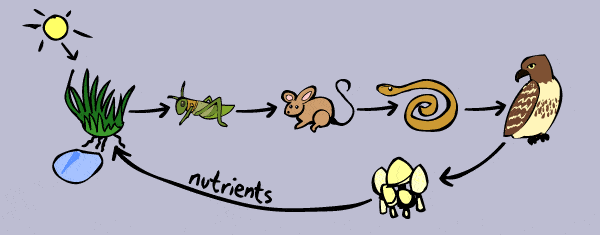
What does a food chain represent?
a)
How all living organisms within a habitat are connected.
b)
All of the things that a particular animal eats.
c)
How plants create their own food.
d)
A single path of energy transfer within a habitat.
14.
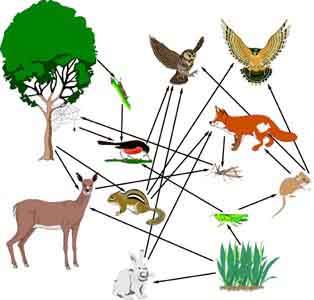
What does a food web represent?
a)
All connections of energy flow throughout all organisms in a habitat.
b)
The specific ways that mutualism is carried out.
c)
A single pathway or energy flow between organisms. 
d)
How carnivores get their food. 
15.
A manatee is a water-dwelling herbivore on the list of endangered species. If manatees were to become extinct, what would be the most likely result in areas where they had lived?
a)
Certain producer organisms would become more abundant in the area.
b)
Other manatees would move into the area and restore balance.
c)
Predators in the area would have more food to eat.
d)
The area would not be affected.
16.
There are many large-mouth bass, a type of fish, living in a small lake near Waco, Texas. How would increased fishing in the lake effect the lake ecosystem?
a)
Predators of the bass might starve due to loss of a food source
b)
The population of the bass’ prey would decrease.
c)
The bass would spend more time swimming near the surface
d)
Water level in the lake would decrease as more fishing took place
17.
What happens to the Lynx (red) population as the Hare (purple) population increases?
a)
The Lynx population stays the same
b)
The Lynx population increases
c)
The Lynx population decreases
18.
A relationship between two organisms in which one organism benefits and the other is unharmed...
a)
Mutualism 
b)
Competition
c)
Parasitsm 
d)
Commensalism