
 Worksheets
Monday Conceptual Physics Review
Total questions: 42
Worksheet time: 37mins
Name
Class
Date
1.
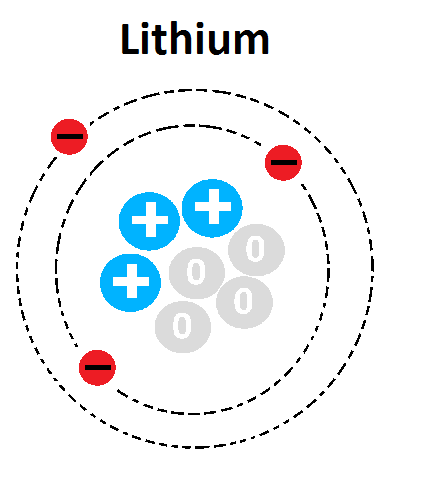
What is the atomic mass of this atom?
a)
1
b)
3
c)
4
d)
7
2.
What is the mass number defined as?
a)
the number of protons
b)
the number of protons and neutrons
c)
the number of neutrons
d)
the number of protons and electrons
3.

What is the atomic number of Nickel? (enlarge the periodic table)
a)
110
b)
28
c)
46
d)
78
4.
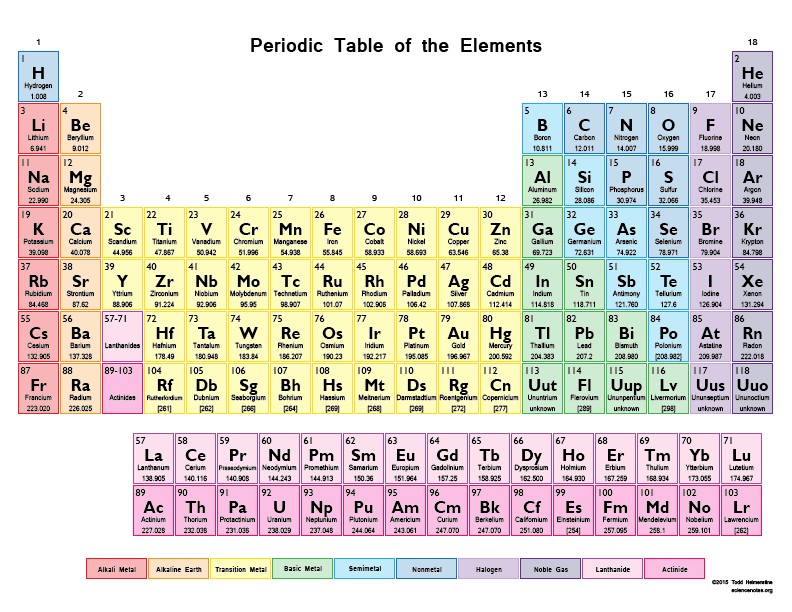
How many protons are in a sodium atom? (tap to enlarge the periodic table)
a)
Sodium has 1 proton.
b)
Sodium has 3 protons.
c)
Sodium has 11 protons
5.
An element has the mass number 12 and atomic number 6. The number of neutrons in it is:
a)
6
b)
10
c)
4
d)
8
6.

A vertical column is called...
a)
group
b)
tower
c)
period
d)
crew
7.

Pure forms of these elements are stored in oil so they won't react with oxygen and water in the air.
a)
Alkali Metals
b)
Alkaline-earth metals
c)
Halogens
d)
Noble Gases
8.
Which group of the periodic table is composed of inert (not reactive) gases?
a)
alkali metals
b)
alkaline earth metals
c)
halogens
d)
noble gases
9.
Elements in a __________ have similar chemical properties.
a)
period
b)
group
c)
row
10.
A proton is....
a)
A negatively charged subatomic particle
b)
A positively charged subatomic particle
c)
A neutrally charged subatomic particle
d)
The only subatomic particle located in the nucleus
11.
phosphorus trichloride
a)
KCl3
b)
PCl3
c)
K3Cl
d)
P3Cl
12.
Name the prefix associate with:
7
7
a)
septa
b)
hexa
c)
octa
d)
hepta
13.
Which of these compounds is ionic?
a)
Carbon dioxide
b)
Dinitrogen trioxide
c)
Silicon tetrachloride
d)
Lithium bromide
14.
What is the name of the compound SO2
a)
Monosulfate oxide
b)
Sulfur Dioxide
c)
Monosulfur dioxide
15.
What is the formula for sulfur pentoxide?
a)
SO2
b)
SO3
c)
SO4
d)
SO5
16.
What happens when the sodium atom loses an electron?
a)
It become negatively charged
b)
It become positively charged
c)
none
17.
What usually forms the positive ion?
a)
Metal
b)
Non Metals
c)
None
18.
What usually forms the negative ion?
a)
nonmetals
b)
metal
c)
none
19.
Covalent compounds
a)
Share electrons
b)
transfer electrons
c)
contain a sea of electrons
d)
conduct electricity
20.
What is a valence electron?
a)
an electron that is found in the outermost shell of an atom.
b)
an electron found in the innermost shell of an atom.
c)
an electron found in the middle shell.
21.
all matter is made of what
a)
energy
b)
atoms
c)
electrons
d)
compounds
22.
the central region of an atom where its neutrons and protons are is its
a)
nucleus
b)
electron cloud
c)
core
d)
center
23.
The particles that are found in the nucleus of an atom are
a)
neutrons and electrons
b)
electrons only
c)
protons and neutrons
d)
protons and electrons
24.
True or False: The majority of an atom is made up of empty space
a)
True
b)
False
25.

Order the atomic models below from the oldest to the most recent.
a)
2, 1, 3, and 4
b)
1, 2, 4, and 3
c)
3, 2, 4, and 1
d)
3, 1, 2, and 4
26.

What is an ion?
a)
A Charged Atom
b)
A Large Atom
c)
A Small Atom
d)
A Cute Atom
27.

Anions are...
a)
Positive
b)
Negative
c)
Neutral
d)
Crying
28.

An atom becomes _______ when it loses electrons.
a)
Positive
b)
Negative
c)
Neutral
d)
Invinsible
29.
The number of _______ per atom is always the same for a given element.
a)
protons
b)
neutrons
c)
electrons
d)
quarks
30.
What quantities vary between isotopes of an element?
a)
protons, electrons, and atomic mass
b)
protons, electrons, and atomic number
c)
neutrons and electrons
d)
neutrons and atomic mass
31.
The following reaction is an example of what reaction type?
CoCO3 → CoO + CO2
CoCO3 → CoO + CO2
a)
Synthesis
b)
Decomposition
c)
Single Replacement
d)
Double Replacement
32.
When balancing equations, the rule is that you can only add, change, and remove ____________
a)
Coefficients
b)
Mass
c)
Subscripts
d)
Elements
33.
Which of the following is an example of synthesis?
a)
Na + Br2 --> NaBr
b)
KClO3 --> KCl + O2
c)
HgO + Cl2-->HgCl + O2
d)
Cl2 + NaBr --> NaCl + Br2
34.
What is a coefficient?
a)
The small number on the right of the chemical symbol.
b)
The large number to the left of a formula.
35.
AgF + CaCl2 ---> AgCl + CaF2
a)
double replacement
b)
decomposition
c)
single replacement
d)
synthesis
36.
Ca + O2 --> CaO
Is this reaction balanced?
a)
Yes
b)
No
c)
Maybe
37.
2 Ca + O2 --> 2 CaO
How many O are there?
a)
2
b)
1
c)
0
38.

This is used to represent the number of each atom being represented.
a)
A Exponent
b)
The Coefficient
c)
A Molecule
d)
The Subscript
39.

How many oxygen atoms are in 2Fe2O3?
a)
6 oxygen atoms
b)
2 oxygen atoms
c)
3 oxygen atoms
d)
4 oxygen atoms
40.
The Law of Conservation of Mass means that the number of atoms of the products is greater than the number of atoms in the reactants.
a)
True
b)
False
41.
OH-
a)
Hydroxide
b)
Carbonate
c)
Peroxide
d)
Nitrite
42.
Ammonium
a)
NH4+
b)
NO3-
c)
NO2-
d)
MnO4-
100 %

