
 Worksheets
electrochemistry
Total questions: 15
Worksheet time: 20mins
Name
Class
Date
1.
What is the oxidation state of Cu in Cu2+?
a)
-1
b)
-2
c)
+2
d)
0
2.
What is the oxidation state of Cl in ClO- ?
a)
0
b)
+1
c)
-1
d)
+2
3.
What is the oxidation state of H in H2?
a)
+2
b)
+1
c)
0
d)
None of the above
4.
What is the oxidation state of Pb in PbO ?
a)
+2
b)
+4
c)
0
d)
-2
5.
C in CO32-?
a)
-4
b)
+2
c)
0
d)
+4
6.
H in NaH ?
a)
+1
b)
0
c)
-1
d)
None of the above
7.
What type of reaction is this: C2H2 becomes C2H6
a)
Reduction
b)
Oxidation
c)
Neither
d)
Combustion
8.
What type of reaction is this: SF4 becomes SF6
a)
Hydrogenation
b)
Reduction
c)
Oxidation
d)
None of the above
9.

Which statement is correct?
a)
Oxidation is loss of elec and a decrease in oxidation state.
b)
Oxidation is gain of elec and an increase in oxidation state
c)
Reduction is loss of elec and increase in oxidation state.
d)
Reduction is gain of elec and a decrease in oxidation state.
10.
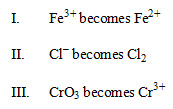
Which are examples of reduction?
a)
I and II
b)
I and III
c)
II and III
d)
I, II and III
11.

Which statement is correct?
a)
H2SO3 is reducing agent because it undergoes reduction.
b)
H2SO3 is reducing agent because it undergoes oxidation.
c)
Sn4+ is oxidizing agent because it undergoes oxidation
d)
Sn4+ is reducing agent because it undergoes oxidation
12.

What happens to Cr3+ ion when it is converted to CrO42–
a)
Oxidation number decreases and it undergo reduction
b)
Oxidation number decreases and it undergo oxidation
c)
Oxidation number increases and it undergo reduction
d)
Oxidation number increases and it undergo oxidation
13.

What is the oxidation number of Fe in the two complex ions?
a)
A
b)
B
c)
C
d)
D
14.

Which compound contains nitrogen with an oxidation number of +3?
a)
NH4Cl
b)
HNO3
c)
N2O4
d)
KNO2
15.

What happens to iodine when iodate, IO3–, converted to iodine, I2?
a)
Undergo reduction and oxidation number changes from –1 to 0
b)
Undergo oxidation and oxidation number changes from –1 to 0
c)
Undergo reduction and oxidation number change from +5 to 0
d)
Undergo oxidation and oxidation number change from +5 to 0
100 %

