
 Worksheets
Phys Chem Madness !!
Total questions: 15
Worksheet time: 47mins
Given the following balanced equation :
2NO(g) + Cl2(g) → 2NOCl(g)
If the rate of disappearance of Cl2 is 4.84 x 10⁻² Ms-1, what is the rate of disappearance of NO?
1.45 x 10⁻² Ms-1
2.42 x 10⁻² Ms-1
3.67 x 10⁻² Ms-1
9.68 x 10⁻² Ms-1
The reaction A + 2B → products was found to have the rate law, k = k[A][B]2. Predict by what factor the rate of reaction will increase when the concentration of B is doubled and the concentration of A remained uncanged
2
4
6
8
For second order reaction, the initial concentration of reactant A is 0.24 M. If the rate constant is 8.1 x 10⁻² M-1 s-1, what is the concentration of A after 29 seconds?
0.02 M
0.15 M
0.30 M
0.45 M
The first order rate constant for the decomposition of 0.5 M compound A at 100oC is 0.03 min-1. Calculate the half-life of A.
1.5 min
8.3 min
23.1 min
66.7 min
Which of the following statements about catalyst is true?
It does not take part in the reaction
It increase the yield of the reaction
It provides an alternative mechanism for the reaction
It increases the number of collisions between reacting molecules per second
If two objects have different temperatures when they come in contact, heat will flow from the warmer object to the cooler one UNTIL ____________
one reaches a temperature of zero
they both have an equal temperature
one runs out of energy
If the specific heat of water is 4.18 J/g∙°C, how much heat is required to increase the temperature of 1.2 kg of water from 23 °C to 39 °C?
-80,256 J
80.256 J
80,256 J
-80.256 J
A sample of iron receives 50J of heat energy that raises the temperature of the iron by 25.0°C. If iron has a specific heat of 0.10 J/g°C, what is the mass of the iron sample? (show your work)
25g
30g
20g
50g
What is an anode?
It is the electrode where oxidation takes place.
It is the electrode where reduction takes place.
It is an aqueous solution containing an electrode.
It is the salt bridge that connects half-cells.
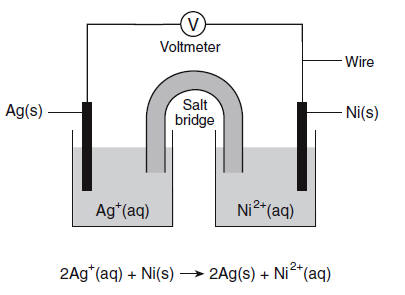
What reaction occurs at the anode?
Ag+/Ag = 0.80V
Ni2+/Ni = -0.25V
Ag+ + e- →Ag
Ag → Ag+ + e-
Ni2+ + 2e- → Ni
Ni → Ni2+ + 2e-
What would be the standard cell potential of the previous electrochemical cell?
Ag+/Ag = 0.80V
Ni2+/Ni = -0.25V
1.05V
-1.05V
0.55V
-0.55V
A current of 5.0 A flows for 4 hours through an aqueous solution of copper sulphate (VI). Calculate the mass of copper deposited at the cathode.
21.69 g
22.69 g
23.69 g
Calculate the cell potential of the electrochemical cell.
Cr(s) l Cr3+(aq, 0.010 M) ll Ni2+ (aq, 0.20 M) l Ni (s)
Eo Ni2+/Ni = -0.25 V
Eo Cr3+/Cr = -0.74 V
+0.41 V
+0.51 V
+0.61 V
When a certain amount of electric charge flows through an aqueous solution of silver nitrate, 3.24 g of silver is deposited on the cathode.
Calculate the mass of aluminium, Al that will be deposited by the same quantity of charge.
Molar mass of Ag = 107.9 g/mol
Molar mass of Al = 27.00 g/mol
0.27 g
0.29 g
0.40 g

