
Font size
S
M
L
XL
 Worksheets
Physical Science Review
Total questions: 77
Worksheet time: 3625secs
Name
Class
Date
1.
Which object is the best conductor of electricity?
a)
A ceramic mug
b)
A plastic fork
c)
A penny
d)
A wooden craft stick
2.
What form of energy is being used when a person pushes heavy boxes across the floor?
a)
Electrical energy
b)
Mechanical energy
c)
Heat energy
d)
Sound energy
3.

Which statement is true about the picture?
a)
The metal pan causes the water to boil.
b)
The metal pan is a poor conductor of heat.
c)
The wooden handle is a good heat insulator.
d)
The wooden handle is a good heat conductor.
4.
A girl turned the light off and went to bed. She remembered she had accidentally left her glass of ice water on the counter. When she got up the next morning, the ice had melted. What form of energy caused the ice to melt?
a)
Sound energy
b)
Light energy
c)
Thermal energy
d)
Mechanical energy
5.
Which form of energy is produced when a guitar string vibrates?
a)
Sound energy
b)
Electrical energy
c)
Chemical energy
d)
Light energy
6.
Which form of energy is produced when a lamp is switched on?
a)
Sound energy
b)
Electrical energy
c)
Chemical energy
d)
Light energy
7.
Which of the following materials are good conductors of heat, sound, and electricity?
a)
Water
b)
Glass
c)
Copper
d)
Wood
8.
____________ energy is from the sun or also called solar energy.
a)
heat
b)
chemical
c)
radiant
d)
mechanical
9.
____________ energy is transferred from gasses, solids, and liquids.
a)
chemical
b)
radiant
c)
mechanical
d)
heat
10.
__________ energy is released from a substance when transformed into a new substance.
a)
chemical
b)
radiant
c)
mechanical
d)
heat
11.
__________ energy is possessed by an object due to its motion or due to its position.
a)
chemical
b)
radiant
c)
mechanical
d)
heat
12.

Which type of energy does the battery produce?
a)
sound
b)
light
c)
mechanical
d)
electrical
13.

Calculate the net force of the object in the image shown.
a)
20N
b)
35N
c)
5N
d)
25N
14.

Is this a balanced or unbalance force?
a)
Balanced
b)
Unbalanced
c)
Neither one
d)
Both
15.

Which direction will the object move?
a)
Up
b)
Down
c)
Right
d)
Left
16.

Calculate the net force of the object.
a)
10N
b)
2N
c)
15N
d)
5N
17.

Is this a balanced or unbalanced force?
a)
Balanced
b)
Unbalanced
c)
Neither
d)
Both
18.
What is a PUSH or PULL of an object?
a)
Motion
b)
Force
c)
Friction
d)
Gravity
19.
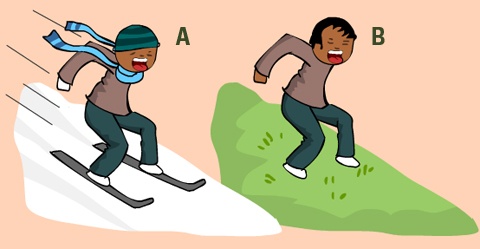
Why is it harder for the boy in Image B to get down the hill?
a)
Motion
b)
Friction
c)
Work
d)
Displacement
20.
How is gravity affected by mass?
a)
the larger the mass of the object, the greater the gravity
b)
small objects have no gravity
c)
gravity is not affected by mass of objects, whether large or small
21.
What is the standard unit force is measured in?
a)
Newtons
b)
pounds
c)
grams
d)
meters
22.
1. It is easier to ride a bicycle down a hill than to ride up a hill because _______ helps the bicycle move down the hill.
a)
gravity
b)
friction
c)
rotation
23.
What is a force that works AGAINST MOTION?
a)
Force
b)
Motion
c)
Gravity
d)
Friction
24.
Which portion of the electromagnetic spectrum includes the entire range of light that can be detected by the human eye?
a)
ultraviolet light
b)
visible light
c)
infrared light
d)
x-rays
25.
If the wavelength of an electromagnetic wave is longer, what is true about the energy?
a)
Energy is higher.
b)
Energy is lower.
c)
Energy is not dependent on wavelength.
26.
Which part of the electromagnetic spectrum has high enough energy to cause damage to eyes and skin, and sometimes even cancer?
a)
infrared light
b)
visible light
c)
ultraviolet light
d)
microwaves
27.

Which of the following electromagnetic waves has the highest energy?
a)
radio waves
b)
microwaves
c)
infrared light
d)
visible light
28.

Which of the following electromagnetic waves has the lowest energy?
a)
infrared light
b)
visible light
c)
ultraviolet light
d)
x-rays
29.
Which is the correct order of waves of the electromagnetic spectrum, from lowest energy to highest energy?
a)
radio waves, microwaves, infrared waves, visible light, ultraviolet light, x-rays, gamma rays
b)
gamma rays, x-rays, ultraviolet light, visible light, infrared light, microwaves, radio waves
30.

EM waves are always____________
a)
Transverse
b)
Compression
c)
Longitudinal
d)
Seismic
31.

EM waves________________travel through space.
a)
Never
b)
Cannot
c)
Can
d)
Wish they could
32.

EM waves ________ a medium.
a)
require
b)
don't require
c)
can have
d)
sometimes have
33.

_______ carry the greatest amount of energy.
a)
x-rays
b)
gamma rays
c)
infrared rays
d)
visible light
34.
What happens to frequency when the energy increases?
a)
it increases
b)
it decreases
c)
it stays the same
35.

What part of the wave is shown at letter A?
a)
crest
b)
trough
c)
wavelength
d)
frequency
36.

Which part of the wave is shown at letter B?
a)
crest
b)
trough
c)
wavelength resting point
37.

Which part of the wave is shown at letter C?
a)
crest
b)
wavelength
c)
resting point
d)
amplitude
38.

Which part of the wave is shown at letter D?
a)
trough
b)
resting point
c)
wavelength
d)
frequency
39.
What does a wave carry?
a)
boats
b)
matter
c)
energy
d)
water
40.
If there is no wave, the particles would be at the _____________________.
a)
wavelength
b)
resting point
c)
trough
d)
beach
41.
When wavelength increases, what happens to the frequency?
a)
it increases
b)
it decreases
c)
it stays the same
42.
Sound is an example of which type of wave?
a)
Transverse
b)
Longitudinal
c)
Both
d)
Neither
43.
How would you describe the movement of a transverse wave?
a)
Up and down
b)
Back and forth
c)
In zigzags
d)
Linear
44.

Which wave is pictured?
a)
Transverse
b)
Longitudinal
c)
Both
d)
Neither
45.
What are the parts of a longitudinal wave?
a)
Compressions and rarefactions
b)
Crests and troughs
c)
Compressions and crests
d)
Rarefactions and troughs
46.
Which of the following energy transformations occur when a lamp that is plugged into a wall socket is functioning correctly?
a)
Chemical to light
b)
Electrical to chemical
c)
Electrical to light
d)
Chemical to electrical
47.
Which of the following shows an energy transformation from chemical energy to electrical to light energy?
a)
A bolt of lightning lights the night sky.
b)
A candle glows brightly in the dark.
c)
A fire in a fireplace lights up a room.
d)
A battery causes a flashlight to shine.
48.
What energy transformations take place when a battery-operated radio is in use?
a)
Electrical to chemical to light
b)
Sound to chemical to mechanical
c)
Chemical to electrical to sound
d)
Light to electrical to thermal
49.
People get energy from the food that they eat and transform that energy as they move. Which energy transformations occur as a student rapidly rubs the palms of his hands together?
a)
mechanical to thermal to electrical
b)
chemical to mechanical to thermal
c)
mechanical to chemical to sound
d)
chemical to sound to electrical
50.
Which of the following devices transforms electrical energy into mechanical energy?
a)
An e-reader
b)
a fan
c)
a manual pencil sharpener
d)
ipod
51.
Heat transfer always goes from-
a)
Cold to Hot
b)
Hot to Cold
c)
Heat doesn't transfer
d)
Freezing to Cold
52.
What happens to particles as they heat up?
a)
They slow down
b)
Nothing
c)
They don't move
d)
They speed up
53.
What happens to particles as they cool down?
a)
They slow down
b)
Nothing
c)
They don't move
d)
They speed up
54.
Which sentence explains why a cold metal spoon placed in a pot of boiling water becomes hot?
a)
Thermal energy is transferred from the spoon to the water.
b)
Thermal energy is transferred from the water to the spoon.
c)
Thermal energy in the water is transformed into kinetic energy in the spoon.
d)
Thermal energy in the spoon is transformed into kinetic energy in the water.
55.
Thermal energy ALWAYS moves from _____ to _____.
a)
solid to liquid
b)
ice to water
c)
hot to cold
d)
solid to gas
56.
The amount of matter in an object is a measure of the object's ________________.
a)
volume
b)
density
c)
mass
d)
solubility
57.
In which state does matter completely fill its closed container?
a)
Gas
b)
Liquid
c)
Solid
d)
Ice
58.
Which is a chemical change?
a)
finger painting
b)
Banana rotting
c)
Opening a book
d)
Opening a bag
59.
Which is a chemical change?
a)
Painting a wall
b)
Breaking your arm
c)
Biting an apple
d)
Burning wood
60.
Ripping paper is a chemical change.
a)
True
b)
False
61.
Breaking a pencil is a chemical change.
a)
True
b)
False
62.
What is a chemical change?
a)
When you mix two substances
b)
The change of physical properties
c)
When a substance combines with another tomake a new substance
d)
When you rip up peices of paper
63.
Is this a chemical change: rusting of iron
a)
True
b)
False
64.
Is dying your hair a chemical change?
a)
True
b)
false
65.
Which is a chemical change
a)
Squeezing a lemon
b)
cutting grass
c)
baking a cake
d)
typing on your ipad
66.
Is growing a chemical or physical change?
a)
Chemical
b)
Physical
Physical
67.

GOLD
a)
Al
b)
Ag
c)
Ar
d)
Au
68.

CALCIUM
a)
C
b)
Ca
c)
Cu
d)
Cl
69.

CARBON
a)
C
b)
Ca
c)
Cl
d)
Cu
70.

SODIUM
a)
S
b)
So
c)
N
d)
Na
71.

HELIUM
a)
H
b)
He
c)
Hl
d)
Hm
72.

HYDROGEN
a)
H
b)
He
c)
Hy
d)
Hd
73.

The smallest particle into which an element can be divided and still be the same element is a(n)
a)
proton
b)
neutron
c)
electron
d)
atom
74.

Which subatomic particle has a positive charge?
a)
proton
b)
nuetron
c)
electron
d)
atom
75.

Which subatomic particle has a neutral (0) charge?
a)
proton
b)
nuetron
c)
electron
d)
atom
76.

Which subatomic particle has a negative charge?
a)
proton
b)
neutron
c)
electron
d)
atom
77.
Which TWO of the following subatomic particles are inside the nucleus?
a)
protons
b)
electrons
c)
neutrons
d)
There are no subatomic particles in the nucleus of an atom.
Reset

